Get Full Government Meeting Transcripts, Videos, & Alerts Forever!
Get email alerts on the Healthcare Con Proposal topic
No spam. Unsubscribe anytime.
Norwalk Hospital asks Connecticut to allow elective angioplasty without on‑site cardiac surgery; Stanford Health objects
Summary
Norwalk Hospital and affiliated clinicians urged the Office of Health Strategy to approve elective percutaneous coronary intervention (PCI) services at Norwalk Hospital, citing local access, continuity and lower cost; Stanford Health intervened, arguing existing regional capacity, flat utilization and staffing risks undercut a public‑need finding.
Norwalk Hospital asked the state Office of Health Strategy on Nov. 5 to grant a Certificate of Need to expand cardiovascular services and perform elective percutaneous coronary intervention (PCI) without on‑site cardiac surgery, saying the change would reduce travel burdens and improve care continuity for vulnerable Norwalk residents.
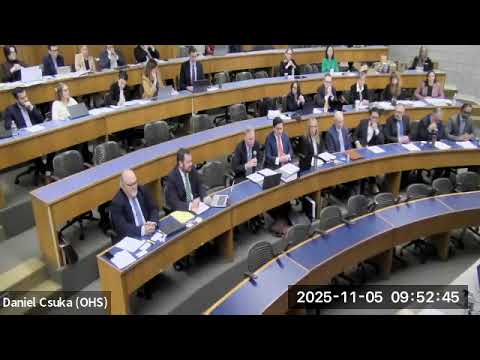
The application was presented at a hybrid hearing before Hearing Officer Alicia Novy. Benjamin Jensen, counsel for the applicant, said Norwalk already performs emergency PCI and seeks authorization to provide non‑emergency PCI to patients who choose Norwalk for care. "We will enhance equitable access to local care, provide patients with choice to receive elective PCI at a hospital they trust, closer to home," testified Michelle Robertson, chief operating officer for Nuvance Health (to become market president of the Nuvance region for Northwell Health on Jan. 1, 2026).
Why it matters: Hospital witnesses framed the proposal as an access and equity measure. Doctors testifying for Norwalk described transfer delays, difficulties obtaining outside imaging and records, and the effect of travel and scheduling on patients who are elderly, low‑income or rely on public transportation. "Transfers lead to diminished value of the care delivered with poor patient and higher cost," said Dr. Mark Warshofsky, system chair of the Heart and Vascular Institute for Nuvance Health, citing national guidance and a five‑year forecast he said shows growing PCI volume.
Stanford Health, which intervened in the proceeding, disputed the application’s need component. Elizabeth Longmore, executive vice president and chief operating officer for Stanford Health, testified that four full‑service cardiovascular centers already serve Fairfield County and that each town in Norwalk Hospital’s primary service area is "within a 30‑minute drive of one of these four cardiovascular centers." She provided utilization data from the patient census report and argued outpatient PCI growth has been modest.
Stanford’s interventional cardiologist, Dr. Scott Martin, told the panel that "the PCI business is not really a growing business" and pointed to trials and medical‑therapy advances that have flattened elective PCI demand. He and Longmore also raised concerns that adding a local elective PCI program could intensify competition for a limited pool of cath‑lab nurses and technologists and increase reliance on higher‑cost travel nurses.
Evidence and gaps: Applicant witnesses acknowledged limitations in hard outcome data after transfers to unaffiliated hospitals. Norwalk clinicians described several anecdotal cases where transfer timing and coordination affected care and said their electronic records and accepted transfer protocols do not always yield accessible imaging or timely outcome reports from outside institutions. Stanford noted the CHIME/patient‑census data it submitted showing low compound annual growth in outpatient PCI over recent years and cautioned that staffing pressures and market diversion could harm existing providers.
Procedure and next steps: The hearing record includes pre‑filed testimony, exhibits a–t and OHS administrative data (state facilities plan, all‑payer claims database, HRS). Hearing Officer Novy allowed limited cross‑examination restricted to the statutory criteria under Conn. Gen. Stat. § 19a‑638 and § 19a‑639 and recessed the hearing for lunch with public comment and OHS questioning to follow. OHS staff indicated they will issue written findings under § 19a‑639 after reviewing the full record.
What remains unresolved: The hearing produced competing factual claims about local demand, staffing capacity and the clinical impact of transfers; witnesses on both sides cited national guidance and local datasets but also acknowledged data limits. The record does not contain a final administrative decision; OHS will decide whether the statutory CON criteria are satisfied and issue written findings.
The hearing was recessed for lunch and scheduled to resume with public comment and OHS staff questions.