Laredo staff present rate study proposing phased toll increases to fund bridge expansions and technology upgrades
Loading...
Summary
City staff told the Port-of-Entry committee that Laredo needs roughly $63 million in additional bridge revenue over four years to fund planned expansions and system upgrades, proposing phased increases and a 3% annual cost-of-living adjustment; industry members pressed staff for clearer vehicle-origin data and alternate scenarios, and the committee asked staff to return with more detail and a workshop before council review.
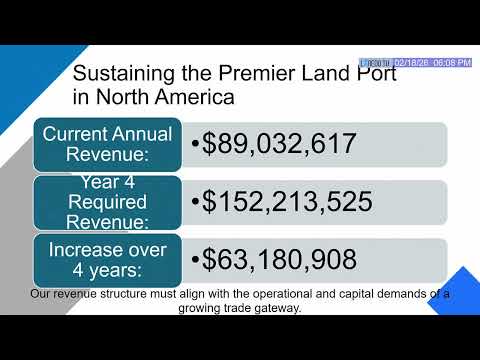
City Manager Joe Neeb and Finance Director Francis Scolmont presented a city-commissioned bridge rate study to the Port-of-Entry committee, saying the bridge system generated $89,032,617 in revenue last year and that the city estimates it will need roughly $152 million by year four to cover planned expansions and operating needs.
"Our current annual revenue for the bridge for this last year was $89,032,617," Neeb told the committee, and he added that the study’s baseline scenario requires about $63,180,908 in additional revenue over a four-year window to fund expansions and upgrades. Neeb described the staff proposal as a phased, three-year corrective structure with an annual, standardized 3% cost-of-living adjustment thereafter to avoid a single, large increase.
Scolmont told members the study uses three primary datasets — Webb County vehicle registrations, southbound bridge counts maintained by the city and U.S. Department of Transportation northbound counts — to estimate how much of city service demand is attributable to bridge traffic. "Our first assumption is that 20% of those vehicles utilize the... the bridge system monthly," Scolmont said, explaining how that assumption and an assumed crossing frequency were converted into estimated nonlocal vehicle counts used in the cost-allocation model.
Industry representatives and committee members contested the key assumptions. Multiple speakers said the 20% Webb‑registered vehicle assumption and the study’s assumed frequency (two crossings per month) undercount local crossing behavior, noting that some drivers and commercial operators cross daily. Committee members asked staff to provide more granular breakdowns — by origin, vehicle type and incident reports — so the allocation of traffic-related police, fire, streets and traffic costs can be validated.
Scolmont acknowledged the assumptions are adjustable and emphasized the city’s rationale for the conservative approach to datasets: "We have three sets of datasets... and that's what's being played," he said, noting Webb County vehicle registrations (228,000) as a core local dataset. Staff said more detailed disaggregation (for example, isolating truck volumes or origin-based incident reports) can be produced on request.
The presentation also included a market-competitiveness analysis. Staff showed that, in some modeled scenarios, a year‑four per-axle rate could make Laredo more expensive than alternate crossing routes on a per-axle basis but argued that additional travel distance and fuel/time costs would limit wholesale rerouting by many shippers. Staff also flagged the potential impact of external factors such as tariffs (which the presentation said had a minimal measured impact of about 0.8% on volume) and federal grants. Neeb and Scolmont said federal grants could reduce the city's funding need but cautioned grants are typically reimbursable and cannot be relied on as a near-term substitute for bonding.
On capital totals and timing, Neeb told the committee the city is planning roughly $225 million in capital work across the World Trade and Columbia bridge projects, including a cited $150 million for bridge expansion and a $25 million toll-system modernization line-item. Staff said World Trade construction is estimated to begin in 2027 and that the city plans to time bond sales and debt service with the construction schedule. "This 63,000,000 that generated over the 4 years buys me $225,000,000 worth of investment," Neeb said when describing how the phased toll plan fits into the larger financing strategy.
Committee members requested a workshop and additional detailed analyses before the item goes to city council. Staff agreed to return next month with requested breakdowns and to bring a refined package to council in April. The committee also passed a motion to extend the meeting to continue questioning staff.