
Council debates elevator language in bill 5156 and its interaction with single-exit policy
Get AI-powered insights, summaries, and transcripts
Subscribe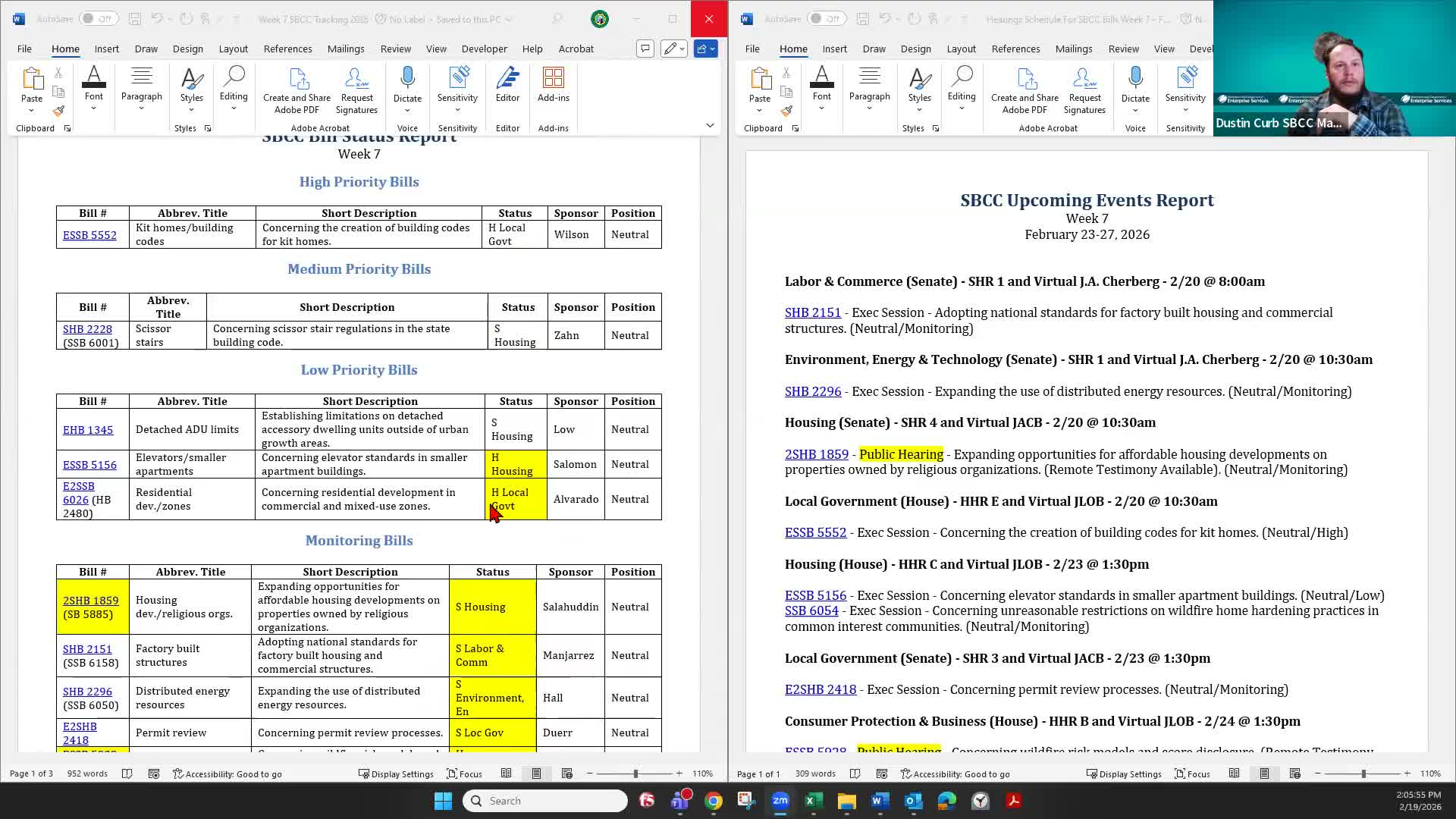
Summary
Members debated whether language in bill 5156 — which asks for elevator provisions for buildings up to six stories and 24 units and a recurring review tag for hoistway protections and two-way visual emergency communications — belongs in the base code or a single-exit appendix and questioned whether the legislature should mandate a new tag.
At the Feb. 19 meeting of the State Building Code Council legislative committee members spent substantial time debating elevator provisions in a bill cited in the transcript as 5156 and how that language interacts with existing 'single-exit' code pathways.
Todd Behruder framed two related policy paths: the emergency-shelter path (temporary life-safety provisions in existing buildings) and a permanent small-unit path (for example, "sleeping cabins" or small permanent units), and said the council should move quickly to clarify standards for the permanent-path units. He said the bill's text looked to enable elevator provisions for buildings "up to 6 stories with 24 units." (Todd Behruder)
Several members pushed back on conflating the 'scissor stair' discussion with single-exit policy. Roger Haringa and others emphasized that a scissor stair provides two exits "by definition," and Angela Haught said elevators are an accessibility feature, not a substitute for means-of-egress requirements. "Putting elevators into the single exit would have no bearing. I mean, it would basically add additional cost for no reason," she said, cautioning that mandating elevators would defeat the affordability intent of single-exit provisions (Angela Haught).
The committee also discussed Section 2 of the bill, which the group read as asking the council to create an ongoing tag to review elevator hoistway opening protection and two-way visual emergency-communication devices at each code update and to judge cost-versus-safety. Several members opposed the legislature prescribing the creation and composition of a new tag, noting the council already maintains tags and that adding a legislatively mandated, narrowly focused tag would add recurring workload and governance questions.
Members agreed the Washington State Department of Labor & Industries (L&I) has an elevator program that adopts standards and inspects elevators and that the building-code language should harmonize with L&I-adopted standards to avoid conflicting requirements. But the committee did not take any formal action on the bill text at this meeting and said they would monitor the bill and, if necessary, ask the sponsor to clarify intent.
Next steps: the committee will monitor hearings, may request clarifying language from the bill sponsor, and intends to consider these issues in future code cycles and tag work.