
Work group reviews PACE pathway; providers urge employer role in hiring and flag equity for family childcare
Get AI-powered insights, summaries, and transcripts
Sign Up Free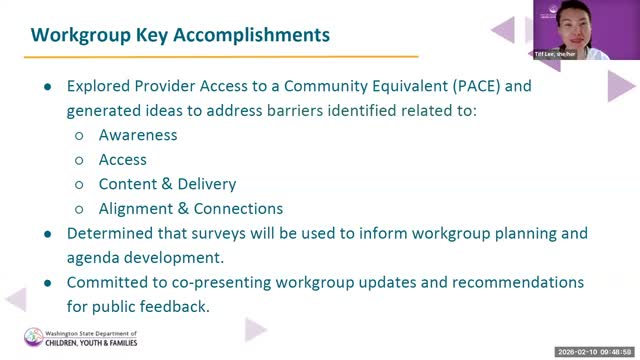
Summary
The ELAC staff‑qualifications work group reported progress on improving the PACE community pathway and on calculating experience and out‑of‑state education verification; providers urged that employers retain primary hiring authority and raised equity concerns about family childcare rules on CDA versus diploma equivalency.
Tiffany Lee, senior administrator of workforce and professional development at DCYF, and collaborators from the staff qualifications work group presented initial recommendations and the group’s phased approach to implementing PACE (the community‑based pathway) under House Bill 1648.
Why it matters: HB 1648 charges DCYF with establishing criteria and verification methods for staff qualifications; how the agency recognizes experience, out‑of‑state education and credential equivalencies will affect hiring and retention across centers and family childcare.
What the work group said: The group identified four main barrier categories to PACE access—awareness & access, content & delivery, adult learning & scalability, and alignment with higher education—then proposed member‑driven agenda setting, multilingual materials, modularized content, and stronger links to higher education. Presenters said members voted to survey participants before each meeting and to co‑present results to advisory bodies.
On verifying experience and education, Brett Skinner of the licensing division said some experience verification is automated in MERIT for in‑state licensed work but automated checks for EC state certificates have not yet been built. He outlined current rules for out‑of‑state education: aligned degrees must come from regionally accredited institutions recognized by the U.S. Department of Education, transcripts are crosswalked into MERIT, and providers can appeal education verification outcomes.
Provider responses and outstanding questions: Susan, a provider in the work group, told the council "As employers, we have a responsibility to verify work experience... It should be a conversation between the employer and the employee," arguing that DCYF‑centric determinations could exclude workers who perform well in practice. Tanya and others raised equity concerns that a CDA (Child Development Associate) is accepted in ECAP and Head Start settings but not consistently accepted for family childcare providers; presenters said that alignment and policy review are appropriate topics for the work group.
Next steps: Presenters said a memo describing next steps is being finalized and will be distributed once cleared through the policy and rules office. They will continue trainings for licensors, refine MERIT functionality timelines, gather Padlet feedback through Feb. 18, and return with initial data and recommendations for discussion.
Ending: The discussion closed with an encouragement to use the feedback loop for follow‑up and an agency commitment to communicate changes in ways aligned with the work group’s recommendations.