Get Full Government Meeting Transcripts, Videos, & Alerts Forever!
Get email alerts on the Legislative Budget topic
No spam. Unsubscribe anytime.
DCYF outlines 2026 short‑session impacts: Ballmer Group proposal could expand ECAP while governor’s budget trims supports
Summary
DCYF staff told the Early Learning Advisory Council the governor's supplemental budget preserves the agency’s support for core ECAP funding but proposes administrative and program reductions; a proposed Pre‑K Promise account tied to Ballmer Group philanthropic funds could add private support for ECAP expansion if the state maintains existing funding levels.
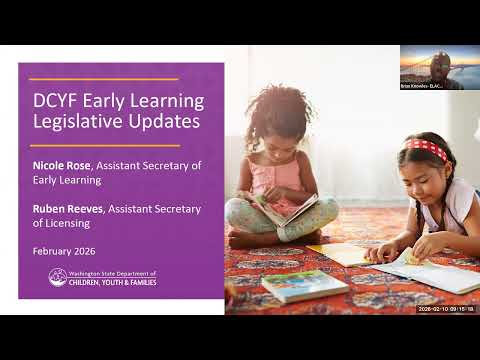
Nicole Rose, assistant secretary of early learning at the Department of Children, Youth, and Families, told the Early Learning Advisory Council that the Legislature’s short (supplemental) session runs through March and that any actions would take effect July 1, 2026. She said DCYF is "supportive of the governor's budget" and is focusing on items that remain after that release.
Why it matters: The governor's proposed supplemental budget affects subsidy rates, professional development funding and implementation timelines for payment models that would change how providers are paid. Those changes could affect provider revenue, program access and enrollment rules for families.
What DCYF presented: Rose summarized both proposed investments and cuts. On potential new investment, she described bills to create a Pre‑K Promise account to permit private philanthropic funding to expand ECAP (the early childhood education and assistance program). "There was a bill to establish the pre k promise account," she said, and the proposal would allow the state to receive "up to a $170,000,000 per year of private funding," conditioned on the state not reducing existing state‑funded ECAP slots or dollars in FY27.
On reductions, Rose outlined several governor‑proposed adjustments: a $61,000 administrative reduction within the early learning portion of DCYF’s budget; removal of the administration’s planned start of enrollment‑based and prospective payment models; a $2.1 million reduction in provider professional development funding; and a roughly $41 million reduction achieved by lowering center subsidy rates toward a lower market‑rate percentile. She also described a Working Connections proposal (House Bill 2689, as cited in the presentation) that would stop new entries and introduce a soft caseload cap for new enrollments beginning July 1, with exceptions for immediate child‑welfare placements and specified target populations.
Context and caveats: Rose repeatedly noted the session is a short one and that the governor’s budget narrowed what DCYF is pursuing. She said some decision packages discussed earlier in planning were dropped when the governor’s budget was released, so the agency is now tracking what remains in bills and budget language. She also warned the numbers reflect the governor’s proposal and could change as the House and Senate release competing budget proposals.
Next steps: DCYF will track bills through the February–March committee cutoffs and post one‑page summaries and webinar recordings to its government affairs web page. Members were directed to the agency feedback loop for follow‑up questions.
Ending: The presentation concluded with an invitation to submit questions via the feedback loop and a reminder that the legislative calendar includes a February 17 house‑of‑origin cutoff and an expected last day of session around March 12.