Get Full Government Meeting Transcripts, Videos, & Alerts Forever!
Get email alerts on the State Economy Tariffs topic
No spam. Unsubscribe anytime.
Washington officials say federal tariffs could raise prices, cost jobs and shave billions from state revenue
Summary
Governor Bob Ferguson and state officials released an Office of Financial Management analysis saying recently announced federal tariffs could raise grocery costs, reduce growth and cost Washington billions in revenue; the state joined legal action and local businesses and food‑aid groups warned of immediate strain.
Governor Bob Ferguson and state economic officials on Tuesday described projections from the Office of Financial Management showing that recently announced federal tariffs could produce higher consumer prices, reduced economic growth and substantial losses to Washington’s general fund.
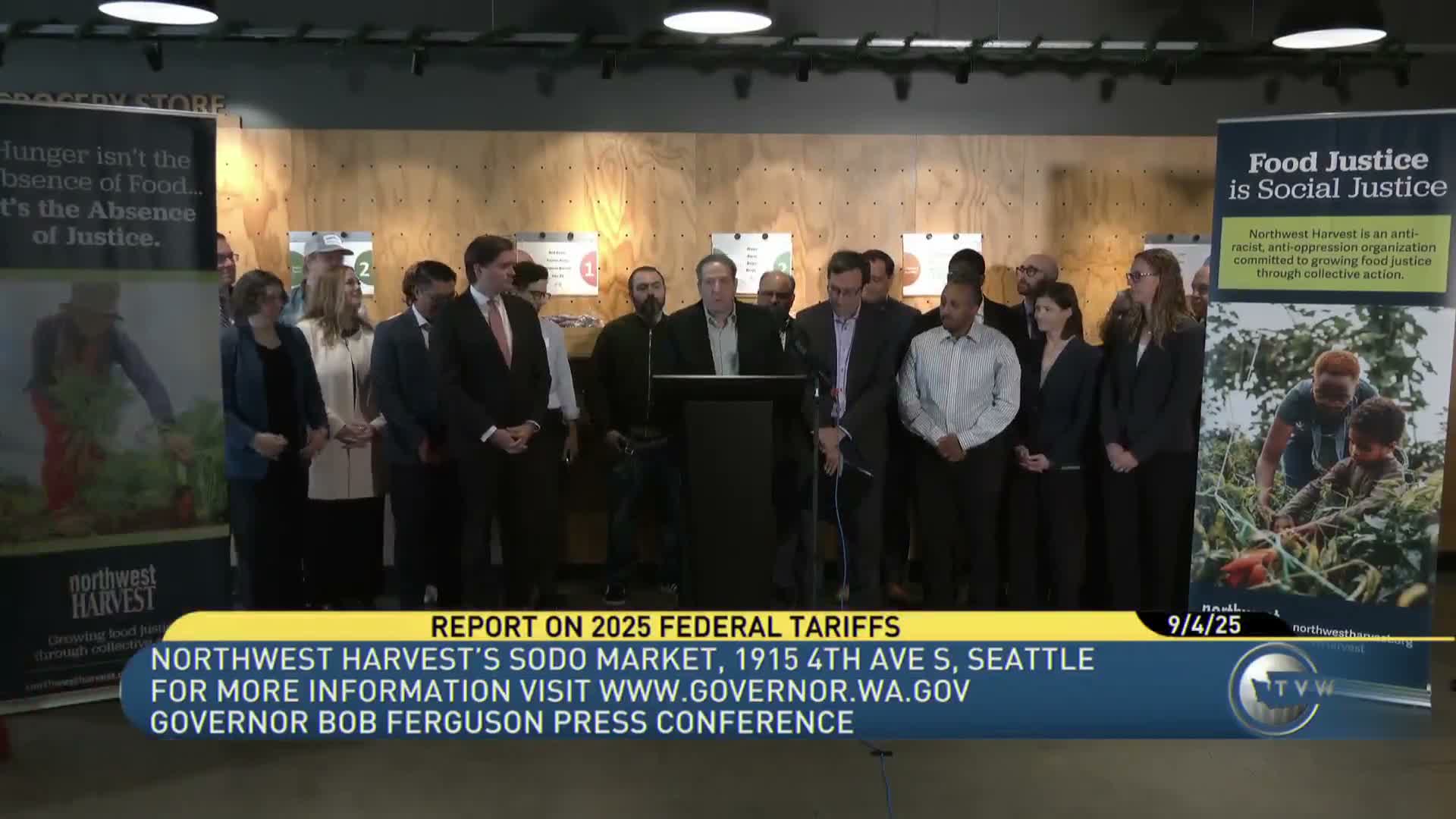
The governor summarized the OFM scenarios and said the most extreme ‘‘liberation day’’ tariff scenario would bring an effective tariff rate of about 27 percent and, if fully implemented through 2029, could push grocery prices up by as much as 16 percent over two years. "The illegal tariffs imposed by President Trump will, as Thomas made clear, affect all Washingtonians to higher prices, business disruptions, and much more," Ferguson said at a Seattle press event held at Northwest Harvest.
Why it matters: The state’s financial office ran alternative models to show different potential paths. Under the August 7 scenario — a snapshot of tariffs actually in effect on that date — OFM projects a smaller but still consequential hit, and the report estimates losses to state general fund revenue in the low billions over several years. Treasurer Mike Feliciotti told reporters the pressure on the state treasury could be "as much as $2,200,000,000 by 2029," and officials warned trade‑dependent sectors such as agriculture, manufacturing and aerospace would be most exposed.
Details and sources: Ferguson noted that the state filed an amicus brief in federal litigation challenging the president’s authority to impose tariffs without congressional approval. He said the U.S. Court of Appeals recently affirmed a trial court ruling that the tariffs were unconstitutional in a 7–4 decision, and that the Trump administration has appealed to the U.S. Supreme Court.
Officials pointed to several concrete projections from OFM and other analyses: quarterly growth could slow by roughly 1.2 to 1.8 percentage points in affected periods; job losses under the most severe scenario were estimated at roughly 31,900 statewide, while the August 7 scenario produces estimates in the 20,000–25,000 range; and the analysis forecast a notable rise in prices for several categories, including a projected 14 percent increase in natural gas prices and a 25 percent rise in used‑car costs in the full‑implementation scenario.
What officials will do next: Ferguson and Treasurer Feliciotti said the state will continue coordinating with other governors, attorneys general and state treasurers on legal and policy options, and that lawmakers can expect proposals in the coming legislative session to mitigate harms. The governor also offered one‑on‑one follow‑ups and said OFM staff were available to walk reporters through industry‑specific data.
Context and limitations: Officials emphasized the analysis is a projection, not a prediction of certainty. Ferguson and Feliciotti repeatedly framed the numbers as scenario‑based and attributed the specific estimates to OFM and affiliated nonpartisan analyses released with the event. The appeals‑court ruling does not by itself resolve all legal questions; the Supreme Court may still rule on the case.
The press event concluded with the administration offering follow‑up briefings and staff availability for reporters and stakeholders.