
Gambling commission forwards Squaxin Island Tribe compact amendment to governor after unanimous vote
Get AI-powered insights, summaries, and transcripts
Subscribe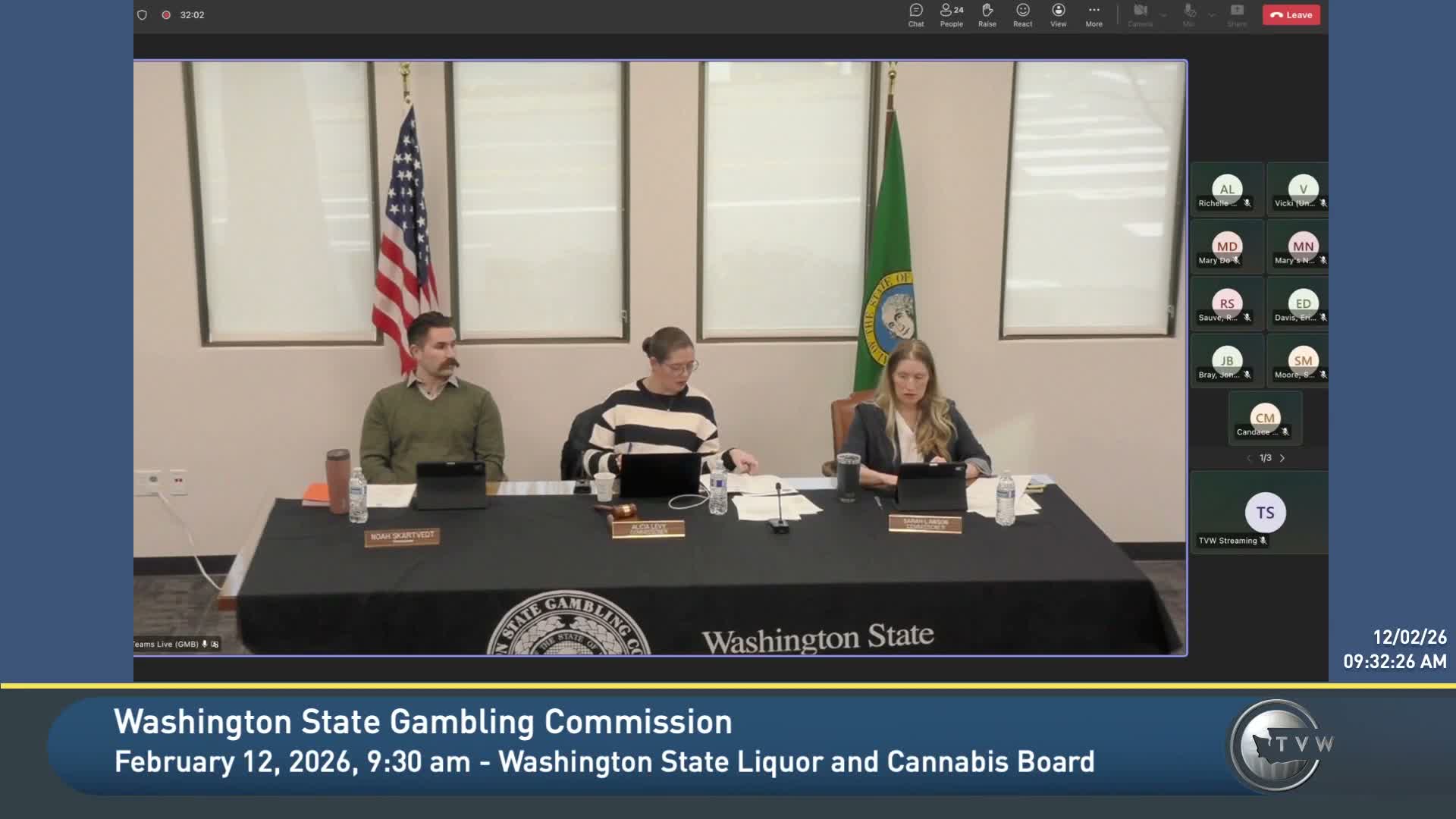
Summary
The Washington State Gambling Commission voted 6–0 Feb. 12 to forward a restated tribal–state gaming compact with the Squaxin Island Tribe to the governor for review and execution. Presenters said the restatement combines six prior amendments and adds updated appendices on high‑limit rooms and electronic table games.
The Washington State Gambling Commission voted 6–0 on Feb. 12 to forward a restated tribal–state gaming compact with the Squaxin Island Tribe to Gov. Jay Inslee for review and final execution. The commission took the action after presentations from state staff and tribal representatives and a recorded roll‑call vote.
Tina Griffin, executive director of the Gambling Commission, told commissioners the tribe and state had reached a tentative agreement on a restated compact that consolidates and clarifies prior amendments. "We would like to thank the Squaxin Island Tribe for their collaborative work on updating the compact," Griffin said, calling the restatement a "heavy lift" made smoother by the tribe's participation.
Ray Peters, the tribe's intergovernmental liaison and chair of the Little Creek oversight board, said the amendments "simply simplify and clarify the existing compact, improving the ability of the tribe to regulate, manage the casino." Peters added that the tribe is "the largest employer in Mason County" and described gaming revenue as an important source for housing and health‑care services in the surrounding counties.
Johnny Bray, the Gambling Commission's tribal relations advisor, summarized technical changes: the restatement pulls together six prior amendments, incorporates several appendices into the compact proper, removes certain addenda, and adds two appendices labeled E (limitations) and G (electronic table games). Bray said the changes were intended to make the compact more readable and to align the Squaxin Island compact with recent updates in other tribal compacts.
Under federal law, tribal‑state compacts for Class III gaming operate within the framework established by the Indian Gaming Regulatory Act, which Griffin reviewed during the presentation. Staff also told commissioners that the compact negotiation process included notice to and hearings by relevant legislative committees earlier in the session.
After confirming a quorum, a commissioner moved to forward the proposed compact amendment to the governor for review and final execution. Director Griffin called the roll; Vice Chair Lawson, Commissioner Charles, Commissioner Scarfett, Senator Holy, Representative Clobagh and Chair Levy recorded "aye." The motion carried, 6–0.
Next steps are ministerial: the commission's action forwards the compact to the governor's office for the governor's review and signature or further action.