
WHRC hears 2025 equine health and safety report; fatalities and medication violations remain low
Get AI-powered insights, summaries, and transcripts
Sign Up Free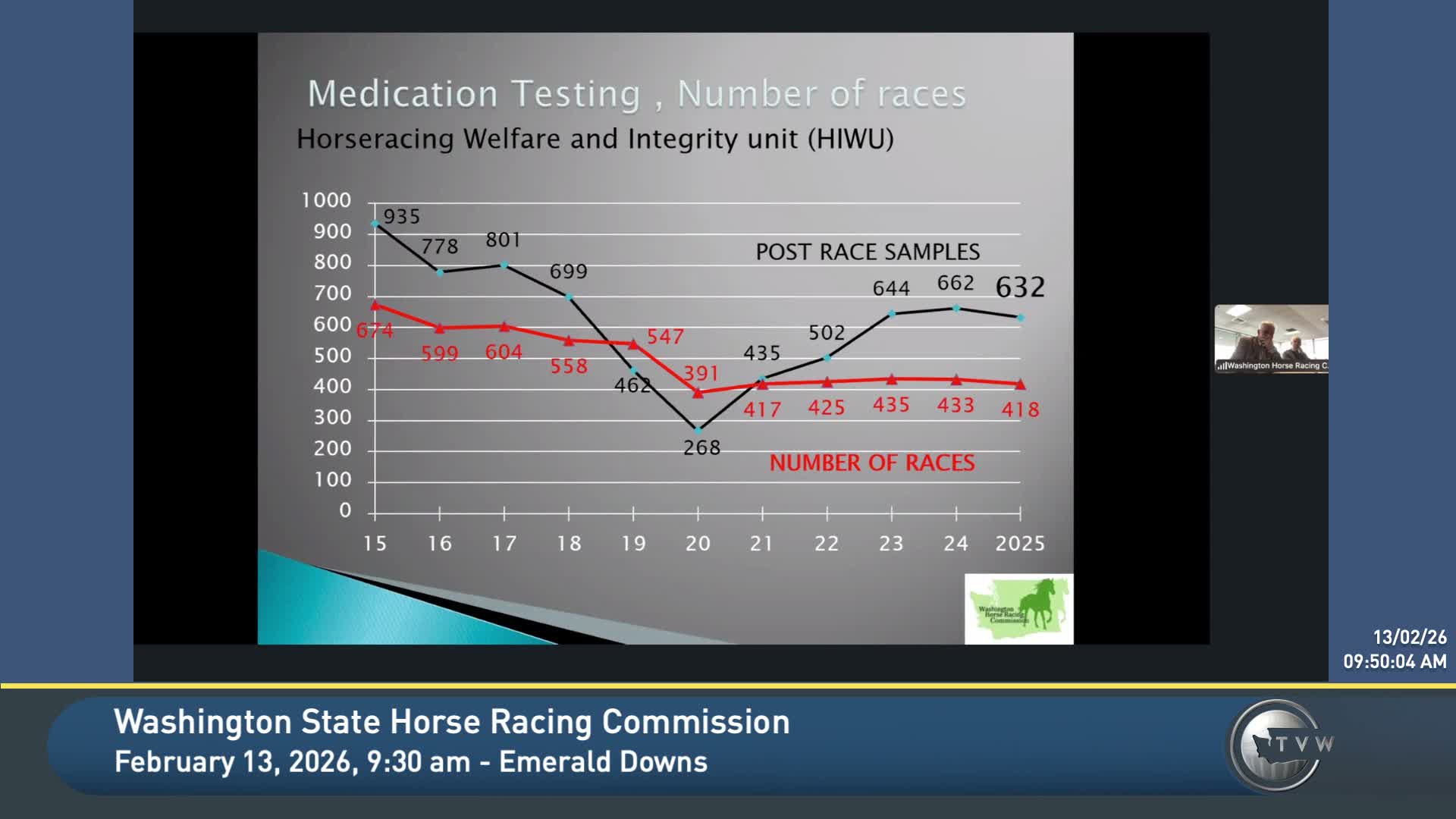
Summary
Equine medical director Dr. Ron Friedman told the Washington Horse Racing Commission that testing and safety measures produced a low medication-violation rate and one of the commission's lowest fatality rates in 2025, while urging better trainer reporting and steward support for enforcement.
Dr. Ron Friedman, the commission’s equine medical director, presented the Washington Horse Racing Commission’s 2025 equine health and safety report on Feb. 13 at Emerald Downs, saying the commission “collected samples post race, 632 horses” and that overall medication violations and fatality rates have declined.
The report — delivered to commissioners and posted online — summarized testing, violations, necropsy processing and recommended changes to strengthen trainer reporting. Friedman told commissioners the commission collected 632 post-race samples in 2025, selected 248 courses for carbon-dioxide testing, and performed 94 out-of-competition tests; he said there were no TCO2 or out-of-competition violations identified in those samples.
Friedman reported six post‑race medication violations in 2025 — four for cannabidiol (CBD), one for the diuretic trichloromethiazide and one for phenylbutazone — and additional pending cases carried over from prior years. He characterized the 2025 violation rate as about 0.9 percent of samples submitted and said the rate has fallen substantially compared with earlier years.
On fatalities, Friedman said Emerald Downs recorded 10 fatalities in 2025 (racing, training and non‑racing combined) and that the calculated racing fatality rate was 0.65 per 1,000 starts (0.065 percent), a figure he described as among the lowest in commission history. He compared that rate with a recent HISA quarterly observation showing roughly 1.02 fatalities per 1,000 starts nationally and noted that most racing and training fatalities reflected chronic mechanical overloading and preexisting microscopic injuries.
Friedman also discussed the necropsy and laboratory process: WADDL (Washington Animal Disease Diagnostic Laboratory) reduced racehorse necropsies mid‑season, and musculoskeletal specimens have been forwarded to a California animal‑health lab at additional cost. Commissioners pressed for clarity on the change in service and the effect on agency costs; Friedman confirmed the shift has increased expenses for cases requiring extensive musculoskeletal analysis.
The report addressed horses placed on the vets list and attrition: 88 horses were placed on the vets list in 2025, with claim exams and voided claims accounting for a notable share of horses that later retired. Friedman said approximately 164 horses placed on vets lists since 2022 have retired and emphasized that better veterinary histories and reporting would improve identification of preexisting injuries and reduce later catastrophic outcomes.
On enforcement, Friedman recommended the commission enforce trainer reporting rules and make fuller use of the 150‑day layoff report to require medical histories for horses returning from extended layoffs. Commissioner Claude Bridal asked why HISA/ISA does not mandate consistent diagnostic reporting; Friedman said ISA’s rules include reporting requirements but that ISA lacks the staffing to review every post‑layoff report and that commission and steward support would be needed to act on identified cases.
Commissioners praised the report’s transparency and noted rehoming and aftercare programs as positive outcomes for horses that do not return to racing. No formal rule or penalty changes were adopted during the discussion; commissioners asked staff to continue monitoring trends, enforcement options and budget impacts related to necropsy costs and ISA/HISA compliance.
The commission received the report, discussed enforcement options with staff and said it would follow up on implementation and steward coordination.