Get Full Government Meeting Transcripts, Videos, & Alerts Forever!
Get email alerts on the Immigration Enforcement topic
No spam. Unsubscribe anytime.
Governor and Attorney General Say They Will Use Legal Tools, Push Legislation After Minnesota ICE Actions
Summary
Washington’s governor and Attorney General Nick Brown condemned recent federal immigration enforcement in Minnesota, said they signed a joint letter to the Department of Homeland Security and outlined a five-point preparedness plan that includes staffing changes, coordination with local partners and urging the legislature to act on bills to restrict impersonation and face coverings by non-officers.
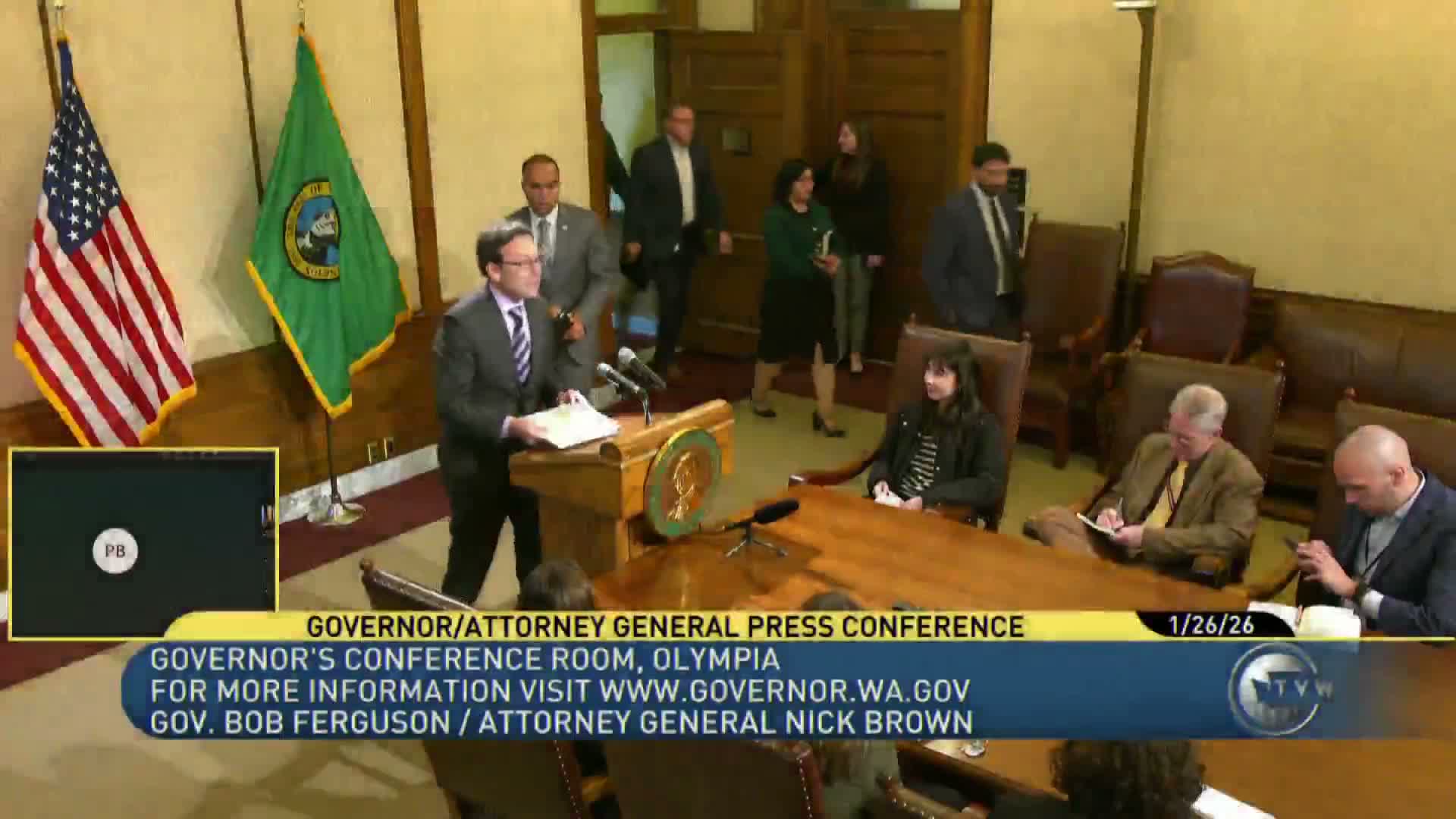
Governor opened a joint news conference to condemn recent federal immigration-enforcement operations in Minnesota and to outline steps Washington state will take if similar activity occurs here.
The governor said she and Attorney General Nick Brown “just a few minutes ago” signed a joint letter to the Department of Homeland Security asserting that a recently reported ICE memorandum authorizing warrantless entries is unconstitutional. “ICE is, to be blunt, completely and totally out of control,” the governor said, adding that the state will use “every legal option available to us to hold the federal government accountable.” Attorney General Nick Brown echoed the criticism and called the actions in Minnesota a constitutional crisis that threatens Fourth Amendment protections.
Why it matters: The state’s announcements signal an intent to prepare legally and operationally for escalations by federal immigration agents. Officials described a mix of immediate legal work, interagency coordination and requests for legislative remedies that would affect how enforcement is carried out in Washington.
What officials announced: The governor outlined five broad steps. First, she said legal teams are scrutinizing the ICE memo and will challenge any unconstitutional implementation. Second, she elevated immigration-response staffing: Sarah Peterson, chief of the Office of Immigrant and Refugee Assistance, will begin attending cabinet meetings, and David Kim will serve as a senior advisor on immigration policy. Third, she said she had discussed Minnesota developments with General Welsh of the Washington National Guard and would consider Guard activation if needed. Fourth, she said the state will coordinate closely with statewide elected officials, mayors, law enforcement and the federal delegation. Fifth, she urged the legislature in the short session to move quickly on measures to limit impersonation and the use of law-enforcement-style coverings by non-officers.
Legislative context: The governor cited several bills by number that relate to impersonation and face coverings; in the press conference she referenced what she said were Senate Bill 5855, Senate Bill 5876 and House Bill 2165 and said a related measure had passed a House committee on Community Safety. Details of the proposed statutes (scope, penalties and enforcement mechanisms) were not specified during the conference.
Attorney General Brown said Washington has filed numerous suits in recent years to protect residents’ civil rights and pledged that the state “will be prepared to respond” in any instance where it can act on behalf of Washingtonians. He urged members of the public and advocacy groups to continue reporting incidents and sharing video or other documentation with state civil-rights intake teams and hotlines so the state can investigate and, where appropriate, pursue legal action.
On enforcement and courts: When asked whether a ban on face coverings for non-law-enforcement would be followed, the governor said the state’s recourse would be judicial: “our job would be to take them to court, and judges would determine that.” Both officials said they would not publicly disclose legal tactics in detail because doing so could reveal strategies to federal authorities.
Public role and risks: Reporters raised concerns that grassroots groups monitoring ICE activity might unintentionally spread unverified information; the governor and the attorney general said they value community reporting but encouraged people to pass information through official hotlines and legal intake channels so it can be vetted and used in investigations.
What the officials did not say: They did not identify specific intelligence or operational details indicating that ICE was preparing an immediate operation in Washington state. They declined to outline particular legal filings or operational moves they might take in a hypothetical future incident.
Next steps: The governor said she will meet later the same day with statewide elected officials and continue coordination with local leaders and law enforcement. The state may pursue litigation and will advance the bills she cited through the short legislative session, where their scope and enforceability would be determined if they move forward.
The press conference concluded with officials reiterating a pledge to use available state tools to defend residents’ rights and to keep the public informed as matters develop.