Get Full Government Meeting Transcripts, Videos, & Alerts Forever!
Get email alerts on the Education Funding topic
No spam. Unsubscribe anytime.
Task force recommends state consider continuing key COVID‑era programs for children; members press for clearer data and funding end dates
Summary
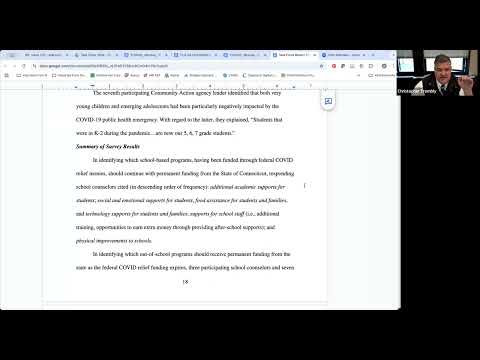
The task force reviewed a draft report proposing that the state continue certain federally funded programs for children — including academic supports, social‑emotional and mental‑health services, food assistance, technology and staff supports — and asked authors to clarify survey representativeness and flag which funding is time‑limited.
A state task force reviewing how COVID‑era federal funds were used recommended that lawmakers consider funding a set of programs for children on a permanent basis while asking report authors to make the limits and data clearer.
Christopher (committee member) led a presentation of the draft report and the team's analysis of federal spending, saying the group had reviewed large programs funded by federal COVID relief and consolidated them according to the task force’s five “whole child” priorities. “COVID had exacerbated existing problems,” Christopher said, “and mental health was a significant factor that was brought up time and again.” He told members the committee traced roughly $2,800,000,000 in federal COVID relief that entered the state and identified priorities the legislature could consider funding with state dollars.
The draft draws on several inputs: a short survey the team distributed to the Connecticut School Counselor Association (six counselor responses) and to community action agency leaders (seven responses) for a total of 13 replies; the blue ribbon panel report; and related documents from the Connecticut Conference of Municipalities and state agencies. Alicia, citing the blue ribbon panel, said early‑childhood and preschool work “fits right along” with the task force findings and warrants continued attention and funding.
Not all members were satisfied with the survey’s representativeness. Irene questioned the counselor sample size, saying, “6 just seems like a small size for response,” and noting state data list roughly 1,600 school counselors. Members agreed to add clearer context and supplementary data to the report before it goes to the legislature so readers understand the limits of the survey evidence and how the team used other sources.
The committee also discussed a widely cited figure from CCM about 119,000 disengaged or disconnected young people. One member summarized the breakdown and offered to share further detail: about 56,000 characterized as in‑school and at risk or disengaged; 63,000 described as out of school or disconnected, of which roughly 8,000 are employed, about 8,000 have college degrees and approximately 20,000 are not in the labor force. The presenter said that context will be provided to avoid oversimplifying the 119,000 figure.
Members stressed the report must not imply that programs are permanently funded when they are time‑limited: several raised the need to mark explicit expiration dates or “guardrails” attached to spending. Christopher said he would draft language calling attention to statutory or budget guardrails and circulate it for comment; the group will incorporate updated funding status the staff provide and aim to review a revised draft at the next meeting ahead of the December session.
Votes at a glance: The committee approved the meeting minutes by voice vote (motion by Christopher; second recorded as Jennifer), with six members saying “aye.”
What’s next: Staff will add the requested context about survey limitations, annotate program listings with funding end dates, and circulate a revised report and draft language on fiscal guardrails to members in advance of the next meeting for final review and a likely vote to transmit the report to the legislature.