Get Full Government Meeting Transcripts, Videos, & Alerts Forever!
Get email alerts on the Opioid Recovery topic
No spam. Unsubscribe anytime.
Franklin County hearing highlights NET recovery devices and a countywide recovery plan through opioid‑abatement funds
Summary
Residents and recovery advocates urged Franklin County leaders to fund NET recovery devices and expand a four‑pillar recovery ecosystem. Consultants and local officials described a strategy tied to opioid‑abatement funds that planners expect to guide work through 2039, and commissioners pressed for near‑term spending to help people now.
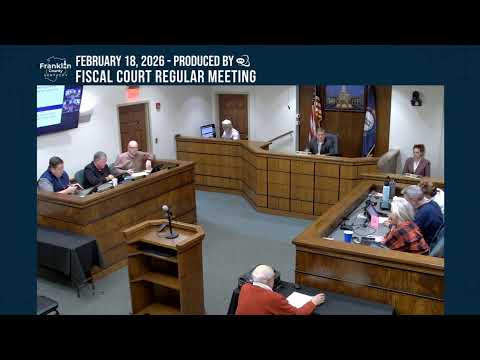
Residents and recovery advocates urged Franklin County Fiscal Court on Wednesday to expand local recovery services and consider funding NET recovery devices to help parents in treatment.
Rachel Moore, executive director and founder of William Joseph Crisis Nursery, told the court her nonprofit will offer short‑term safe care for children while parents seek treatment and said NET devices could "be a game changer for the families we serve." She emphasized that NET is not a replacement for medication‑assisted treatment, saying, "I'm in no way saying that I disagree with MAT treatment. I believe it can be very beneficial and can save lives." (Rachel Moore, public comment.)
Justin Penn, who said he grew up in Frankfort and has been in recovery, described personal observations from treatment programs and the NET device’s apparent effects. "I would say about 95% of them had their withdrawals cut in half," he said of people he spoke with who used the device. "They said they started feeling better sooner. Many of them said they felt relief within just one day." (Justin Penn, public comment.)
Why it matters: County leaders are balancing short‑term help for people currently struggling with a multi‑year planning effort that aims to embed services in the community. Court members repeatedly returned to questions about whether to spend opioid settlement funds now or reserve them for longer‑term systemic change.
Consultants Gene and Charlie — brought in to coordinate a countywide recovery ecosystem — told the court they have organized prevention, risk‑reduction, treatment and recovery "pillars," each with chairs and co‑chairs, to inventory services, synthesize data, and present priorities to judges and elected officials. Gene said the intent is an "opioid plan for 2039," tied to the date many opioid abatement funds will sunset. He said the pillars will allow the county to present a coordinated petition for use of funds when the court is asked to appropriate them.
Several court members asked for options to spend a portion of the court’s opioid funds immediately. One commissioner asked that the court "move some of our money to do that immediately and try to tackle some of the people that are struggling today," noting there is roughly $500,000 available in the county account. Consultants said they would defer to clinical experts for treatment decisions and urged that any device be demonstrated as safe and effective in planned settings; they also said earlier local uses had shown success in the jail.
Court next steps: Commissioners asked staff and the recovery teams to refine recommendations and to return to the court in March with clearer options that include clinical guidance and estimated costs; no formal appropriation to purchase NET devices was approved during the work session. Presenters also said a public website and an April countywide meeting are planned to broaden community input and share pillar priorities.
The presentation and public comments underscored a recurring operational gap — transportation to get people to treatment and to provide childcare while parents attend care — that county leaders said they will add to the list of priorities to address through the pillar structure.
What they said: "We try to prevent children from initiating substance use in the first place," Gene said, urging prevention work alongside treatment and recovery. "When someone is ready ... having something that reduces the physical suffering ... can make a huge difference." (Gene, presentation.)
Status: Discussion only — county staff and recovery partners were asked to return with a refined plan and cost estimates; the court did not make a binding appropriation at this meeting.