
Committee hears broad support and local concerns on bill to require cities to allow 'step housing'
Get AI-powered insights, summaries, and transcripts
Subscribe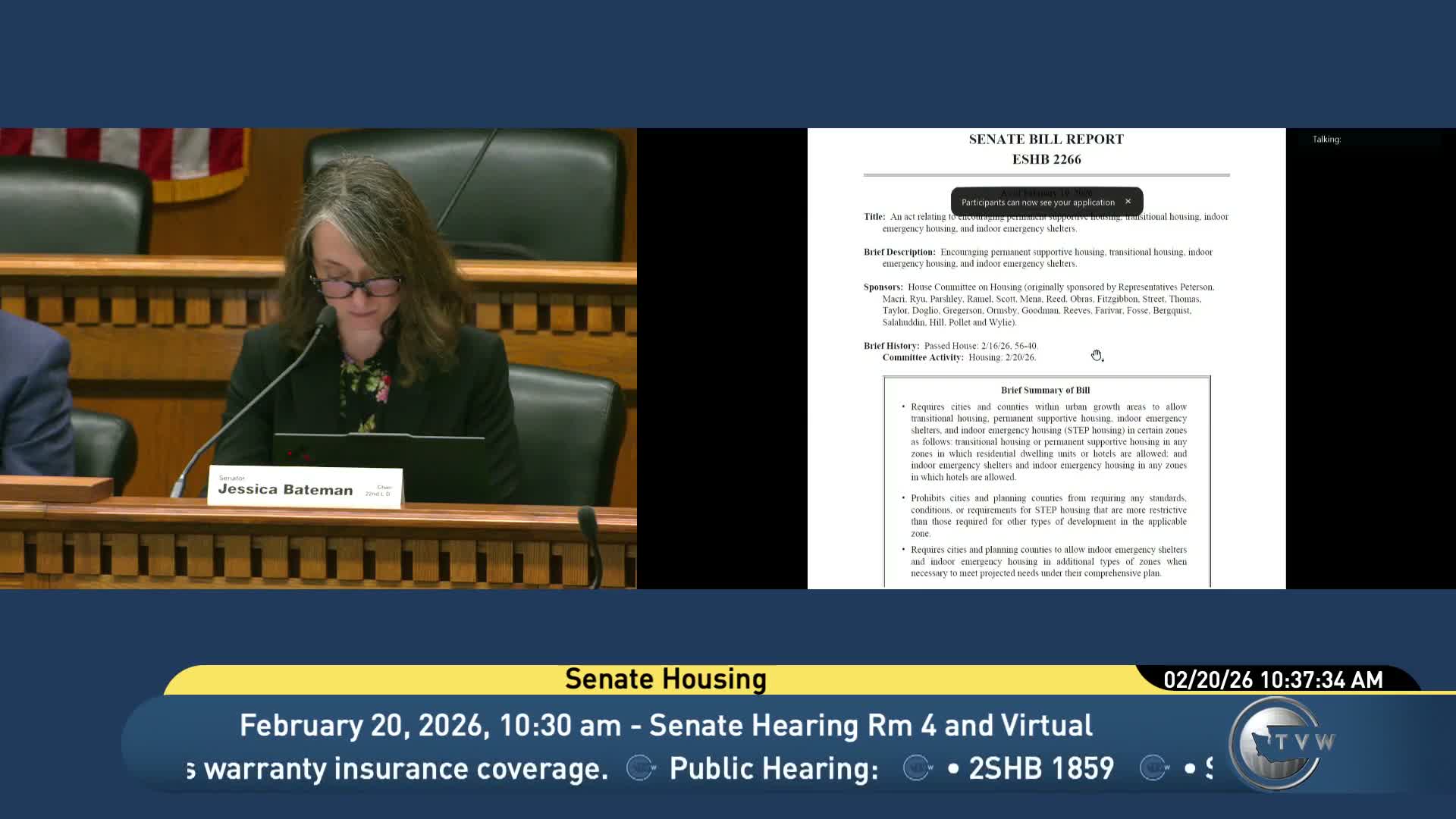
Summary
Supporters including counties, nonprofit housing providers, state agencies, and disability advocates urged passage of ESHB 2266 to remove local barriers to permanent supportive, transitional, and emergency housing; cities asked for operational verification, funding flexibility, and limited local review when they invest resources.
The Senate Housing Committee spent a large portion of its Feb. 20 hearing on Engrossed Gross Substitute House Bill 22‑66, a statewide standard to ensure cities and planning counties allow 'step housing' — an umbrella that includes permanent supportive housing, transitional housing, indoor emergency shelters, and indoor emergency housing.
Committee staff summarized the bill’s key provisions: cities may not prohibit step housing in zones that allow residential units or hotels; only objective development regulations and administrative design review may apply; for facilities proposed within 500 feet of a school, a local government outside a city may negotiate additional health and safety requirements with a sponsor but may deny a permit if a good‑faith negotiation fails within 90 days; sponsors may be required to certify they meet listed requirements; and local fiscal impacts were described as indeterminate.
Representative Strom Peterson, the bill’s prime sponsor, described it as both a supply and accountability bill modeled after previous middle‑housing work. He emphasized unanimous amendments negotiated with cities to protect existing operating agreements, to allow cities that donate land or funds to negotiate operating conditions, and to require operators to provide information so cities can be assured of safe operations.
Supporters included King County, Plymouth Housing, the Attorney General’s civil rights division, the Department of Commerce, Disability Rights Washington, medical practitioners, and people with lived experience. King County testified that the bill reduces unnecessary local barriers that add cost and delay. Plymouth emphasized that step housing residents hold leases, pay rent, and that extra local administrative requirements often function as unfunded mandates. The AG’s civil rights division warned that exclusionary zoning can have discriminatory impacts.
City officials and municipal associations acknowledged the need for housing but asked for clarifications and amendments. Spokane Valley asked for an on‑site 24‑hour contact for threatening behavior; the Association of Washington Cities sought the ability for cities to verify operational requirements rather than accept written certifications; Fife and Bellingham raised concerns about limited local capacity to provide services and the bill’s restriction that contracts require a significant general‑fund contribution, asking the bill allow other local housing revenue sources; several cities warned about the regional burden when some jurisdictions opt out of providing shelter capacity.
Several committee members pressed witnesses on neighborhood concerns and whether the bill undermines local comprehensive planning; witnesses stressed that many jurisdictions are already proactive and that the bill seeks clarity rather than to upend planning. Medical testimony stressed life‑saving implications: a physician testified that unsheltered people face dramatically higher mortality and severe injuries, and a nurse practitioner described patients discharged from hospitals to the streets who would benefit from increased shelter capacity.
The hearing recorded robust cross‑examination and a wide range of testimony but produced no committee action on HB 22‑66 on Feb. 20; sponsors urged continued work with cities and stakeholders.