
Senate committee hears bill to ease density‑bonus rules for affordable housing on religious land
Get AI-powered insights, summaries, and transcripts
Subscribe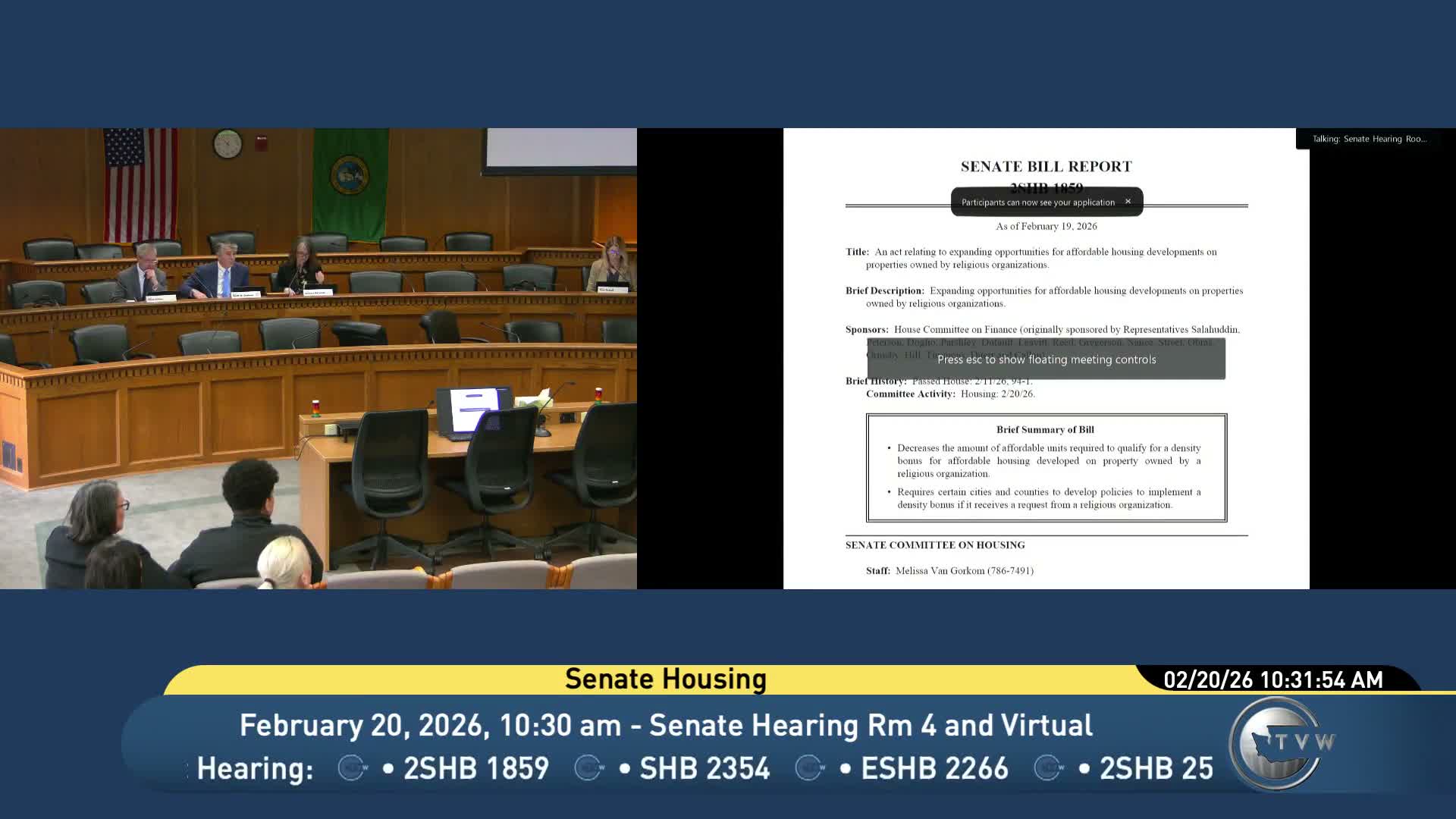
Summary
Sponsors and advocates told the Senate Housing Committee that reducing the required share of affordable units for density bonuses will make development on underused faith‑institution land more feasible; staff said the change reduces the current 100% threshold to 50% (low‑income) or 20% (very low income).
Senate Housing Committee members heard testimony Feb. 20 on Second Substitute House Bill 18‑59, which would make it easier for religious organizations to use their land for affordable housing by lowering the affordable‑unit thresholds required to qualify for a local density bonus.
Melissa Van Gorkam, staff to the committee, told members the current law grants a density bonus when 100% of units on religious‑owned property are set aside or occupied by low‑income households and remain affordable for at least 50 years. Under the bill, the required set‑aside would fall to 50% for low‑income households and 20% for very‑low‑income households. Van Gorkam said a fiscal note shows no state revenue impact and an indeterminate local government cost.
Representative Osman Sladeen, the bill’s sponsor, said the bill responds to stalled projects and financing barriers and argued the prior 100% requirement “does not pencil out” for many faith‑based projects. He told the committee he had heard from faith leaders statewide and framed the measure as a way to move “housing supply on land that already exists.”
Local elected officials and nonprofit developers testified in support. Bellevue City Council Member Lynn Robinson said the 100% requirement has limited uptake in jurisdictions that adopted the underlying statute and that a lower threshold would make projects more feasible. Affordable‑housing consultant Shannon Marr highlighted that small infill sites such as church parking lots often require higher unit counts to be financially viable.
The committee took public comment from faith leaders, affordable‑housing developers, and municipal officials, who said the change strikes a balance between preserving congregations’ missions and increasing housing supply. The public hearing on HB 18‑59 was suspended for committee consideration of other bills; no committee vote on the measure was taken during the Feb. 20 session.