
PUC lays out detailed directives to Public Service for July combined customer‑programs filing
Get AI-powered insights, summaries, and transcripts
Subscribe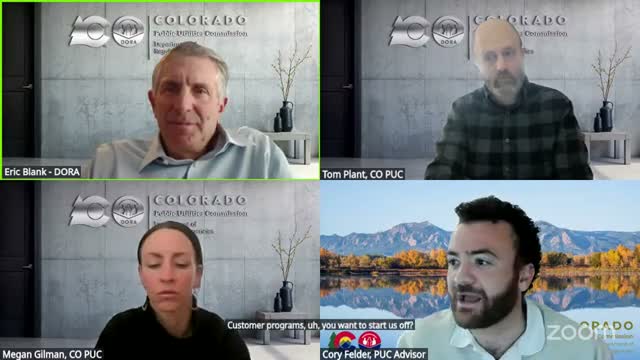
Summary
The Public Utilities Commission gave Public Service a long checklist for a July 1 combined filing covering DSM, beneficial electrification, transportation electrification, on‑bill financing and clean‑heat resources, asking for new studies, refined cost‑benefit tests, and PIM designs.
DENVER — At its Feb. 18 weekly meeting the Colorado Public Utilities Commission directed Public Service Company of Colorado to submit a consolidated filing by July 1 that combines demand‑side management, beneficial electrification, transportation electrification, on‑bill financing and clean‑heat resources and includes several new studies and clarified reporting requirements.
Corey Felder, who presented the advisory team’s slide package, told commissioners the combined application must incorporate directives from prior proceedings and additional information ordered by the commission, including a new DSM potential study, refined avoided‑cost methodologies, and improved accounting for methane leakage. "The slide shows the timing of each of the final decisions here," Felder said, and he listed specific requirements for the July submission.
The commission asked the company to provide two cost‑effectiveness analyses using multiple discount rates (the company’s weighted average cost of capital and a blended societal rate), to submit AMI program design that more fully leverages investments, and to present performance incentive mechanisms (PIMs) for energy efficiency, beneficial electrification and demand response. The commission also directed that the company evaluate on‑bill financing features such as 0% rate buy‑downs for targeted customers, establishment of a loan‑loss reserve, and clearer inputs for a modified utility cost test.
Commissioner Gilman emphasized that managed charging and demand flexibility must be embedded from the start. "Demand response and flexibility has to be embedded rather than an afterthought," Gilman said, urging that program design prioritize participation and measurable system benefits. Chair Eric Blank and Commissioner Plant stressed the importance of capturing locational value — notably the cost impact of projects and loads that land inside the Denver Metro constraint — and carrying consistent modeling assumptions across cases (DSP, JTS, future ERPs).
Commissioners discussed running a stakeholder simulation (SIM) in advance of the July filing to identify barriers to managed charging and ways to improve program enrollment and speed. Chair Blank asked advisory staff to capture the meeting discussion in writing for parties and suggested the commission could host a commissioner information meeting in March on demand‑response/program examples.
What happens next: Public Service must include the ordered studies and program design details in its July 1 combined filing. The commission will expect clear, recent data on cost inputs, consistent model assumptions across proceedings, and a plan for embedding managed demand and flexibility into program designs.
Key directives from the meeting include: a new DSM potential study and demand‑response study; AMI optimization plans; upstream/downstream methane leakage accounting; multiple discount‑rate cost‑effectiveness runs; PIM design improvements; and on‑bill financing parameters (0% buy‑downs, loan‑loss reserve, >10‑year repayment term analysis).
Commission staff and advisors said they will circulate a written capture of the discussion for parties to review prior to the filing.