Get Full Government Meeting Transcripts, Videos, & Alerts Forever!
Get email alerts on the Millionaires Tax topic
No spam. Unsubscribe anytime.
Legislative leaders unveil "millionaire's tax" to fund schools, health care and public defense
Summary
House Majority Leader Joe Fitzgibbon and Senate Majority Leader Jamie Peterson introduced a proposed "millionaire's tax" to shift revenue away from sales and B&O taxes, estimating roughly $3.5 billion in revenue, about $175 million (5%) toward public defense, and about 30,000 affected taxpayers; hearings are scheduled in the Senate Ways & Means Committee.
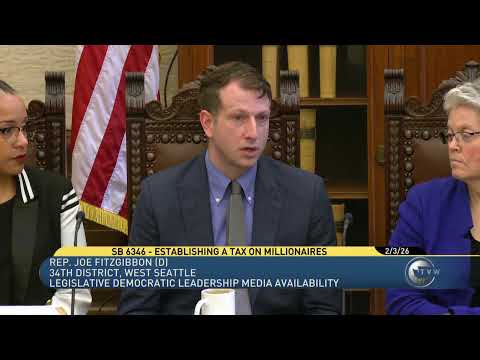
House Majority Leader Joe Fitzgibbon and Senate Majority Leader Jamie Peterson on Tuesday announced a newly filed proposal to impose an income tax on very high earners in Washington, saying the change is intended to reduce reliance on sales and business-and-occupation (B&O) taxes and to generate revenue for education, health care and public safety.
Fitzgibbon said he and Peterson filed the bill the day before and that the text is available online. "We see this as a really, remarkable opportunity for us to reduce our reliance on the taxes that we have relied on for over 90 years," he said, citing the burden sales tax places on low- and middle-income households and calling the B&O tax "inefficient" and riddled with exemptions.
Peterson framed the proposal as a corrective to what he called an "upside-down" tax system and tied the effort to recent federal tax changes. "We have a generational opportunity in front of us to change that trajectory and to make the whole system fairer," he said, adding that the introduced draft is a starting point and will change as lawmakers and stakeholders weigh in.
Why it matters: Leaders said the revenue would be used to restore and expand services that officials say were cut or stressed by prior federal-level tax changes and recent budget actions. Peterson cited an estimate that the proposal could raise about $3.5 billion; he said 5% of that—about $175 million—could be directed toward public defense, and contrasted that with King County's estimate of roughly $75 million in added costs from a recent Supreme Court mandate, noting the bill would provide about $88 million to the county under his cited figures.
Key provisions and safeguards cited by sponsors: The leaders said the bill mirrors the structure of Washington's capital gains tax for definitions and treatment of married couples, includes dollar-for-dollar credits to account for B&O and public-utility taxes already paid by pass-through businesses, and would offer a pass-through entity election allowing businesses to pay the tax on behalf of owners and treat it as a deductible business expense. They also said the proposal would expand the Working Families Tax Credit to ages 18+ and to those over 65, estimating roughly 120,000 additional Washingtonians would qualify.
Scope, numbers and eligibility: Sponsors said their best estimate is about 30,000 taxpayers would be subject to the tax, and that the first $1 million of income would be largely sheltered in the bill's structure (leading to a lower blended effective rate for many taxpayers). Peterson characterized the blended-rate examples as generally comparable to other high-income-state rates and said credits for capital-gains tax and B&O would reduce liability for many pass-through entity owners.
Political and procedural next steps: Fitzgibbon and Peterson acknowledged the governor issued a statement opposing the bill in its current form and said they will continue negotiations with the governor, business groups and local governments. Peterson announced the first public hearing for the senate bill in the Senate Ways & Means Committee on Friday at 1:30 p.m. and said the senate vehicle will likely be the initial focus, with the house finance committee to take up the measure under regular order if it arrives from the senate.
Opposition and concerns: Questioners raised concerns about a possible "marriage penalty," the impact on startups with impending stock vesting, and commentary from outside analysts that the top marginal rates would put Washington among higher-tax states for top earners. Peterson and other sponsors said the bill's structure and credits are intended to address those concerns and that the introduced draft is only a starting point for negotiations.
What the sponsors did not adopt during the event: There was no formal vote or final vote tally, and no binding amendments were adopted at the media availability. Fitzgibbon and Peterson said the bill will change as it proceeds through committee and floor deliberations.
Next steps: Senate Ways & Means will hold a public hearing on the senate bill at 1:30 p.m. Friday; sponsors said they expect continued public engagement and the possibility of an initiative to the people later in the year.