Get Full Government Meeting Transcripts, Videos, & Alerts Forever!
Get email alerts on the Millionaires Tax topic
No spam. Unsubscribe anytime.
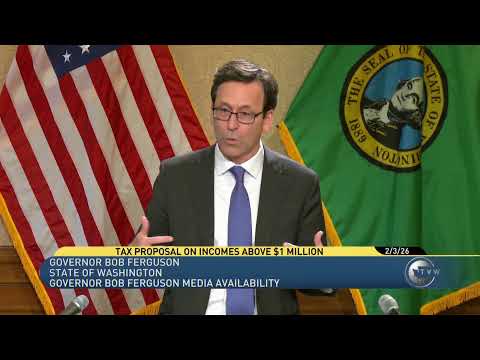
Gov. Bob Ferguson: Senate 'millionaire's tax' a start, but '7% is not close' to returning revenue to Washingtonians
Summary
At a Seattle media availability, Gov. Bob Ferguson praised elements of the state Senate's millionaire's tax proposal that would expand the Working Families Tax Credit and exempt hygiene products from sales tax, but said the plan returns only about 7% of revenue to residents and urged larger small-business tax relief.
SEATTLE — Gov. Bob Ferguson said the state Senate's proposal for a "millionaire's tax" contains provisions he supports but not enough measures that put revenue directly back into residents' pockets.
Ferguson told reporters at a brief media availability in Seattle's International District that he appreciates the proposal as "a good start" but that the roughly 7% of projected revenue the plan would return to Washington households "is not close." He named three elements in the Senate package that would deliver money to residents — changes to the Working Families Tax Credit, a sales-tax exemption for hygiene products, and tax breaks aimed at small businesses — but said those items together amount to only a small share of the total revenue the tax could generate.
Why it matters: The governor framed the debate as a negotiation over how much of any new revenue should be dedicated to tax relief versus other priorities such as K–12 education and public health. Ferguson said he wants a larger share of the proceeds to be directed at working families and small-business relief as lawmakers craft a final bill.
Key details: Ferguson identified three provisions in the Senate proposal that would return money to households and small businesses, citing approximate annual costs for each: elimination of an age limitation on the Working Families Tax Credit (~$44,000,000), a sales-tax exemption for hygiene products (~$76,000,000), and small-business tax breaks (~$104,000,000). "That totals about $230,000,000, if my math is right, or about 7% of the total revenue that we'd be receiving," he said. "The 7% that we see here is not close."
On small-business relief, Ferguson said he wants a far larger program than the Senate proposal and said, "I propose devoting $1,000,000,000 in tax relief to our small business owners." He characterized that as a major item for negotiation with legislative leaders.
On the Working Families Tax Credit, Ferguson said the program "sends a check" back to families but that it "doesn't reach many working families" and that eligibility and payment amounts should be expanded. (A numeric figure mentioned in the transcript for an example rebate is unclear and is not specified in this record.)
Legal and process questions: Reporters asked whether Ferguson would support including a "necessity clause" in an enacted bill and whether he backs a 5% carve-out for public defender costs included in both versions of the proposal. He said it was "too soon" to take public positions on those specific details and that his team is still discussing them with House and Senate leaders. On whether he expects a legal challenge if the proposal passes, Ferguson said, "There'll be a court challenge, and there'll be a vote of the people on whether they think this is the right thing for them or not." He added that constitutional questions would be for the courts to decide.
Other questions and local impacts: Reporters raised whether a state tax change could affect professional athletes' decisions to play in Washington and how that might affect small businesses; Ferguson said he has spoken with business groups and would "check more into that." He also mentioned ideas such as expanding sales-tax exemptions to other essential items and considering exemptions for clothing under $100.
Next steps: Ferguson said talks with legislative leadership are ongoing and that he expects negotiations to continue through the short legislative session. He offered no formal commitments or votes; no bills were signed or formally acted on at the availability.
Quote: "I appreciate the initial step that they've made here," Ferguson said of the Senate proposal, adding, "But the 7% that we see here is not close."