
Habitat and RRM present five-unit affordable-housing plan on North Montgomery; commissioners flag parking and scale concerns
Get AI-powered insights, summaries, and transcripts
Subscribe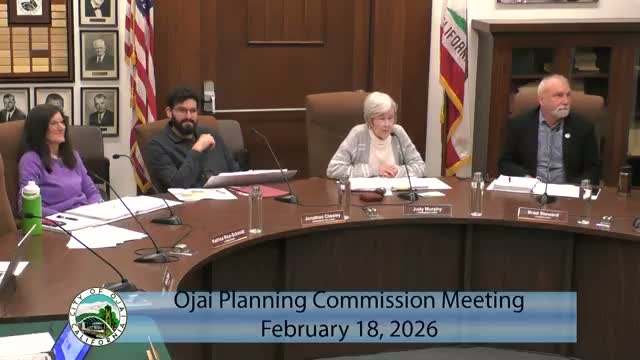
Summary
Habitat for Humanity and RRM presented a proposal for five deed-restricted, for-sale affordable homes on North Montgomery. The commission provided input on design, parking, potential two-story options, fire separation and maintenance arrangements; staff noted density-bonus rules could allow concessions and reduce parking from a nominal 13 spaces to six when 100% affordable units are proposed.
Habitat for Humanity and RRM Design Group on Feb. 18 presented an input-session concept for a five-unit, single-story, deed-restricted affordable-housing project on North Montgomery Street. The Planning Commission carried no decision; the session collected questions and directed staff to return the item as a noticed public hearing with a resolution.
Community Development Director Lucas Seibert framed the item as an input session and explained the site’s history: the city obtained the parcel following prior code-compliance issues and a dissolution of the redevelopment agency; a covenant requires affordability on the lot. He noted the SPL overlay’s base density allows up to five units on the parcel and that state density-bonus law can, under 100% affordable scenarios, increase allowable units (staff cited a notional bump to as many as 10 units). Seibert also explained how affordability concessions reduce parking demand: “13 would be required if they weren't doing affordable, but 6 with the affordability piece,” he said.
Darcy Taylor, CEO of Habitat for Humanity (Ventura County), described Habitat’s model: volunteer-driven builds, sweat-equity requirements for buyers, sale-to-first-time homebuyers and long-run affordability controls and CC&Rs. Habitat emphasized it builds for sale (not rent), targets low-income buyers (the organization said its ‘‘sweet spot’’ is about 40% of area median income) and uses resale/maintenance agreements that limit profit and preserve long-term affordability.
Architect Lauren Henkel described a single-story, craftsman/ranch-influenced design with six on-site parking stalls (including one accessible stall), bicycle parking and a site layout intended to minimize neighborhood impacts. Commissioners and neighbors expressed concerns about the tight site (roughly 0.2 acres or ~8,800 sq ft), potential crowding with five units, parking and vehicle maneuvering on Franklin Drive, and the desirability of exploring a partial two-story solution to add parking. Habitat and RRM said single-story construction supports a volunteer-build model and reduces costs; the two-story option would raise costs and insurance/subcontractor complexity.
Commissioners asked for follow-up materials — simplified comparative illustrations showing a one- and two-story option, clarification on parking and maintenance responsibilities, specifics on the proposed deed-restriction term and whether RDA or county funding could apply. Director Seibert said staff will return written responses to tonight’s questions and present a formal resolution at a future public hearing.
Why it matters: the project would provide deed-restricted, for-sale units targeted at very low-income households in Ojai, testing trade-offs among density, neighborhood scale, volunteer-build feasibility and parking obligations under state density-bonus law. The commission’s comments focused on balancing neighborhood compatibility with the city’s affordable-housing objectives.