
Connecticut hearing backs state loan program to plug federal Grad PLUS gap
Get AI-powered insights, summaries, and transcripts
Subscribe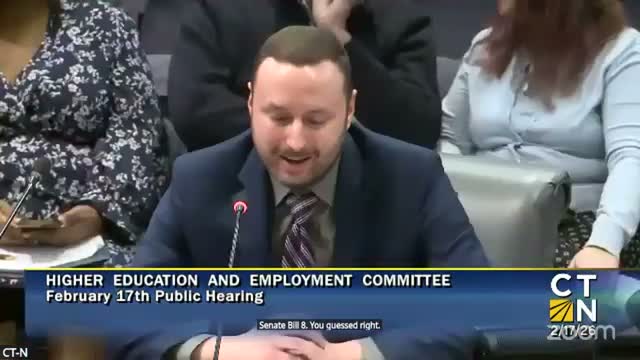
Summary
Lawmakers and witnesses urged quick action on SB 8 to replace eliminated federal Grad PLUS loans, highlighting risks to nursing, social work, physical therapy and other graduate pipelines. CHESLA says a $30M structure (state $10M + CHESLA $20M) could help about 1,200 students initially.
The Higher Education and Employment Advancement Committee heard near‑unanimous support for Senate Bill 8 on Feb. 20 as students, educators and workforce groups pressed legislators to replace federal Grad PLUS loan authority that will disappear this summer. Witnesses said the federal change threatens enrollment, particularly for part‑time and graduate students in health and social service fields.
“Limiting graduate education today means fewer professionals to meet Connecticut's urgent workforce needs tomorrow,” Jocelyn Medina, a second‑year MSW student at UConn, told the committee in support of the bill.
Josh Herlock, deputy director of the Connecticut Higher Education Supplemental Loan Authority (CHESLA), presented a financing plan that combines a $10 million state bond authorization with a $20 million CHESLA bond issuance to create a supplemental graduate loan program. “In its initial phase, the program can support approximately 1,200 Connecticut graduate students,” he said. CHESLA said the state dollars would widen access where private underwriting or co‑signer requirements would otherwise exclude many students.
Supporters — including college leaders and professional associations for nurses, physical therapists and social workers — described steep tuition and living costs for graduate programs and stressed the consequences of a financing gap. John Maduco, interim chancellor of the Connecticut State Colleges and Universities, told the committee CSU estimated nearly 4,000 students would be affected system‑wide and projected more than $26 million in additional need for fiscal year 2027 if no state response is enacted.
Committee members asked CHESLA and university officials about program mechanics and timing: whether students would submit one or two applications, how underwriting would differ for state‑supported versus CHESLA bond funds, and whether CHESLA could proceed without the state allocation. Herlock said CHESLA can issue its $20 million independently but the $10 million of state funding increases reach and helps cover students with weaker credit or no co‑signers.
Advocates urged an early effective date because admitted graduate students are making enrollment decisions now. University and hospital witnesses cited program timelines — rolling admissions and April offer letters for some masters programs — and warned that delays would deter students from enrolling this fall.
The committee did not take a vote at the hearing. The bill’s financing element is tied to pending bond language in the governor’s budget and companion measures in other committees.