Get Full Government Meeting Transcripts, Videos, & Alerts Forever!
Get email alerts on the Emergency Fund topic
No spam. Unsubscribe anytime.
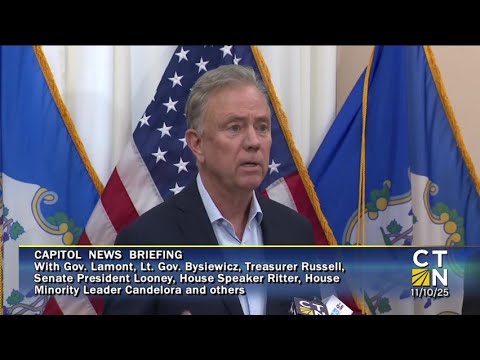
Connecticut leaders announce $500 million emergency fund to backstop SNAP, WIC and heating aid
Summary
Governor and legislative leaders announced a $500,000,000 emergency reserve to backstop SNAP, WIC, LIHEAP and related programs during the federal shutdown; the governor was granted temporary appropriation authority subject to later legislative review and a special-session vote.
Governor announced a $500,000,000 emergency relief fund on the state’s behalf to backstop food and heating programs affected by the federal government shutdown.
The governor said the fund is intended to bridge needs through the regular legislative session in February and to ensure residents receive benefits disrupted by federal action. "We're here to announce a federal emergency relief fund, $500,000,000," the governor said, citing recent interruptions to SNAP benefits and other programs.
Why it matters: Leaders warned that federal uncertainty has left residents at risk of losing benefits. Senate President Marty Looney described federal shifts as forcing an unfair choice between aid programs and said the state needed a local backstop. "We have created a fund to bridge us over until... February," Looney said.
How it will work: Officials said the governor will recommend allocations from the reserve for enumerated categories — including SNAP (food assistance), WIC (Women, Infants and Children), LIHEAP (fuel/heat assistance) and potentially health-care subsidies — and the six legislative leaders will have the ability to accept or reject those recommendations. Speaker Matt Ritter explained the move is intended to avoid repeated special sessions and to let the state act quickly while preserving legislative oversight.
Treasurer Eric Russell described the fund as a short-term contingency while preserving long-term fiscal stability. Russell said the state will continue sizable pension contributions — an additional $1.5 billion was planned to boost pension funding — and that any money left over when the regular session begins would revert to the state’s budget reserve and be available to pay down debt.
Cost context and estimates: Officials gave several cost references during the briefing. They cited an approximate $80,000,000 LIHEAP need, and estimated the full annual cost to the state of exchange health-care subsidies at about $350,000,000. Back-of-the-envelope monthly spending for SNAP, WIC and LIHEAP under a prolonged shutdown was described at roughly $100,000,000 per month in a high-end scenario.
Food distribution and immediate operations: The state said it had stepped in to support FoodShare operations and emergency meal distribution, noting FoodShare delivered about 3,000,000 meals in a recent week and the state would continue that support through November. Officials emphasized SNAP remains the most important source of meals for households and that food banks are supplemental.
Legal and procedural limits: Officials said the measure is written to enumerate roughly six or seven specific uses so it would not become a long-term discretionary fund, and they said the governor’s appropriation authority during the declared fiscal emergency is limited and reversible: if the legislature rejects a proposed allocation, the governor would need to resubmit after negotiations. A declaration of fiscal emergency and the special-session vote were scheduled for Wednesday and Thursday, officials said.
Voices from the briefing: "We didn't use their money. We used our money to backfill that," the governor said when asked whether federal funds used to cover SNAP would be reclaimed by the federal government. Senate President Looney called the federal posture "terrible and heartless," and Treasurer Russell framed the $500 million as a fiscally responsible reserve to protect residents.
What’s next: Legislative leaders expect a vote during a special session later this week; until then, the governor and agencies will implement immediate backstops for SNAP, WIC, LIHEAP and emergency food distribution. Officials said any leftover funds at the start of the next regular session will return to the budget reserve and that the legislature will reassume full appropriation authority when it reconvenes.
Sources and attribution: Quotes and attributions are drawn directly from the public briefing by the governor and legislative leaders. The briefing included named speakers: the governor; Senate President Marty Looney; Speaker Matt Ritter; Representative Candelora; Treasurer Eric Russell; Lieutenant Governor Susan Bysuits; and references to Commissioner Andrea Barton Reeves and FoodShare.