
Attorney General staff urge update to Charitable Solicitation Act as point‑of‑sale and platform risks grow
Get AI-powered insights, summaries, and transcripts
Subscribe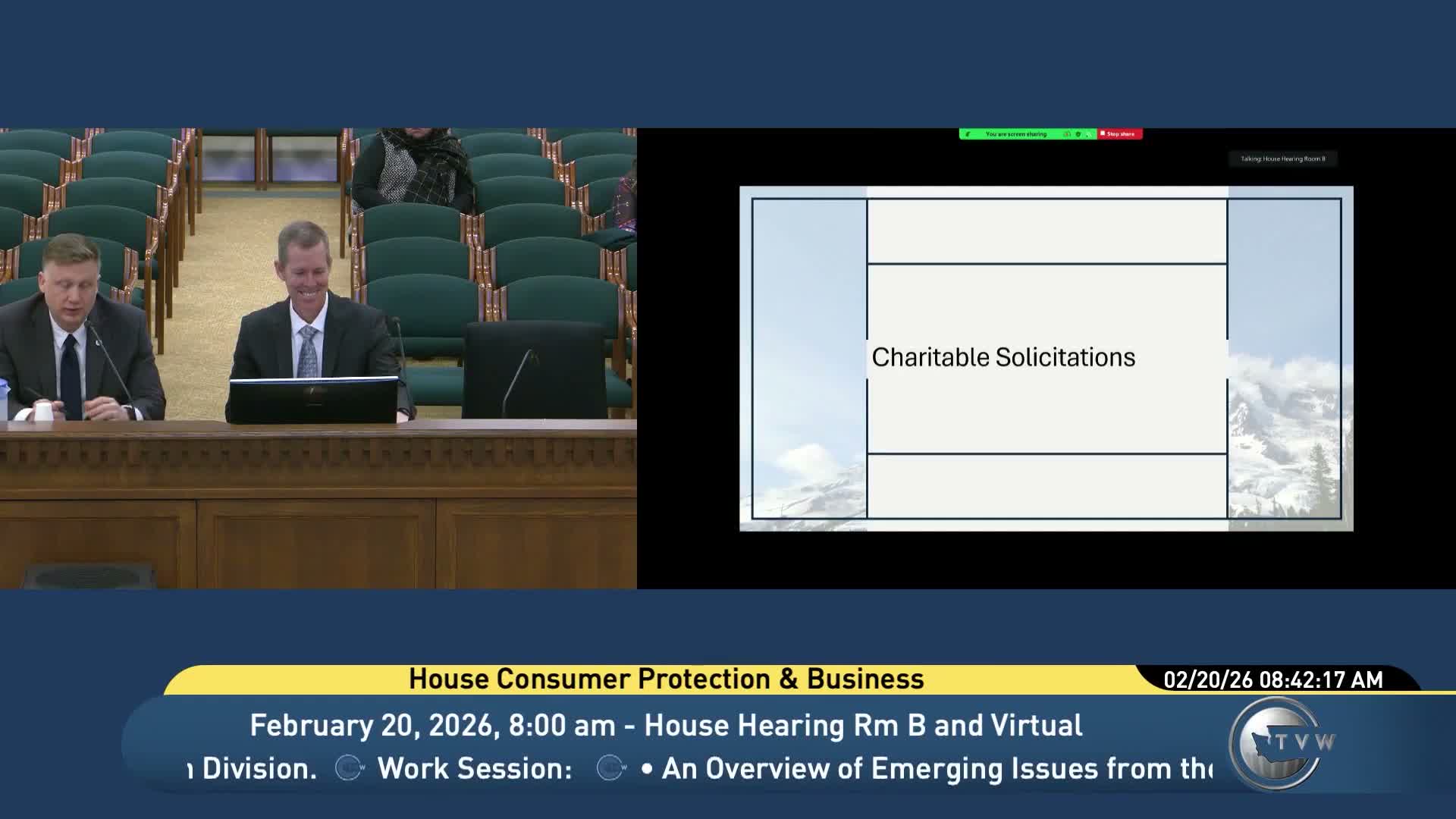
Summary
Charitable Asset Protection Team recommended modernizing the state's Charitable Solicitation Act to cover digital point‑of‑sale donations, fundraising platforms and to improve transparency after examples such as the Flipcause collapse that left many charities unpaid.
The Attorney General’s Charitable Asset Protection Team told a legislative committee Feb. 20 that fundraising methods have outpaced the state’s Charitable Solicitation Act and left donors and charities exposed.
Joshua (Josh) Steeter, who leads the AGO's Charitable Asset Protection Team, told the Consumer Protection and Business Committee that the Charitable Solicitation Act (CSA) was drafted in the early 1990s and last substantively updated in 2010 and therefore does not address modern digital fundraising channels, point‑of‑sale solicitations or for‑profit fundraising intermediaries.
Steeter outlined four common deceptive fundraising tactics: false charities that pretend to be tax‑exempt, imposter/spoof charities, fundraising‑first charities that allocate minimal funds to program services, and "cause washing" where a for‑profit claims charitable benefit without delivering it.
He highlighted two specific risks: point‑of‑sale solicitations ("round up" or tap‑to‑pay at checkout) and online fundraising platforms. Citing a 2024 NPR report, Steeter said Americans donated roughly $750,000,000 at point of sale in 2024 and warned of tap‑to‑pay schemes where donors were charged far more than expected.
Steeter described the Flipcause collapse as an example of platform risk: a California‑based fundraising platform reportedly filed for bankruptcy with about $70,000 on hand and roughly $29,000,000 owed to charities; court filings indicated nearly $1,000,000 was owed to about 84 Washington charities. Steeter said the AGO has limited visibility into many for‑profit partners and fundraising arrangements because those entities generally do not file 990s or register as commercial fundraisers.
Policy options Steeter proposed include modernizing the CSA to require clearer disclosures at point of sale, stronger transparency and reporting from fundraising intermediaries, consideration of reasonable registration fees tied to enforcement, and public education programs such as the AGO's Assured Giving and Assured Impact initiatives.
Committee members asked about legal constraints (First Amendment concerns about limiting charitable speech) and about how to identify whether in‑store vendors or event auctioneers qualify as commercial fundraisers; Steeter said the CSA currently requires disclosures for solicitations but enforcement and administrative authority are limited and would need statutory clarification.
What’s next: Steeter offered to share draft ideas for CSA revisions and encouraged committee members to consider transparency requirements for point‑of‑sale donations; no formal legislative action was taken at the session.