Get Full Government Meeting Transcripts, Videos, & Alerts Forever!
Get email alerts on the Education Survey topic
No spam. Unsubscribe anytime.
Education subgroup refines needs-based survey for special-education providers and school districts
Summary
Members of the Bergen Commission education subgroup reviewed a draft needs-based survey for private providers and LEAs, agreed to add clarifying definitions and Likert-style items for placement and staffing drivers, and assigned Sean to finalize the survey for broader distribution; next meeting scheduled for the 11th at 9.
Members of the Bergen Commission education subgroup spent the meeting reviewing and revising a draft needs-based survey intended for private special-education providers and local education agencies (LEAs). The group focused on clarifying questions about out-of-district placements, capacity and staffing constraints, and how to measure rising student complexity.
The committee prioritized changes to improve data quality and respondent clarity. Speaker 6 argued the survey should include quantifiable items so the subgroup can report clear results, saying it would allow them to "report on a data point that says, like, 98% of programs have experienced increased student complexity." Speaker 1 (meeting facilitator) asked the group to balance open-ended questions with closed, Likert-style items so the analysis would capture both nuance and measurable trends.
Why it matters: the survey is intended to generate supply-side (private provider) and demand-side (LEA) data to document gaps in placement and services for students with disabilities. Members stressed that precise wording and definitions are essential to avoid misclassification — for example, Speaker 9 noted that "homebound has an explicit meaning in Connecticut law" and must not be used interchangeably with temporary home tutoring when collecting placement-status counts.
Key edits and questions introduced during the meeting included: converting some rank-order items to a five-point Likert scale for frequency/importance; adding explicit fields for out-of-state students and total students with IEPs so percentages can be calculated; including nursing as a staffing category; separating physical space limits from slot/capacity limits; and adding an open-ended prompt for barriers to approval or helpful aspects of the approval process. Liz Montgomery, who identified herself during the meeting, urged open-ended fields to capture individualized reasons for placement changes, saying that when children "maxed out every program, ... they could no longer provide service at the level of need."
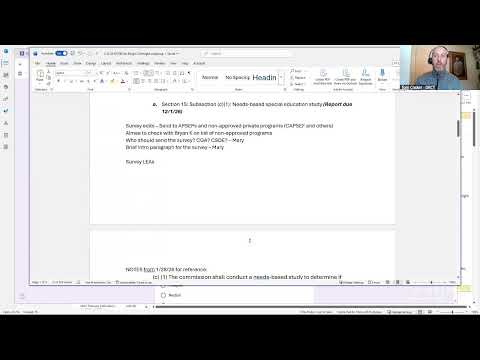
The subgroup also discussed survey distribution. Members proposed sending the survey to both approved and nonapproved providers, and to LEAs, with distribution seeded from trusted senders to improve response rates (options mentioned included a CGA or CSDE address, and targeted follow-up via CAPSEF and Seek). The group debated whether the initial email should come from the Bergen Commission or from a neutral/recognized sender; Speaker 1 suggested a generic CGA or CSDE address with individual forwards from subgroup members.
Technical and administrative next steps were assigned before adjournment. Amy agreed to check with Brian about the list of nonapproved providers; Speaker 6 said he would scrub existing response data and adjust required fields that were causing a live-testing UX issue; and Sean (the survey author referenced repeatedly in the discussion) was asked to update the drafts and circulate them. The subgroup set the next meeting for the 11th at 9 to review revisions and follow up on distribution responsibilities.
The meeting produced no formal motions or votes; members reached consensus on edits to the survey instrument and on follow-up assignments pending the revised drafts.