Get Full Government Meeting Transcripts, Videos, & Alerts Forever!
Get email alerts on the Local Government Funding topic
No spam. Unsubscribe anytime.
Committee codifies direct-distribution formula and approves moving the percentage from 7% to 8%
Summary
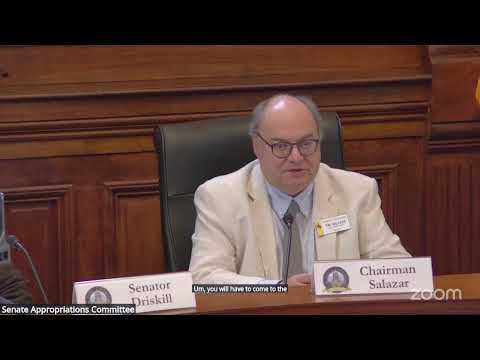
House Bill 107 would codify direct distributions to local governments and replace the biannual appropriation with a dedicated transfer equal to a percent of prior-year sales and use tax receipts; the committee adopted an amendment to set the transfer at 8% and recommended the bill do pass as amended.
Dalton Quilty of the Legislative Service Office summarized House Bill 107, which would codify the direct-distribution model and replace the current biannual appropriation with a dedicated transfer equal to 7% of the prior fiscal year's statewide sales and use tax revenues (as presented). Quilty explained the change would shift timing and calculation to use the immediately preceding fiscal year and move payment dates to October and March 15.
Quilty said the proposed formula would allocate approximately 64.83% of distributions to municipalities and about 35.17% to counties under the model presented. Committee members sought clarification about how the percentages were derived and the projected dollar flows for the next biennium. Quilty told the committee that at 7% the 2027 estimate was about $65.1 million and about $67.1 million in 2028 under the LSO estimate.
Representatives of local governments urged a higher percentage. Ashley Harpstreet, executive director of the Wyoming Association of Municipalities (WAM), and Matt Murdock, president of WAM and mayor of Pinedale, said codifying the distribution in statute would provide predictability for communities that rely heavily on the direct distribution. Jeremiah Grama of the County Commissioners Association said he continued to advocate for 8% to better insulate counties from revenue fluctuations.
A committee member moved to amend the bill to change the dedicated transfer from 7% to 8% of the prior fiscal year's statewide sales and use tax revenue. After discussion about predictability versus funding levels and the potential for future fluctuations, the amendment passed. The committee then voted on the engrossed bill as amended; the clerk recorded five ayes and announced the committee recommended the bill do pass as amended.