Get Full Government Meeting Transcripts, Videos, & Alerts Forever!
Get email alerts on the Rezoning Harris Trail topic
No spam. Unsubscribe anytime.
Bryan County planning panel postpones decision on Harris Trail rezoning after residents raise safety and heritage concerns
Summary
The Bryan County Planning & Zoning Commission postponed action on a rezoning and multiple variance requests for a 4.5-acre parcel on Harris Trail after residents cited traffic congestion, safety near a park and generational ties to the area; the panel will revisit the matter in April.
The Bryan County Planning & Zoning Commission voted to postpone consideration of a rezoning and several variance requests for a 4.5-acre parcel on Harris Trail until its April meeting after residents and commissioners raised traffic, safety and historic-preservation concerns. The commission’s vote was advisory; the Board of Commissioners will make the final decision.
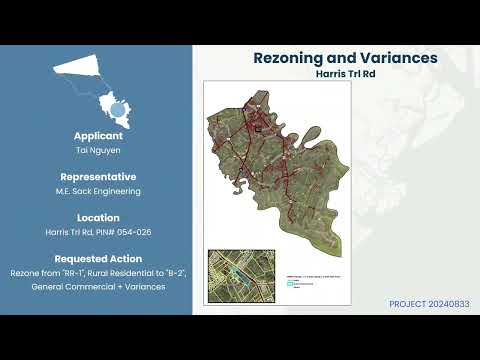
County staff told the commission the applicant seeks to rezone the parcel from RR1 (rural residential) to B2 (general commercial) to allow a roughly 6,900-square-foot multi-tenant building proposed to include a restaurant and a nail salon. Staff recommended approval of the rezoning with conditions, including final county approval of a traffic impact analysis (TIA), incorporation of a future roundabout into the final site design, and reservation of right-of-way for that improvement.
Staff also described multiple variance requests tied to the projected roundabout alignment: a requested front setback reduction (from 75 feet to 20 feet, with staff proposing 25 feet instead), a reduction of a street yard at some drive locations, and a partial reduction of a rear buffer to accommodate parking and loading. Staff recommended denial of some variance requests and approval of others, noting that certain reductions were caused by the applicant’s desired building configuration rather than unique lot conditions.
Randy Dice of MESAC Engineering, representing the potential buyer, said the plan shown to the commission used a “worst-case scenario” alignment for the roundabout provided by county engineers and that some variances respond to that potential right-of-way. He told the commission the design aims to maintain traffic flow and that adjustments to setbacks might be possible once the county’s final right-of-way lines are established; he said the team was open to modest tweaks such as a 22-foot front setback in lieu of the originally requested 20 feet.
Nearby residents opposed the rezoning at the hearing. Margaret Harris Jones, who identified herself as born and raised in Richmond Hill and as living immediately behind the subject parcel, said she opposed commercial development at the site because of existing congestion and crash frequency near the intersection and the presence of a nearby park and schools. “To have this business to come in front of it to me with all the congestion that’s already there … it would just be a disaster,” she said. Sharita Bowles, who said she lives in the nearby Brown House, questioned pedestrian safety (noting the lack of sidewalks), potential stormwater/runoff issues related to an on-site pond, and whether new commercial jobs would meet local living-wage benchmarks.
Commission members asked whether the roundabout design had been finalized and whether additional traffic or stormwater studies would be required later in the permitting process; staff said the county’s engineering group is beginning design work but could not provide a construction timetable. Several commissioners said more time or a site visit would help inform an advisory recommendation. One commissioner said they were inclined to follow staff recommendations given what’s before them, while others asked to delay.
Ultimately the commission voted to postpone action on both the rezoning and the variances until the next meeting in April, when the issue will return for further consideration and the commission may forward a recommendation to the Board of Commissioners. The commission’s recommendation—approval, denial or modification—will be advisory; the board has the final authority on rezoning and on variance decisions under state law.