Get Full Government Meeting Transcripts, Videos, & Alerts Forever!
Get email alerts on the First Time Offender Waiver topic
No spam. Unsubscribe anytime.
Commission backs First Time Offender Waiver changes with caveat on assault and robbery inclusions
Summary
The SGC recommended a 'due pass' on a revised First Time Offender Waiver that would expand eligibility and replace short confinement with deferral/suspended-sentence mechanics, but members recorded mixed views about including robbery 2 and assault 2; the motion carried with substantial abstentions.
The Sensing Guideline Commission on Jan. 23 recommended a "due pass" for a revised First Time Offender Waiver (FTOW) but asked that legislative testimony note internal disagreement over including robbery in the second degree and assault in the second degree among eligible offenses.
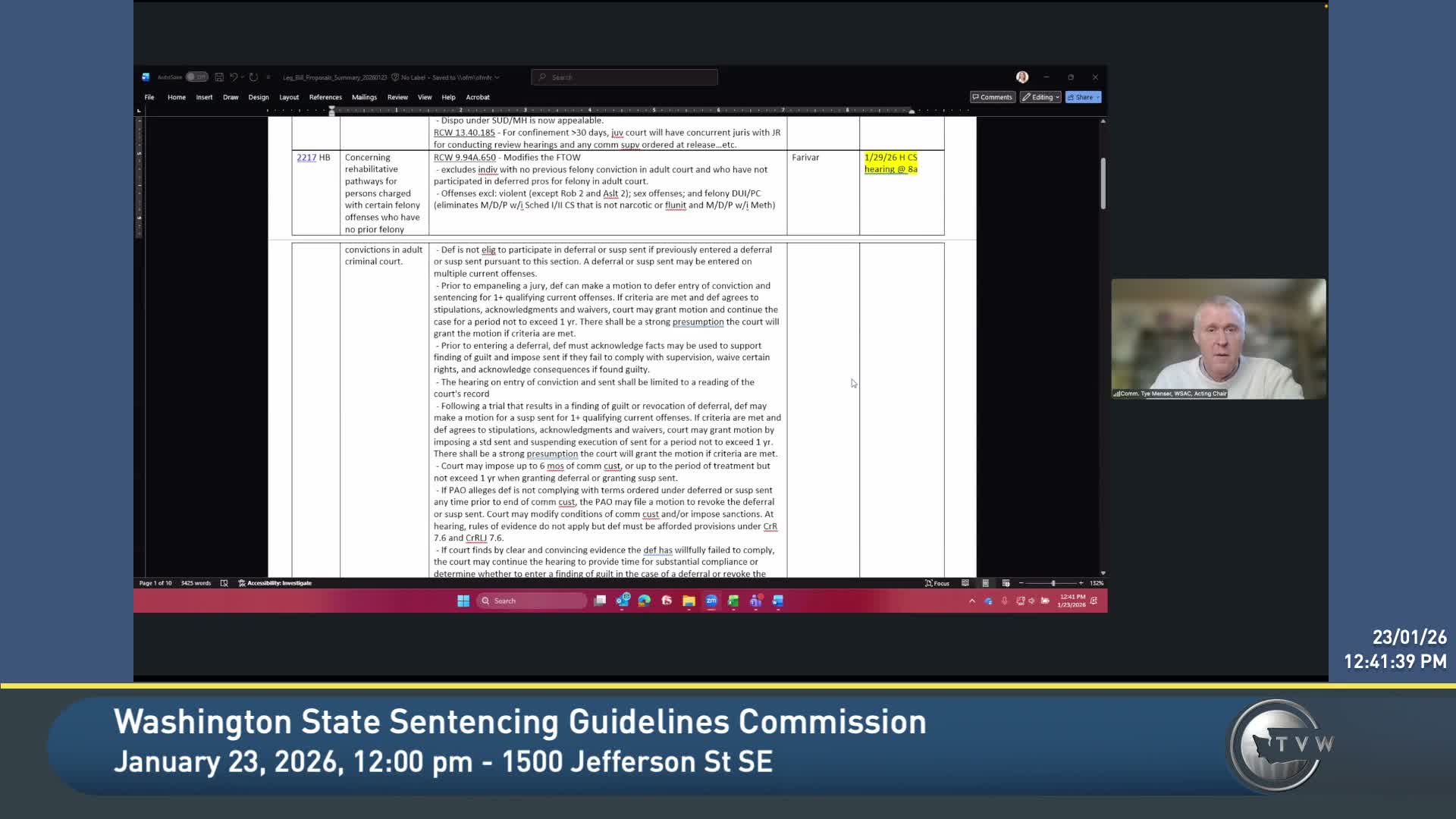
Commission staff summarized the proposal: FTOW would apply to people with no prior felony conviction in adult court (and no prior felony deferred prosecutions in adult court), remove many drug offenses from exclusion lists so some drug-possession cases could be eligible, and replace an option for a short period of confinement with a deferral or suspended sentence tied to community custody or treatment (up to six months of community custody or up to one year tied to treatment).
Why it mattered: advocates said the change could let more people avoid felony convictions and related collateral consequences. "Giving first-time adult felons an opportunity to not go down that road" was a phrase used in testimony by a long-time defense practitioner who supported diverting people from felony records. Judges and members sought clear drafting on whether FTOW requires plea entry or operates like diversion; Judge Ferrera described his diversion drug court practice where defendants do not enter convictions and immigration risk is avoided.
Concerns centered on including robbery 2 and assault 2 as newly eligible offenses given the range of conduct those statutes can cover and known racial disproportionalities in robbery charging. Representative Ruth Davis said she would not support the bill if it included assault in the second degree because some prongs of assault 2 can be very serious (for example, strangulation or assault with a deadly weapon).
Action taken: Miss Ramona Brandes moved to recommend a "due pass" on FTOW; Miss Benward seconded. Members then agreed to amend the recommendation so the commission’s report to legislators would note that the SGC had a mixed response to including robbery 2 and assault 2. The chair called the vote; after counting proxies and hands the chair announced the motion carried. During the count members and staff recorded multiple abstentions; the chair summarized the outcome with the motion carrying and later members asked staff to reflect abstentions in testimony.
Vote tallies recorded in the meeting transcript: on the FTOW motion the chair announced roughly eight members in favor and nine abstentions during the hand count before declaring the motion carried; no 'no' votes were reported in the final count recorded in the meeting.
What happens next: the commission will report a pro recommendation with an amendment noting mixed opinion on assault 2 and robbery 2 when providing testimony to the legislature; staff indicated it can include abstention counts if members request that representation.
Representative Ruth Davis urged precise reporting of abstentions: "If the bill is presented... it will say that it was unanimous. But it was actually 7 people voting with multiple proxies and 9 people abstaining." Staff responded that abstentions do not count toward the vote total but offered to report abstention counts if the commission prefers.
Ending: The motion to recommend a due pass with the amendment carried; the commission moved on to other items and adjourned later in the session.