Get Full Government Meeting Transcripts, Videos, & Alerts Forever!
Get email alerts on the Juvenile Sentencing topic
No spam. Unsubscribe anytime.
Sensing Guideline Commission tables juvenile sentencing bill 2389 amid split on judicial discretion and resource gaps
Summary
Commission members debated bill 2389’s presumption that judges order community alternatives or send youth to juvenile facilities, but raised concerns about the low 'preponderance' risk standard and lack of funding for community programs; the commission voted to table the bill pending amendments.
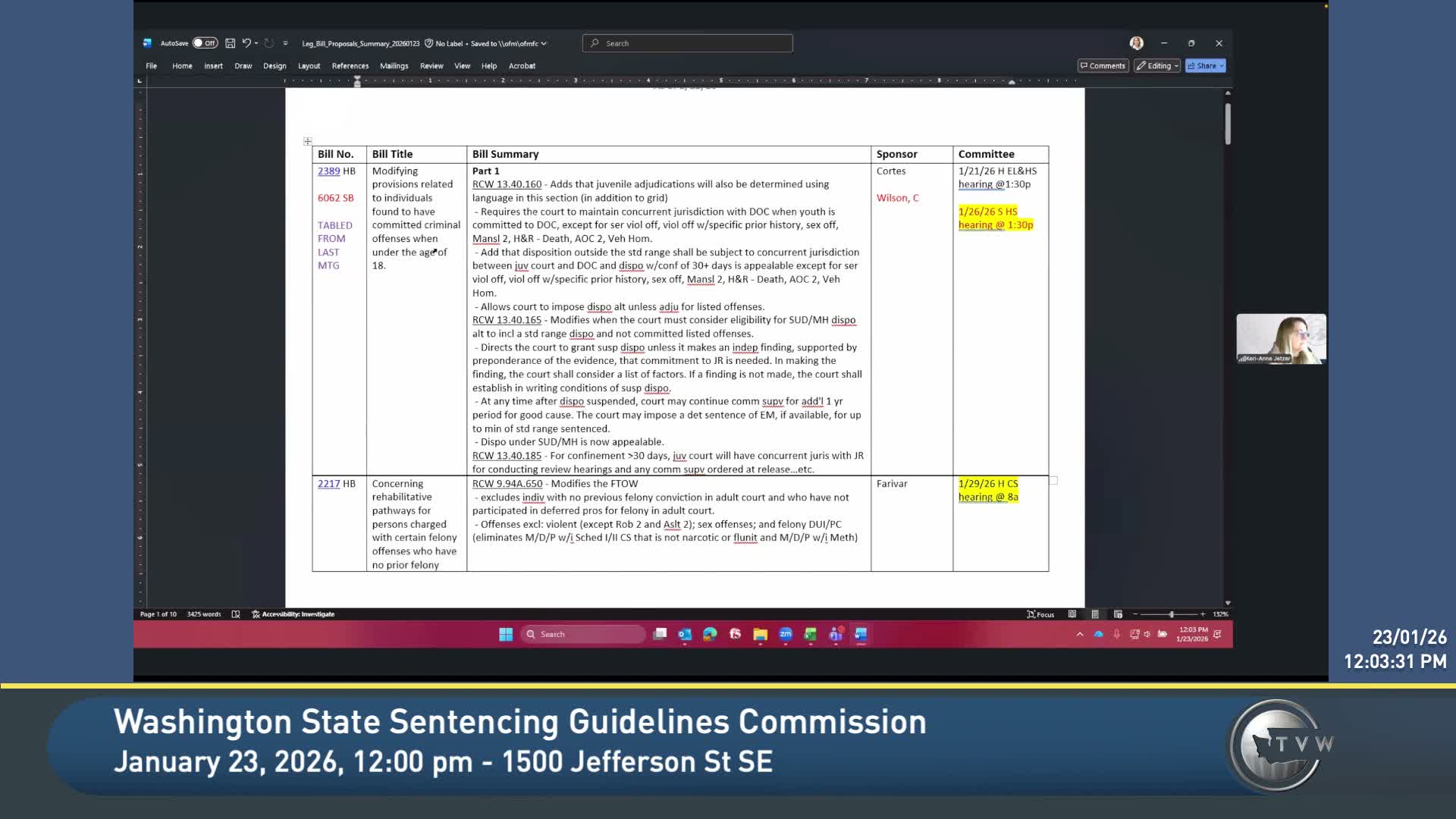
The Sensing Guideline Commission on Jan. 23 debated proposed changes in juvenile sentencing under bill 2389 and voted to table further action until amendments are available.
Commission vice chair Ty Mentzer opened the special meeting at 12:02 p.m. and invited staff to introduce the agenda item. Staff noted bill 2389 (and related file 6062) had been tabled at the prior meeting for additional review because members considered it "a very meaty bill." Judge Gilbond, speaking for the Minority and Justice Commission, said the group favored "additional judicial discretion and individualized determinations for youth," while stopping short of endorsing provisions outside its mission.
Why it mattered: members repeatedly flagged a drafting choice that would make certain sentencing alternatives presumptive — language several speakers described as a "shall" requirement — and questioned whether that presumption improperly constrains judges, especially in counties that lack community treatment resources. One attorney pointed out the bill’s risk finding is by a "preponderance" standard, which he characterized as the lowest civil standard and therefore an easier bar for sending youth to secure facilities.
Central arguments in the meeting centered on two tensions: ensuring courts across the state consistently consider community-based alternatives (to avoid ‘‘justice by geography’’) and recognizing that many counties do not have the programs or providers to implement those alternatives. Representative Ruth Davis said the bill, as written, places the burden on the state and framed the only stated justification as protecting community safety; she warned the bill "doesn't add a single cent" to expand services and said judges’ hands could be tied even when no local services exist.
Supporters of a presumption said it would ensure judges at least consider alternatives in every case. "A presumption that can be overcome" would, proponents argued, require consideration where courts today often never grant options B or C. Several participants recommended alternative drafting that would require the court to "consider" listed factors rather than creating a binding presumption that shifts decisionmaking.
Experts and practitioners described limits in available, evidence-based programs. Doctor Kenneth Peterson summarized state-approved interventions (for example: MST, FFT, EET, COS) and said several function in only a few counties; he warned WSIPP-approved programs are "pretty limiting" and quality-assurance capacity is uneven statewide. Practitioners said juvenile court rule 7.16 also affects supervision options and may limit when courts may seek bench warrants for noncompliant youth.
Action taken: Miss Ramona Brandes moved to table bill 2389, noting the measure is likely to be amended and the commission had not reached consensus; Judge Swan seconded. The chair called the vote; staff reported support "with the proxies" and recorded three abstentions. The motion to table carried.
What happens next: staff noted the House and Senate will hold hearings this week and next; Senator Wilson advised members the Senate hearing would be another opportunity to hear the discussion. The commission will revisit the bill at a later special meeting once amendments are available.
Quotes from the meeting include Judge Gilbond: "We concur that we need to allow for additional judicial discretion and individualized determinations for youth," and Representative Ruth Davis: "This bill actually doesn't add a single cent of additional resources."
Procedural note: members asked staff to accurately reflect abstentions when reporting the commission’s positions to the legislature. The meeting adjourned with the juvenile bill left pending for further review.