Get Full Government Meeting Transcripts, Videos, & Alerts Forever!
Get email alerts on the State Legislation topic
No spam. Unsubscribe anytime.
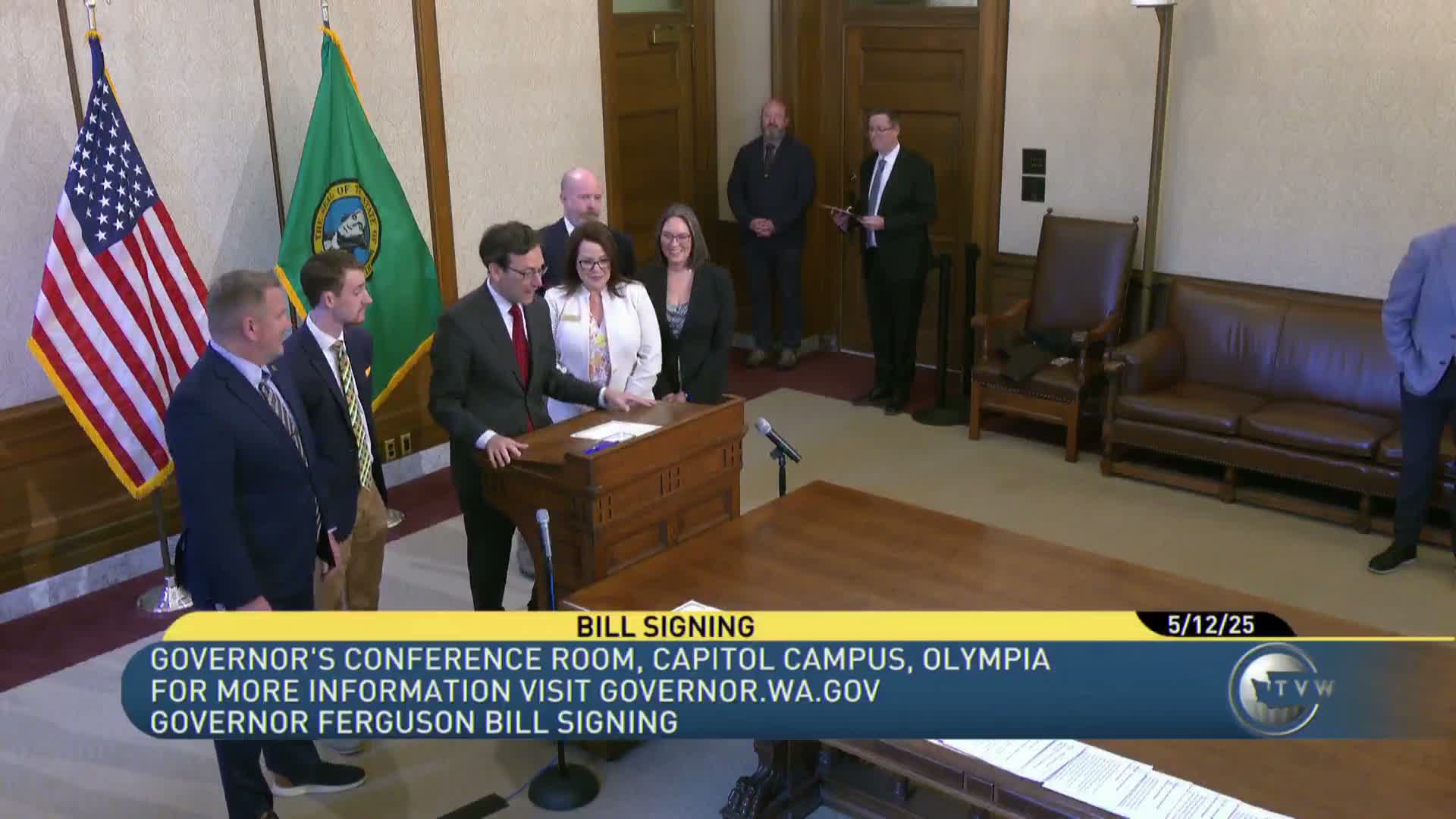
Governor signs bipartisan package of bills on health access, consumer protection and reentry supports
Summary
The governor ceremonially signed a package of bipartisan bills expanding emergency medication flexibility, permitting optional blood-type IDs for first responders, strengthening behavioral-health services and other measures. Sponsors and stakeholders attended photo opportunities after each signing.
Unidentified Speaker 1 signed a slate of bipartisan bills in a ceremonial event at the Governor's Office, announcing that the measures would advance health access, consumer protections and reentry supports across Washington state.
The package includes changes ranging from permitting optional blood-type listings on driver licenses to clarifying attorney-general enforcement over continuing-care retirement communities. "This bill will literally save lives here in Washington state," Speaker 1 said of Senate Bill 5689, which allows people to include their blood type on state-issued IDs and directs the Department of Licensing to educate the public about the option.
Why it matters: the bills address practical barriers in health care and public safety (for example, emergency departments' ability to send more than a 48-hour supply of medications with patients), strengthen consumer protections for older residents, update domestic-violence 'hope card' procedures and remove outdated limits that can impede reentry coordination for people leaving prison.
Key bills and short descriptions
House Bill 1009: Adds a member and makes structural changes to the Pharmacy Quality Assurance Commission to improve representative makeup (prime sponsor: Representative Sam Lowe). Speaker 1 thanked the sponsor and signed the bill.
House Bill 1130: Updates the Developmental Disabilities Administration's waiver system to clarify priority populations (including people age 45 or older and those identified as posing a community safety risk) so eligible Washingtonians can access services (prime sponsor: Representative Farvar). Speaker 1 signed the bill.
House Bill 1186: Gives emergency departments and other health-care facilities more flexibility to provide medications that exceed the current 48-hour supply limit and adds an exemption for anti-infective drugs (prime sponsor: Representative Lisa Parsley). Speaker 1 said the change reduces care disruptions and signed the bill.
House Bill 1395: Streamlines background checks and review processes for home-care providers to help address workforce shortages while maintaining client protections (prime sponsor: Representative Farabhar; companion sponsor: Senator Chapman). Speaker 1 signed the bill.
House Bill 1422: Updates rules governing drug take-back programs at the Department of Health to support safe disposal of unused or expired medications and bolster opioid-epidemic responses (prime sponsor: Strom Peterson). Speaker 1 signed the bill.
Senate Bill 5689: Allows an option to list blood type on driver's licenses or ID cards and asks the Department of Licensing to conduct public education; Speaker 1 said it will help first responders and trauma teams access vital information faster and signed the bill (prime sponsor: Senator Paul Harris).
Senate Bill 5691: Clarifies the attorney general's authority to enforce violations by continuing-care retirement communities under the Consumer Protection Act to ensure promises to residents are kept (prime sponsor: Senator Annette Cleveland; companion sponsor: Representative Nicole Macri). Speaker 1 signed the bill.
Senate Bill 5351: Prohibits same-day denials for dental insurance claims and directs the Office of the Insurance Commissioner to work with Ruckel Health Center to study insurer spending on patient care (prime sponsor: Senator Curtis King; companion sponsor: Representative Milin Tai). Speaker 1 signed the bill.
House Bill 1460: Requires court clerks to issue hope cards on request to victims and survivors of domestic violence and limits personal identifying information on those cards (prime sponsor: Representative Dan Griffey; Representative Simmons present). Speaker 1 signed the bill.
Senate Bill 5029: Provides the Department of Corrections greater flexibility to coordinate releases with nonprofits and removes outdated limits on transportation costs to support people reentering the community (prime sponsor: Senator Claire Wilson). Speaker 1 signed the bill.
Senate Bill 5142: Allows property owners whose land was taken through eminent domain by school districts and not put to intended public use to purchase their property back; Speaker 1 noted broad support and signed the bill (prime sponsor: Senator Bob Hasegawa).
Senate Bill 5419: Redirects state fire-loss reporting to the Office of the Insurance Commissioner to help identify patterns and support public-safety campaigns with fire districts (prime sponsor: Senator John Lubbock; companion sponsor: Representative Dan Griffey). Speaker 1 signed the bill.
Senate Bill 5745: Ensures the involuntary treatment system can provide public defense where local jurisdictions cannot and encourages community treatment in facilities such as the UW Center for Behavioral Health (prime sponsor: Senator Monica Dhingra). Speaker 1 signed the bill.
House Bill 1432: Renews and updates Washington's mental-health parity law by requiring state-regulated insurers to use generally accepted clinical-practice guidelines and reduce burdensome authorization requirements for mental-health and substance-use care (prime sponsor: Representative Tara Simmons; companion sponsor: Senator Jessica Bateman). Speaker 1 said they would sign the bill.
Event and stakeholders: After each signing Speaker 1 invited sponsors and stakeholders to pose for photographs; multiple attendees, including advocates and service providers, were thanked onstage. Jonathan Yagerman of Bloodworks and others were present and introduced themselves during the ceremony.
What happens next: These bills were signed ceremonially at the event. The transcript records no roll-call votes or legislative vetoes during the ceremony; implementation timelines and effective dates are not specified in the transcript and are therefore not included here.
Quoted
"This bill will literally save lives here in Washington state," Speaker 1 said about Senate Bill 5689, which allows blood-type information on state IDs.
Ending
The ceremony concluded with group photos after each signing; sponsors and stakeholders acknowledged the bipartisan cooperation that advanced the package. The transcripts do not record subsequent implementation details or timelines for each bill.