Get Full Government Meeting Transcripts, Videos, & Alerts Forever!
Get email alerts on the Bill Signing Roundup topic
No spam. Unsubscribe anytime.
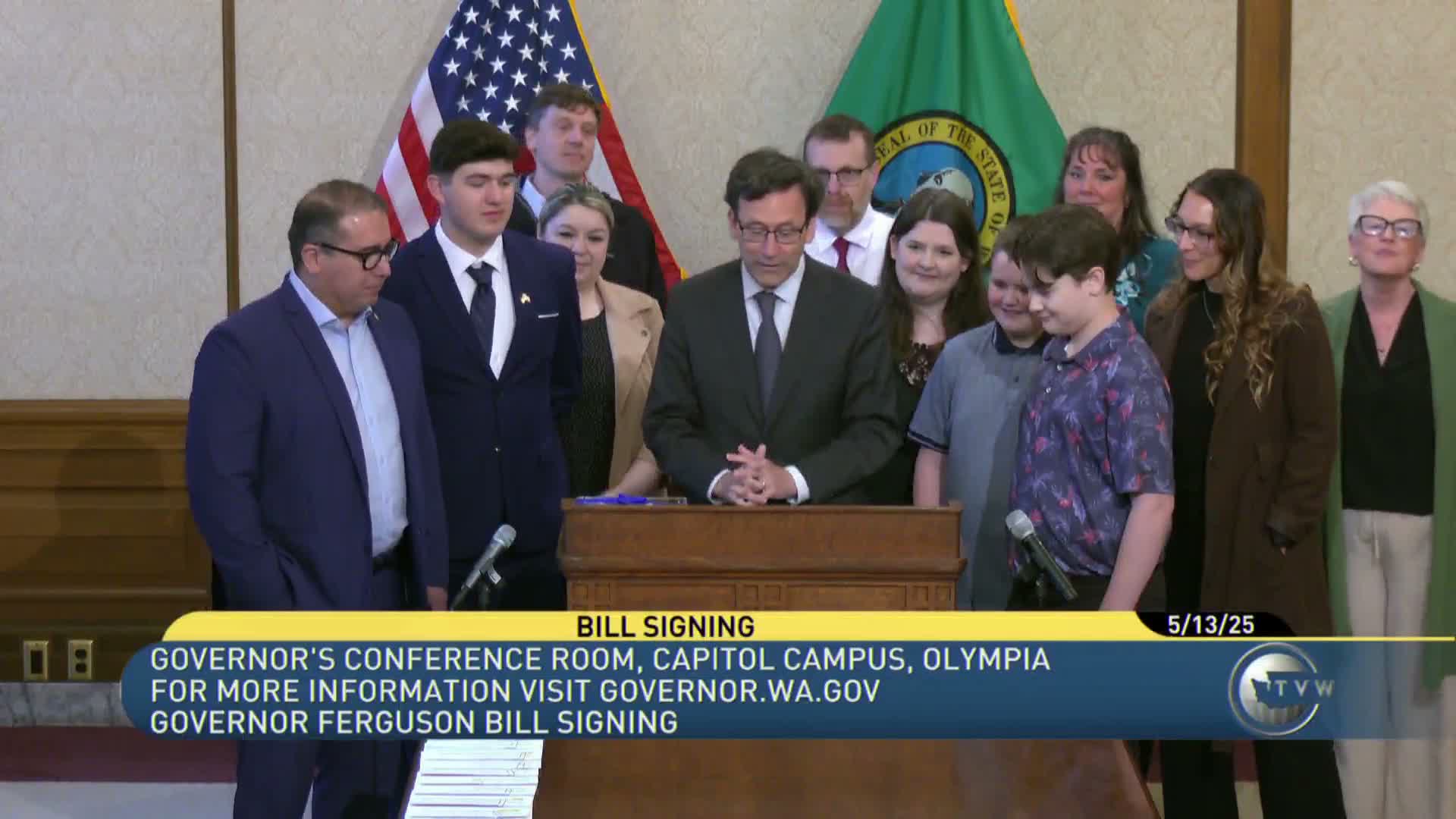
Governor signs 28 bills on education, housing, energy, childcare and worker protections
Summary
At a ceremonial bill-signing event, the governor signed about 28 bills spanning remote test administration, extended special-education services, fusion-energy certification pathways, housing and childcare zoning reforms, and a new mass-layoff notification requirement.
The governor signed roughly 28 bills in a public ceremony that laid out policy changes across education, energy, housing, childcare and worker protections.
"Traveling to testing sites can be a significant burden for students who are part of online programs," the governor said while signing House Bill 1079, which allows school districts with online programs to permit remote state testing and directs the Office of Superintendent of Public Instruction to make technical updates to support remote administration. The measure, the governor said, aims to help students with disabilities, medical issues or long travel distances.
In education, the governor also signed Senate Bill 5253 to extend special-education services beyond age 21: "This bipartisan bill extends that time to the end of the school year when a student turns 22 or high school graduation, whichever comes first," the governor said, noting the change is intended to improve transitions for students with disabilities.
On energy and climate, House Bill 1018 creates a pathway for fusion energy facilities to use the Energy Facility Site Evaluation Council (FSEC) certification process, a step the governor described as part of meeting the state's clean-energy goals. The governor also signed Senate Bill 5445, which exempts certain small-scale solar projects from SEPA review to speed development and includes protections so farmers using land for both agriculture and solar generation are not subject to additional taxation.
Several bills focused on housing and land use. The governor signed Senate Bill 5148 to improve permitting predictability and increase housing near high-capacity transit stations; by 2029 the law is expected to lead to zoning changes around many rail and bus stations, officials said. Bills easing exterior cladding requirements and streamlining unit-lot subdivisions (Senate Bills 5571 and 5559) were also signed to reduce construction costs and speed housing production.
Family- and community-focused measures included House Bill 1351 expanding preschool eligibility to admit some children who turn 3 after Aug. 31 subject to space and funding; House Bill 1562 requiring more baby-changing stations in public buildings; and Senate Bill 5509, which revises zoning and permitting for childcare centers to integrate them into urban planning.
Workers gained a new notice requirement under Senate Bill 5525, which requires employers with 50 or more full-time employees to provide 60 days' advance notice to workers and the Employment Security Department before a business closure or mass layoff.
Other bills signed covered public-safety and tribal matters (House Bill 1829 on cross-jurisdictional enforcement of tribal warrants and House Bill 1946 requiring tribal representation on local health boards), consumer safety (Senate Bill 5628 clarifying restrictions on lead in metal cookware), and multiple administrative updates across local conservation districts, library placement in community centers, and child-support guideline updates.
Sponsors and legislative leaders were recognized throughout the ceremony; the governor repeatedly thanked bipartisan sponsors and invited attendees and staff for photographs after each signing. Organizers said approximately 28 bills were signed during the event; specific effective dates and implementation details were not specified for most measures at the ceremony.
The bills are enacted as signed; implementation and rulemaking responsibilities were noted to fall to the relevant agencies mentioned in each bill (for example, OSPI for remote testing, DCYF for private-school living-accommodation licensing extensions, and the Utilities and Transportation Commission for thermal energy networks).