Get Full Government Meeting Transcripts, Videos, & Alerts Forever!
Get email alerts on the Bill Signing Roundup topic
No spam. Unsubscribe anytime.
Official signs 11 bipartisan bills in Tri‑Cities to boost utilities, public safety, education and agriculture
Summary
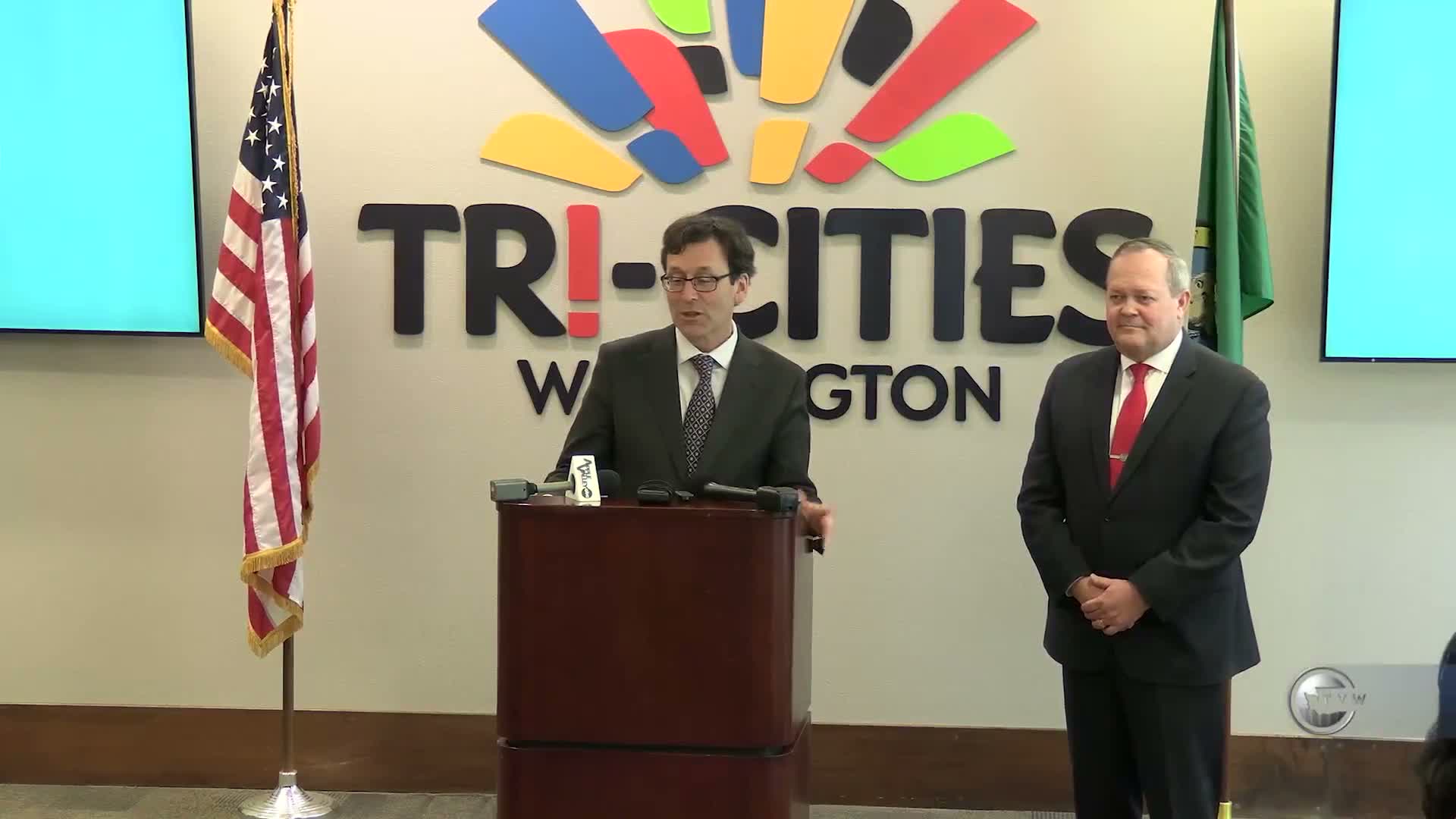
An official hosted a bill‑signing in the Tri‑Cities on Feb. 21, signing 11 bipartisan measures that clarify utility agreements, extend program deadlines, expand education eligibility and increase penalties for theft from first responders; sponsors and local leaders joined for remarks and photos.
An official presiding over a bill‑signing ceremony in the Tri‑Cities on Feb. 21 signed 11 bipartisan measures aimed at addressing regional energy needs, public safety, education and agriculture, then invited legislators and stakeholders for questions and photos.
The host explained the signing protocol and presented each bill in brief: they ranged from utility joint‑use agreements to extensions of workforce and agricultural programs. "House Bill 12 53 allows cities and public utility districts to enter into joint use agreements with private companies to develop transmission, energy storage, and energy generation facilities," the host said, noting the measure is intended to expand options for building future electricity infrastructure.
State Senator Matt Behnke, whose district includes the event site, welcomed attendees and emphasized regional collaboration. "We call this the mighty eighth," Behnke said, describing the district as a crossroads of several legislative districts and regional industries.
The host described several education and workforce provisions: House Bill 16 48 extends the deadline for childcare providers to meet new qualification requirements from 2026 to 2030 to give providers more time to complete training; House Bill 19 36 extends to 2030 a provision allowing experienced retired educators to work part time in nonadministrative roles without immediate pension reductions; and Senate Bill 55 43 expands College Bound Scholarship eligibility to students with a high‑school equivalency certificate (GED), a change requested by the State Board for Community and Technical Colleges.
On public safety and transparency, the host described House Bill 19 34 as shielding victims of workplace harassment from revictimization by requiring agencies to redact personal identifiers and alter audio before releasing records under the Public Records Act; the law nevertheless requires disclosure of a complainant's name and title when that person is an elected official.
Agricultural and water measures signed included House Bill 19 12, which clarifies which fuels are exempt from Climate Commitment Act surcharges and extends those exemptions for two years to help farmers avoid added costs; Senate Bill 54 85, which extends the Department of Agriculture's Livestock Identification Program through July 1, 2030; and Senate Bill 53 03, which extends timelines for projects and permits in the Yakima Basin Integrated Plan by 10 years, to July 1, 2035, intended to support water storage projects for farms and fish amid drought concerns.
The host also described House Bill 12 58, which clarifies city/county sharing of 9‑1‑1 excise tax revenues in Spokane County without changing the state portion of the tax, and Senate Bill 53 23, which increases penalties for theft of essential equipment from firefighters and emergency medical service providers by expanding first‑degree theft and possession definitions.
Finally, the host said Senate Bill 56 82 grants a five‑year extension for the Washington Customized Employment Training Program B&O tax credit to help employers cover training costs. For each bill the host acknowledged the prime sponsor and often used a second pen so a sponsor could receive a signing pen as a memento.
After each bill description, sponsors and local partners came onstage for photographs. The host offered to take a few media questions after the ceremony.
What happens next: the measures as described were signed at the ceremony; further implementation steps (rulemaking, agency guidance, funding details and program administration) were not discussed in depth at the event and will move through the relevant state agencies and legislative follow‑up processes.