Get Full Government Meeting Transcripts, Videos, & Alerts Forever!
Get email alerts on the Land Use Development topic
No spam. Unsubscribe anytime.
State Parks hears detailed Westport Golf Links update as public split over environmental and economic trade-offs
Summary
Commissioners received an informational briefing on the Westport Golf Links proposal, the draft EIS comment response process, and recent litigation developments. Supporters highlighted jobs and expanded access; conservation groups warned of loss of rare interdunal wetlands and coastal risks. No decision was requested.
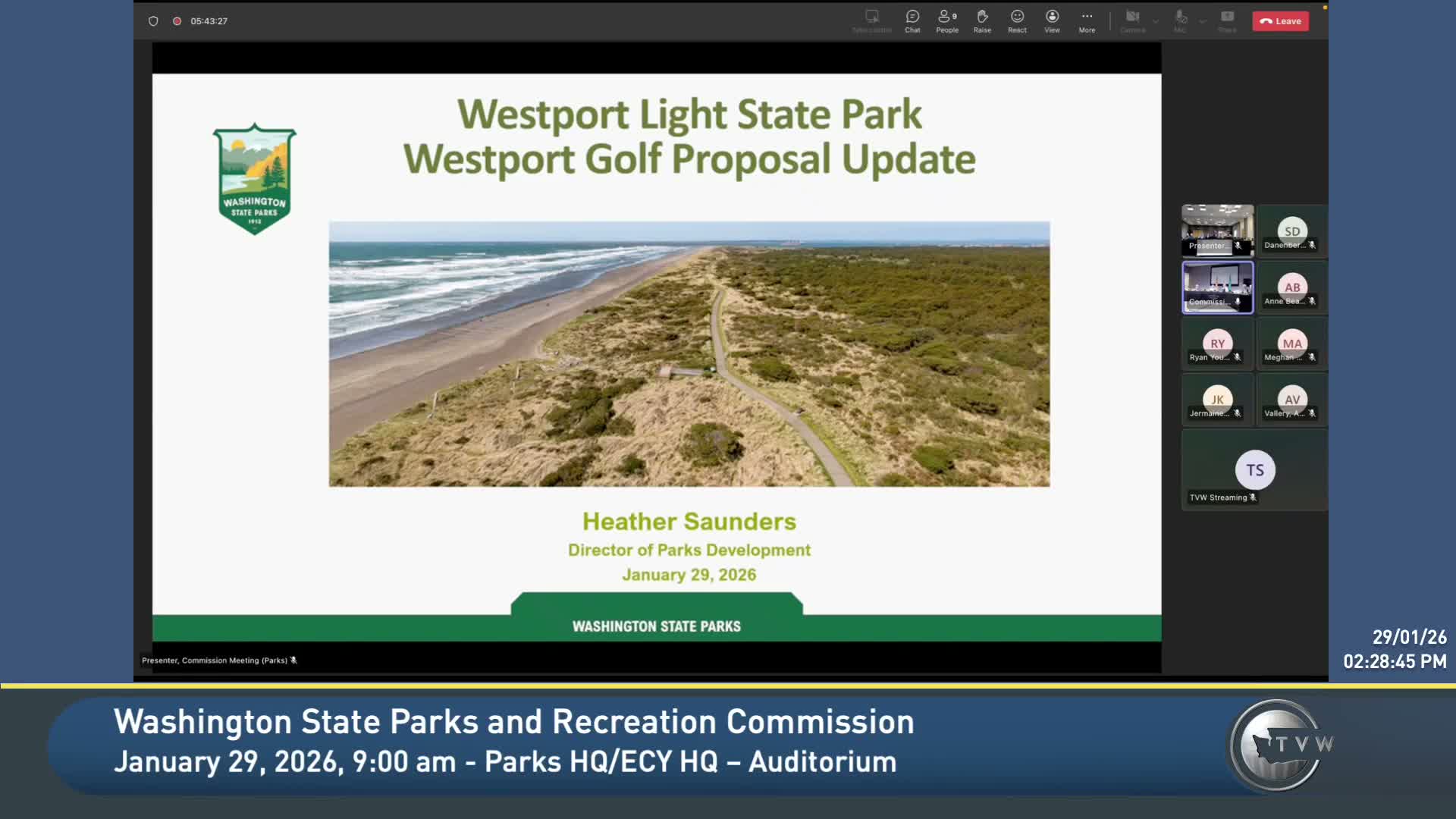
The Washington State Parks and Recreation Commission on Jan. 29 heard a lengthy informational update on the Westport Golf Links proposal at Westport Light State Park, where developers and the city summarized the draft environmental impact statement (DEIS) comment responses, permitting path and mitigation proposals while dozens of residents and organizations offered mixed public comment.
The commission received legal and technical briefings. Assistant Attorney General Joe Pinesco summarized recent litigation: a court ruling on Nov. 21 found that a prior settlement and attendant permits tied to an earlier private golf proposal were no longer binding on the property after State Parks’ 2015 acquisition; that decision removed several foundational legal obstacles for consideration of a new proposal but left the city and developer as defendants in ongoing claims. Pinesco warned that permit-stage appeals (for example, Shorelines Hearings Board challenges) remain likely and can add months to years to any schedule.
The developer and the city described the project as a publicly accessible, privately financed ‘‘links’’-style golf course intended to expand trails, improve parking and safety, and fund ongoing stewardship. The proponent representative said “Free and open access is preserved and expanded,” and outlined a plan that centers public trails in the park and locates lodging and most parking off state land. The preferred EIS alternative under study would place an 18‑hole course and supporting features on roughly 142 acres of the 603‑acre park footprint; staff and the proponent said approximately 35 acres of interdunal wetlands would be affected and that the project’s mitigation plan would include on‑site creation/rehabilitation and additional off‑site restoration, plus long‑term monitoring.
Conservation and tribal stakeholders urged caution. Anna Valerie of Audubon Washington told the commission the DEIS “did not give decision makers the information needed to understand the true consequences” and urged a fuller analysis of habitat, invertebrate food webs and lower‑impact alternatives; Audubon and others warned that filling category‑1 interdunal wetlands is irreversible. Friends of Grays Harbor, Surfrider Foundation, the Quinault Indian Nation and other commenters raised concerns about water quality, impacts to shellfish resources, coastal erosion and the adequacy of mitigation proposals.
Supporters — including local business owners, economic‑development representatives and the PGA professional at Chambers Bay — said the plan would create sustained local jobs, youth programming and year‑round recreation. A number of Westport and Grays Harbor civic leaders described the project as a needed economic investment for a county with high unemployment and limited year‑round hospitality capacity.
Proponents presented financial assumptions and a phased investment plan; they said construction bonds and performance bonds would be used to guarantee work and that they propose to return a portion of gross revenues to the park (the proponent suggested a 5% contribution to a park fund for maintenance and stewardship). Commissioners asked for the developer’s full pro forma and more detail on assumptions driving revenue, staffing and timing.
Staff outlined next steps: the city of Westport intends to issue a final EIS in the spring and the proponent expects to pursue required permits, including shoreline and wetland approvals. Parks staff said it will review the final EIS and the developer’s pro forma, continue government‑to‑government tribal consultation, and evaluate whether any future request will be presented to the commission for land classification changes or concession‑delegation authority. The commission did not vote on the Westport proposal during the meeting; the session served as an informational update and public hearing opportunity.
What’s next: parks staff will review the draft final EIS and related technical materials with the developer and the city, continue tribal consultation, and return to the commission with additional analyses and any proposed decision items once permit and mitigation details are settled. The AG’s office advised commissioners that permit appeals could extend timelines substantially and that litigation risk will persist.