Get Full Government Meeting Transcripts, Videos, & Alerts Forever!
Get email alerts on the Governor Budget topic
No spam. Unsubscribe anytime.
Governor's supplemental budget would provide $19M bridge for ESD federal shortfall, agency says
Summary
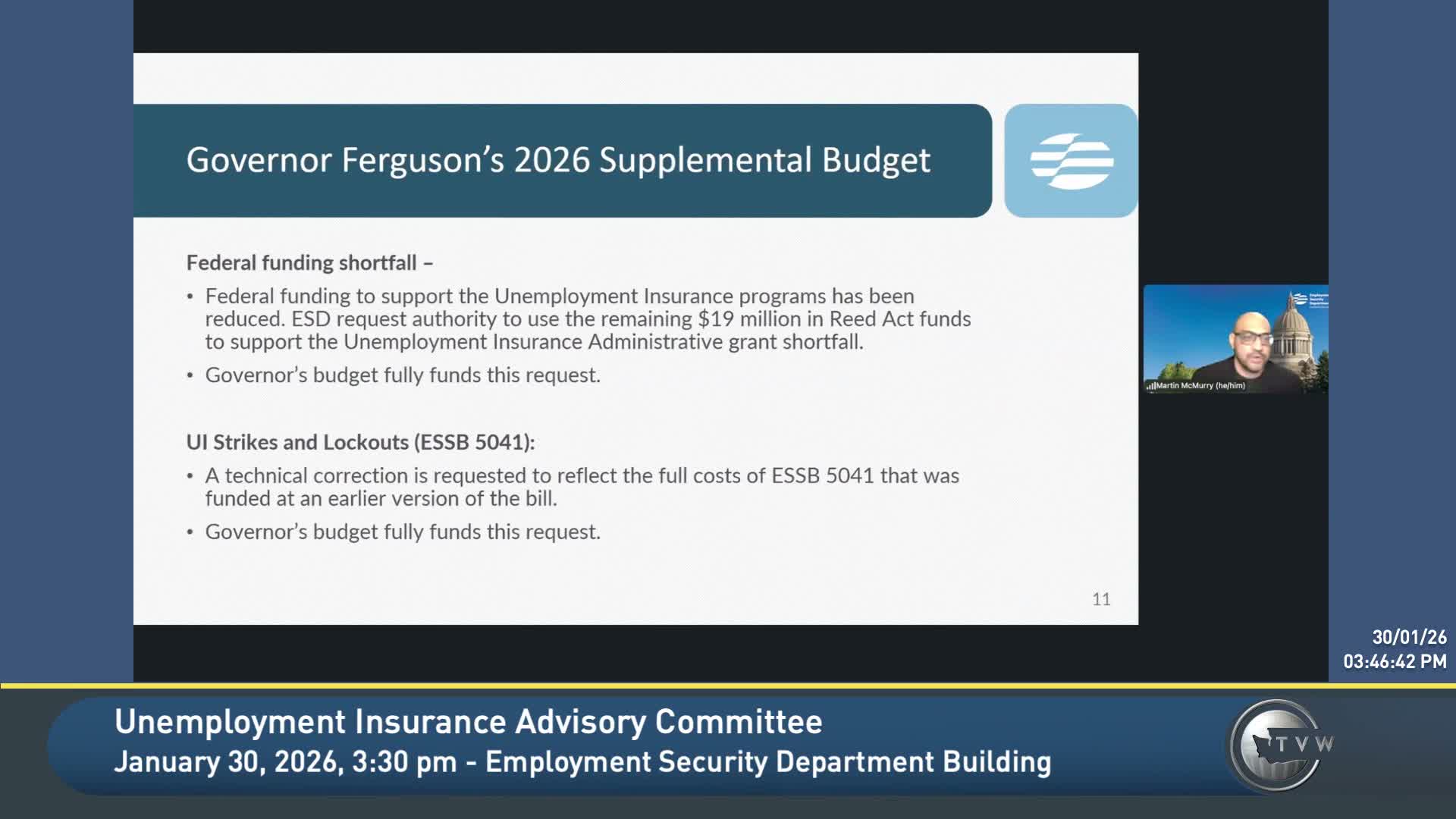
ESD officials told the UIAC the governor’s proposed 2026 supplemental budget includes a $19 million REDDAC allocation to cover a federal funds shortfall, a $14 million shift to workforce programming, and other fund swaps; OAH cost increases for appeals were incorporated into the shortfall package.
Martin McMurray, chief operating officer and interim CFO for the Employment Security Department, summarized the governor’s proposed supplemental budget and its impacts on the agency.
McMurray said the department is seeking the remaining $19,000,000 REDDAC allocation within its appropriation authority to bridge a federal funds shortfall and to allow the agency time to develop longer-term sustainability strategies for the base UI program. He emphasized the request is meant to maintain operations and is not for adding new staff.
He described fund transfers proposed in the governor’s package, including a $14,000,000 shift to a workforce program managed by the Department of Social and Health Services (DSHS). Under the proposal, an initial penalties-and-interest investment that had been $4,000,000 would move to an $18,000,000 investment for the remainder of the biennium in support of that workforce program. McMurray also identified a $2,000,000 fund shift from CPP to expand the Basic Food and Employment Training (BFET) program, which the Economic Services Administration and DSHS manage.
McMurray noted Office of Administrative Hearings (OAH) costs for Employment Insurance appeals increased central-services billings by roughly 17%; rather than propose state funds separately, the governor’s budget incorporates that cost into the federal funds shortfall decision package.
He also described a $2,000,000 color-of-money swap involving CPP and WIOA governor’s-reserve discretionary funds and a one-time additional investment described for the next fiscal year.
No formal committee action was taken on the budget summary during the meeting; McMurray concluded by yielding back for questions.