Get Full Government Meeting Transcripts, Videos, & Alerts Forever!
Get email alerts on the Legislation Signing topic
No spam. Unsubscribe anytime.
Governor signs a wide package of bills into law, including student-privacy and housing measures
Summary
At a public bill-signing event, the governor signed a large group of bills covering student privacy, gun-purchase permits, school transportation flexibility, health-care and labor protections, housing measures and specialty license plates; sponsors and advocates attended the ceremony.
The governor signed a package of bills into law at a public ceremony that brought together lawmakers, advocates and community members to mark passage of measures on student privacy, public safety, health care, housing and labor.
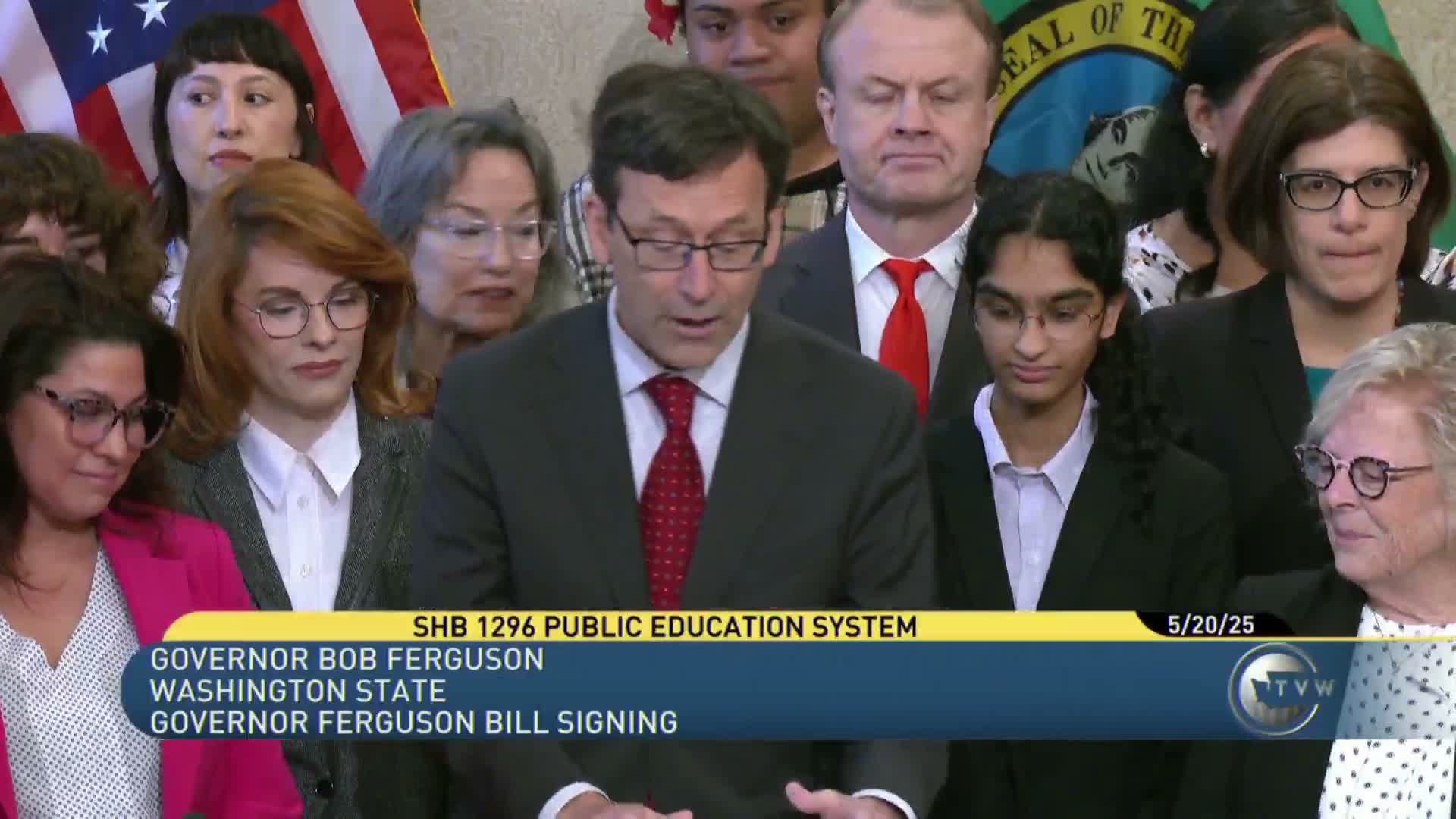
House Bill 12 96, described by the governor as protecting K–12 students’ safety and privacy, adds ethnicity, homelessness, immigration or citizenship status and neurodivergence to the state’s public-school nondiscrimination provisions and clarifies parent and guardian notice rules for health-care and counseling information. The law also directs the Office of the Superintendent of Public Instruction to establish a process to investigate complaints and require corrective action when districts fail to comply. "The top priority for our schools must be to ensure a safe learning environment where every student has the chance to thrive," the governor said during remarks introducing the bill.
Representative Liz Berry, the sponsor noted later in the program, stressed the bill’s long arc of advocacy. "This has been a 10 year effort in the making," she said, adding that the measure "will save lives" and that advocates and students in the room helped push it over the finish line.
Other bills signed at the event included measures that the governor and sponsors characterized as administrative updates or targeted reforms: House Bill 11 63 establishes a structured permit-to-purchase system to build on the state’s existing background-check framework for firearm purchases; House Bill 11 31 expands the clemency and pardons board from five to ten members and extends terms (the governor said a null-and-void clause remains because some funding components are not yet in place).
On transportation and education funding, Senate Bill 5009 lets districts use state funds for vehicles other than conventional school buses if those vehicles are safer or more cost-effective in particular settings. Senate Bill 5083 adjusts how the state reimburses hospitals for public-employee health plans and increases minimum reimbursement for primary care and behavioral health to encourage use of preventive services.
The governor also signed bills addressing family and workplace protections, including Senate Bill 5101, which extends protected leave and safety accommodations to workers who experience hate crimes, and Senate Bill 5217, which expands protections and reasonable accommodations for pregnant and postpartum workers and requires employers to provide paid breaks for pumping breast milk; the Department of Labor and Industries was named as the enforcement agency for that law, which takes effect Jan. 1, 2027.
Housing and consumer protections were also part of the signing package. Senate Bill 5471 authorizes middle-housing options (such as duplexes and cottage housing) in certain rural zones to increase rural housing opportunities, and Senate Bill 5587 requires more detailed housing-production data collection by income band to help track progress toward state goals. Senate Bill 5651 raises and indexes personal property protection exemptions for garnishment so thresholds increase with inflation.
Several health-sector and regulatory reforms were enacted: Senate Bill 5388 aligns regulatory expectations between the Department of Corrections and the Department of Health for substance-use-disorder services in prisons and sets a timetable for standards and inspections; Senate Bill 5579 limits public statements by health-care providers about contract terminations until 45 days before termination and directs the insurance commissioner to issue a standard notice template.
The ceremony also included lighter and commemorative moments: Senate Bill 5444, which creates a set of specialty license plates (including a pickleball plate) and pauses new plate creation until 2029, was signed in a segment that honored the late Senator Bill Ramos; the governor said she would give a pen to Ramos’s spouse, Sarah, as a memento.
The program featured repeated thanks to prime sponsors and companion sponsors — the governor handed signing pens to legislators and community champions, posed for multiple group photos, and invited attendees to a post-signing gathering. No formal roll-call votes or amendments were recorded at the event itself; the signings were ceremonial enactments of bills that had already passed the Legislature.
What happens next: the laws will take effect on the dates specified in each statute (where the transcript cited an effective date, such as Jan. 1, 2027 for portions of SB 5217, the article notes that date). Several items the governor mentioned still require follow-up work by agencies or budget action to implement specific provisions (the governor noted funding still needed for parts of House Bill 11 31).