Get Full Government Meeting Transcripts, Videos, & Alerts Forever!
Get email alerts on the Habitat Restoration topic
No spam. Unsubscribe anytime.
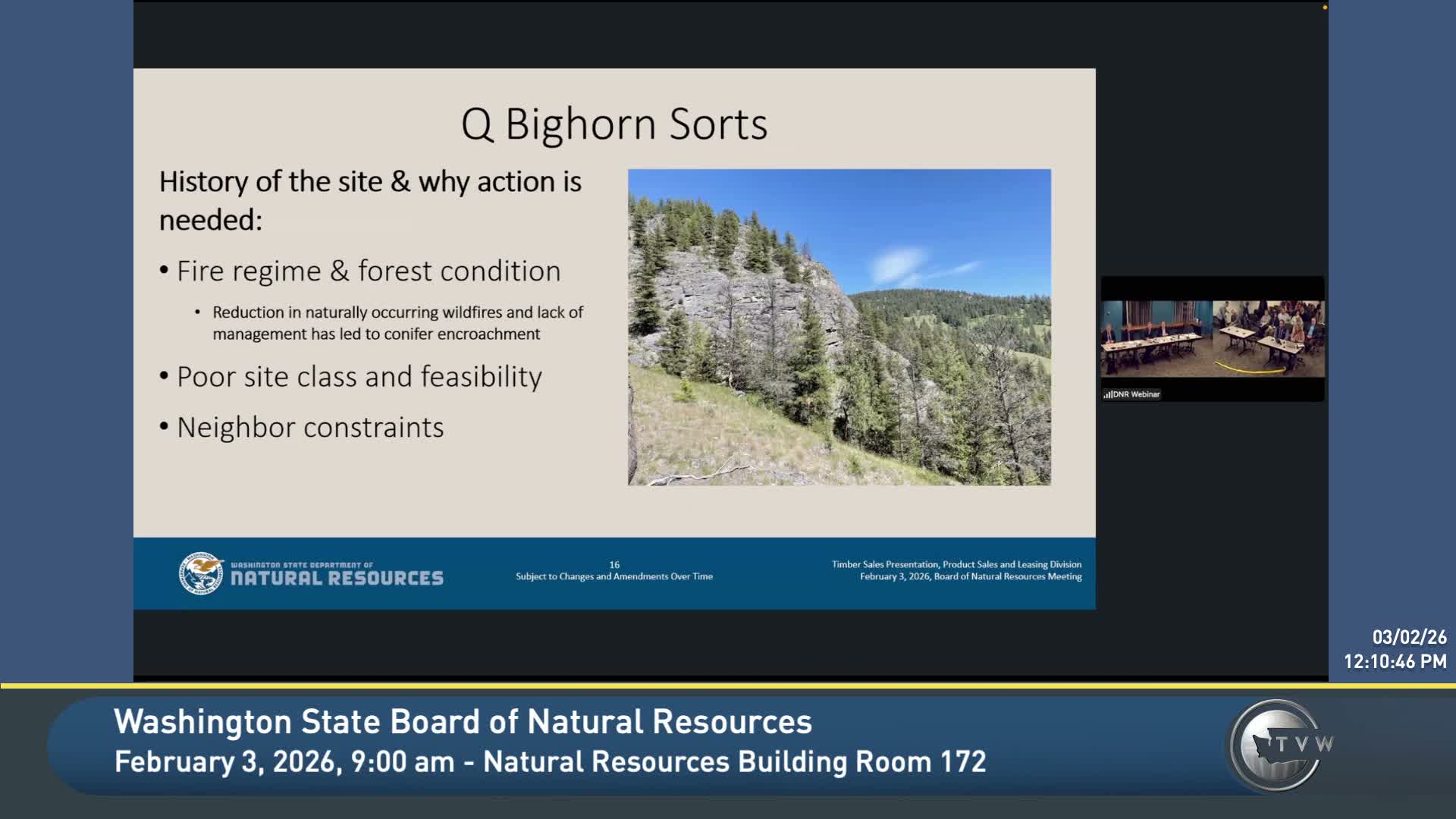
DNR previews Q Bighorn project to restore bighorn sheep habitat on Vulcan Mountain
Summary
DNR presented a habitat-restoration timber-sale concept for Vulcan Mountain that would convert selected stands to open habitat for bighorn sheep with partners including the Wild Sheep Foundation, WDFW and the Colville Tribes; partners committed up to $500,000 in support.
The Department of Natural Resources presented a preview of the Q Bighorn timber-sale project on Vulcan Mountain, a Northeast Region proposal focused on restoring historic open-forest conditions to benefit bighorn sheep and reduce wildfire risk.
Staff said the project area historically experienced frequent, low‑severity fires that created open forest dominated by ponderosa pine and fire-tolerant Douglas fir. Decades of fire suppression and limited management have allowed dense conifer encroachment on poor soils and steep terrain. Units planned for habitat restoration would retain legacy trees (approximately two live trees per acre on treatment units), not be replanted, and aim to create open habitat and improved sight lines for bighorn sheep while reducing predator concealment.
Amanda Taylor noted that the Wild Sheep Foundation has committed up to $500,000 to support implementation, and that partners include the Confederated Tribes of the Colville Reservation and the Washington Department of Fish and Wildlife. Staff said the project relies on atypical silviculture (no replanting on some units) and alternative reforestation requirements to achieve wildlife outcomes; Unit 3 is planned for timber production and replanting with ponderosa pine and western larch.
What it means: The proposal demonstrates how timber-sale tools can be used for habitat restoration when traditional timber economics render active management infeasible. Partner funding and one‑time treatments can make the project viable while achieving conservation and fire‑resilience goals.
Next steps: The project will continue regional planning and partnership formation; it is not included in the current board approval packet and will come forward for action if and when staff complete the required analyses and permitting.