Get Full Government Meeting Transcripts, Videos, & Alerts Forever!
Get email alerts on the Economic Forecast topic
No spam. Unsubscribe anytime.
Forecast council: modest economic gains and $175 million revenue uptick; tariffs remain key risk
Summary
The Economic and Revenue Forecast Council heard a February economic forecast showing modest GDP and employment improvements and roughly $175 million in revenue collections above the November outlook; the director warned a pending Supreme Court ruling on tariffs could create near-term uncertainty.
The Economic and Revenue Forecast Council received a February economic forecast on Feb. 3 that showed modest improvements in GDP and personal income alongside revenue collections about $175,000,000 higher than the council projected in November.
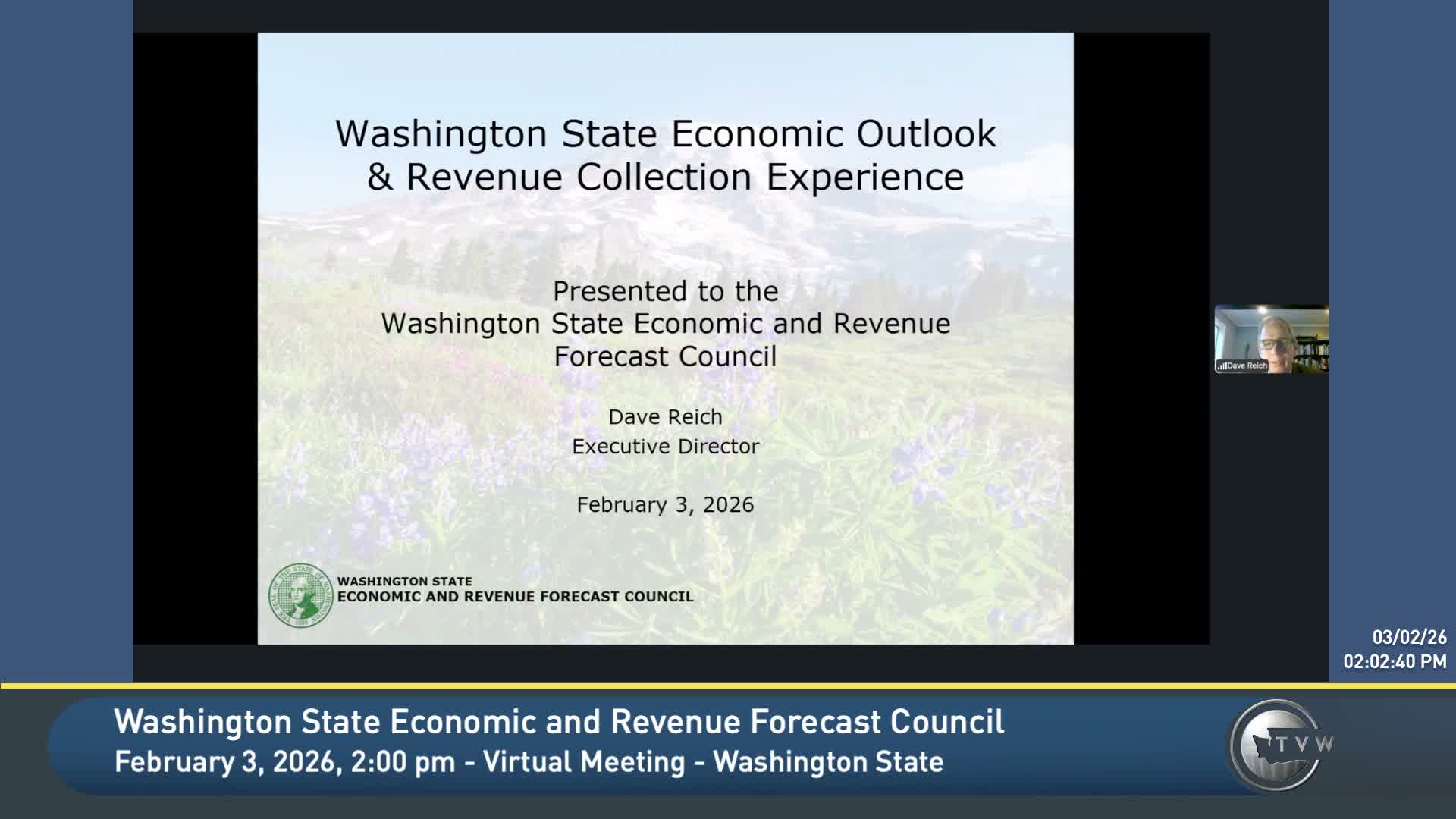
“For the record, Dave Wright, the executive director of the Economic Revenue Forecast Council,” Wright said as he opened the presentation, adding, “Overall, I think it's slightly good news.” He told members the higher revenue performance is already visible in current collections and will feed into the council’s revenue models ahead of the mid‑February update.
Wright listed the council’s headline point forecasts for 2026: U.S. GDP growth of about 2.1%, a U.S. unemployment rate near 4.7%, Washington employment growth around 0.4%, Seattle inflation roughly 2.9%, and personal income growth near 5%. He said taxable sales remain below long‑run averages but that recent data and implementation of 2025 legislative changes have raised collections.
The presentation tied roughly $175 million of the positive variance to both earlier‑than‑expected implementation of tax changes and transient activity such as tariff‑related purchasing. “We're up about $175,000,000 from where we thought we'd be,” Wright said.
Wright emphasized policy risks. He warned that a pending Supreme Court decision on tariffs could invalidate tariffs put in place last year, adding that the removal or replacement of tariffs would produce uncertainty and could require a refund policy. “That's probably the biggest… thing hanging over,” he said, describing tariffs and ensuing trade policy changes as the primary economic risk the council is monitoring.
On labor markets, Wright described a continued pattern of modest hiring and historically low unemployment, calling the labor market a “no hire, no fire economy” in which slower labor force growth limits upward pressure on the unemployment rate. He noted employment gains in 2025 were concentrated in state and local government and health and social assistance, while construction employment is forecast to contract further.
Wright also reviewed regional indicators: Case‑Shiller readings showed a slight dip in Seattle home prices year‑over‑year (about 0.1% in November), exports were up almost 8% year‑over‑year through October largely due to transportation equipment, and the council extended its forecast horizon to 2031 for the upcoming biennium.
During questions, Representative Orcutt asked whether the reported 2.2% decline in construction was split between public and private projects. Wright replied the data are not available in a public/private split, saying available categories are by sector (heavy/commercial/residential) and do not directly answer that question. Senator Trudeau asked how the personal income figures reflect lower‑income earners; Wright said state personal income is reported in aggregate and suggested national studies for distributional detail.
An online question from Jerry Cornfield of The Washington Standard asked how the $175 million variance factors into supplemental‑budget planning. Representative Ormsby called the variance “a little bit of a relief” but said it was unlikely to materially change the underlying budget problem statement until the official forecast is released.
The council was told the next monthly revenue report will be released Feb. 13 and the official updated revenue forecast will be delivered in person on Feb. 16. With that schedule set, the chair adjourned the meeting.