Get Full Government Meeting Transcripts, Videos, & Alerts Forever!
Get email alerts on the Marine Vegetation topic
No spam. Unsubscribe anytime.
New marine vegetation implementation strategy outlines 11 top research needs for kelp and eelgrass
Summary
The Habitat Strategic Initiative Lead team presented a new marine vegetation implementation strategy that prioritizes long-term status-and-trends monitoring, stressor-response studies, ecosystem-services valuation and restoration-effectiveness research; the panel discussed tribal and community-science integration and next steps for funding targeted research.
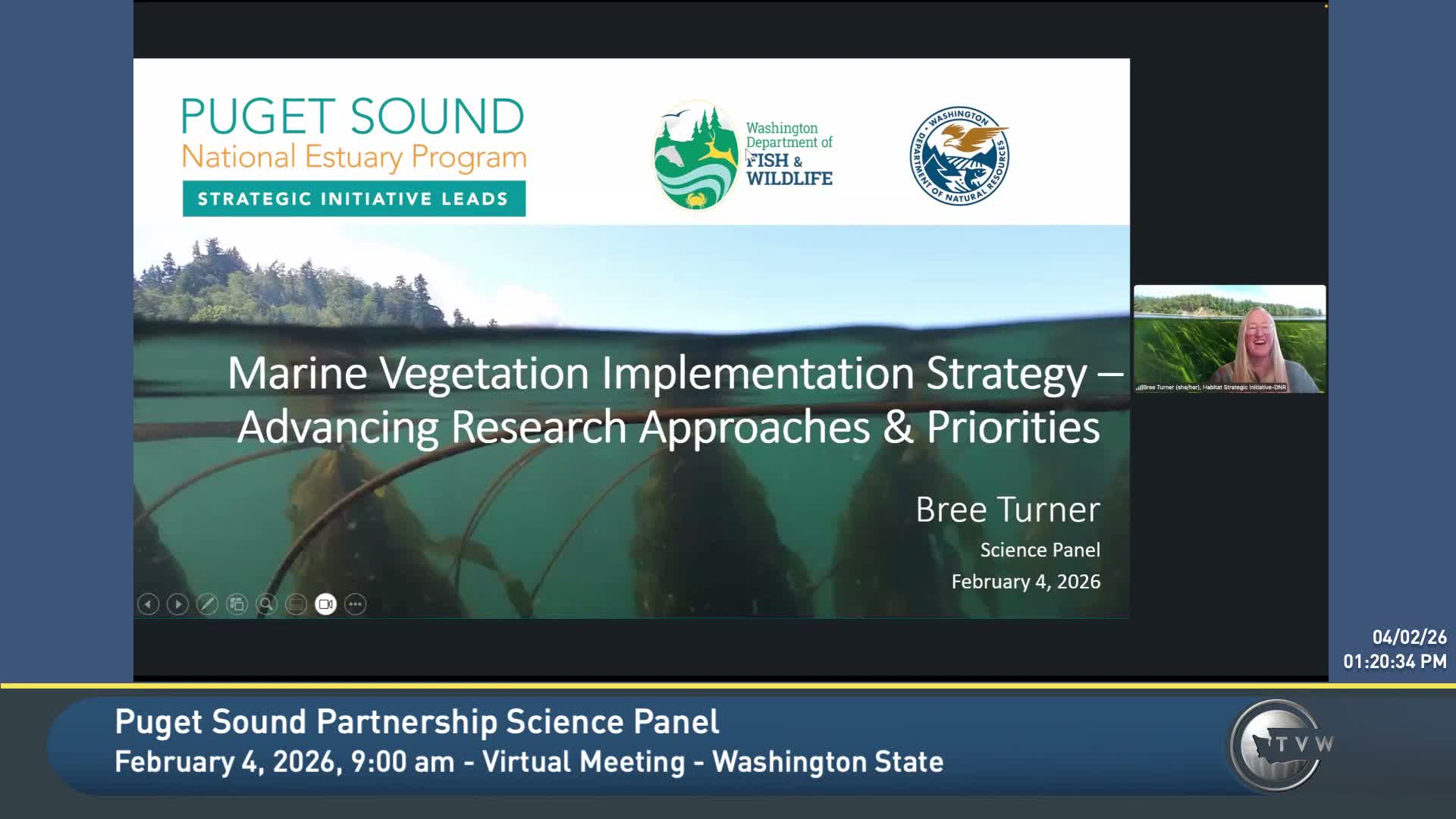
The Habitat Strategic Initiative Lead team presented a finalized implementation strategy for Puget Sound marine vegetation and asked the science panel to help identify how to advance the strategy's research priorities.
Brie Turner (marine vegetation implementation strategy lead) summarized long-term monitoring that shows site-level variability and some sustained declines in eelgrass and floating kelp at local scales. "We have 59 research needs that we winnowed and prioritized into a top 11," Turner said, describing a voting process and an appendix of prioritized research questions.
The strategy's highest-priority research buckets include stressor-response studies (teasing apart human activities and environmental drivers that most affect kelp and eelgrass at local and regional scales), long-term status-and-trends monitoring (including historical baseline reconstruction and incorporation of traditional ecological knowledge), ecosystem services valuation, restoration-effectiveness studies, policy-effectiveness analysis, and improved understory-kelp research. Turner highlighted projects already funded by HSIL: DNR's historical aerial-image analysis to fill baseline data gaps, reef/community diver monitoring expansions, regional eelgrass mapping in Neah Bay led by Makah Indian Nation, and pilot approaches for scaled eelgrass restoration.
Panel discussion emphasized two recurring themes: (1) how to integrate tribal science and traditional ecological knowledge, and (2) how to design monitoring and synthesis methods that feed directly into management. Multiple panelists and presenters noted that tribal needs and capacities vary across sovereign nations; several speakers urged HSIL to prioritize trusted partners and flexible support that respects different data-sharing preferences. The panel also recommended clearer communication plans to package research outputs for county shoreline programs and restoration implementers.
Next steps: HSIL expects to finalize the implementation strategy in March, proceed with planned subawards and workshops, and return with opportunities for the science panel to help scope targeted studies and pilot projects that address the top research needs.