Caseload Forecast Council adopts February forecast; projects rises in higher education and long-term care
Loading...
Summary
The Caseload Forecast Council unanimously adopted its February forecast, with staff reporting modest declines in some K–12 measures and notable increases in higher education enrollment, community-based/long-term care demand and a projected rise in violator caseloads tied to a Department of Corrections policy change.
The Caseload Forecast Council voted to adopt its February forecast after staff presented updated projections across K–12, higher education, corrections, public assistance, child welfare and medical assistance.
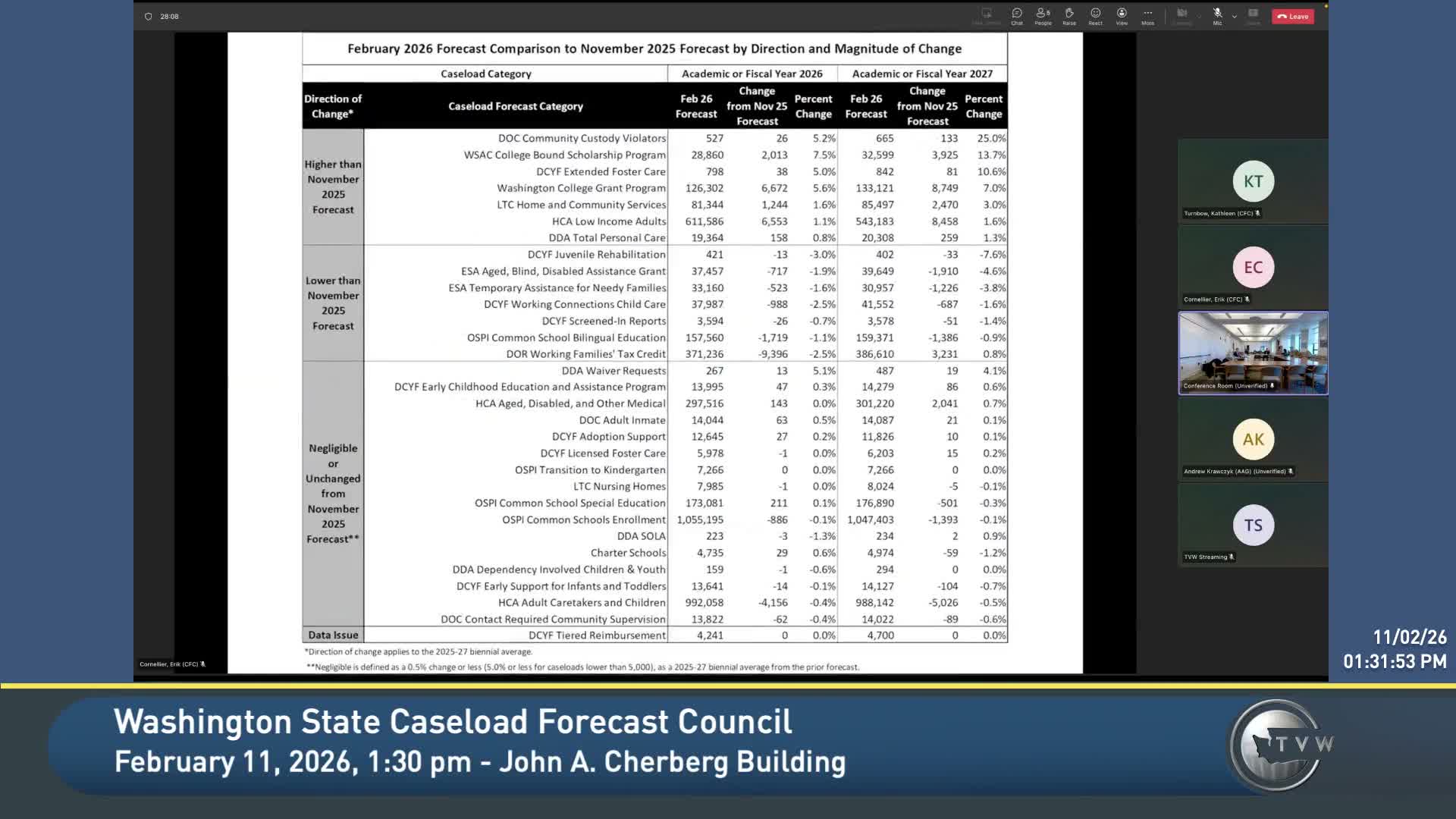
Eric Cornelia, executive director of Caseload Forecast Council staff, summarized the package as “17 that are negligible or unchanged, and then 7 that are up and 7 that are down,” and said two broad themes stood out: higher education trending up and increases in community-based services, long-term care and developmental disabilities.
Education: Paula Moore, who staffs the education portfolio, said common schools enrollment for February is about 0.1% lower than the November forecast and attributed the pattern to demographic shifts — “fewer kids enter kindergarten and first grade while we have larger cohorts graduating” — linked to lower birth rates. Moore said special education is expected to grow faster than general K–12, projecting roughly 3–3.5% growth over the biennium. She also reported a 10.7% increase in College Bound enrollment since November and a 6.3% rise in the Washington College Grant forecast, driven in part by recent changes to federal financial-aid calculations and program eligibility.
Corrections: Alex Gee, a criminal-justice forecaster, told the council the juvenile rehabilitation caseload is forecast about 23 cases (5.3%) lower than November for the 2025–27 biennium. By contrast, the forecast for violator caseloads is substantially higher — about 15.4% above November for the same biennium — primarily because the model includes a step accounting for the Department of Corrections’ decision to restore a 30-day maximum confinement policy for high-level violations; Gee said that change is projected to add an average of about 152 cases per month from January 2026 through the end of the biennium.
Public assistance and child-care programs: Webb Sprague, staff for the public assistance portfolio, said the Working Families Tax Credit forecast is 8% lower than November for the biennium even as actuals tracked above the prior forecast; he explained that the tax credit is reported annually, making month-to-month comparisons volatile, and cited outreach timing and filing-platform changes as influences. Sprague described TANF/WorkFirst as more uncertain: WorkFirst actuals fell 4.3% from October to December 2025, and staff used an averaging approach to reconcile possible backlog effects related to a federal shutdown. Eric Sundock said the Working Connections child-care caseload is about 2.1% lower than November, with recent policy changes to 12-month eligibility (SB 5752) affecting forecasts.
Medical and long-term care: Shudong Zhang said the low-income adult caseload is tracking roughly 0.6% above November and the February forecast is about 1.3% higher for the biennium; he cited cleared backlogs of eligibility reviews and enrollment patterns as factors. Zhang also reported home-and-community services caseloads have grown post-pandemic and are forecast higher, with risks characterized as high because the pace of growth is uncertain. Yolanda Shams, deputy director, presented the developmental disabilities total personal-care caseload, which she described as 1.1% higher than November.
ECAP capacity discussion: Members asked how quickly a hypothetical expansion (staff and members referenced an example figure of 10,000 slots) would be absorbed. Staff said the baseline forecast does not assume new funded slots until budget authorization and described a separate long-range courtesy forecast that estimates eligible children and assumed uptake rates.
Votes at a glance: - Adopt February forecast: Motion moved by the chair and seconded; approved by voice vote, recorded as aye responses in the transcript. Outcome: approved. - Approve Nov. 12, 2025 minutes: Motion moved by the chair and seconded; approved by voice vote. Outcome: approved.
The council set its next meeting for June 11, 2026, at 1:30 p.m. and adjourned.