
Research team describes data contracts, data governance work and examples of predictive analytics
Get AI-powered insights, summaries, and transcripts
Subscribe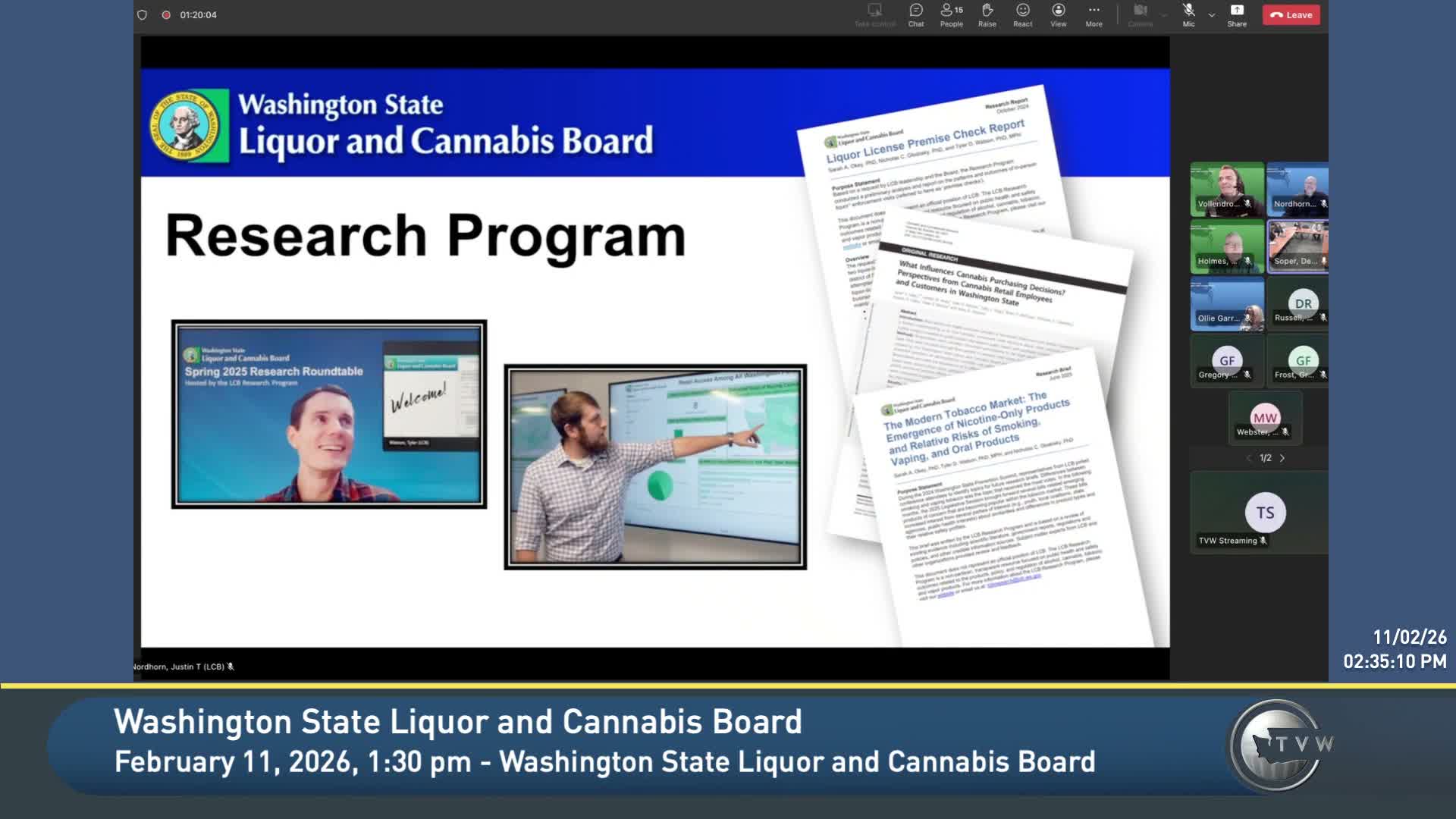
Summary
Research staff outlined building internal data governance, nine external data/use agreements (including the international cannabis policy study oversample), analytics projects (premise checks, budtender training survey, liquor tax elasticity, cannabinoid hyperemesis risk factors) and priorities for 2026–2027.
The research program told the executive management team it has been developing internal data governance while securing external data use agreements to expand analytic capacity.
Research staff said the program is nearly three years old and has focused on building policies and procedures while IT completes systems modernization. Justin is the executive sponsor of a new data governance committee; research is developing an agency‑wide data literacy assessment, a data dictionary, and a 2027 roadmap.
The team listed nine data or research contracts that are secured or pending: a data use agreement with the University of Waterloo to oversample Washington residents in the International Cannabis Policy Study; a data use agreement and collaboration with the University of Washington; interagency activity with Washington State University and the Cannabis Research Center; a Washington Poison Center agreement; and event‑level pilot projects with T Mobile Park, Bloomfield and Climate Pledge Arena to study alcohol product impacts.
Research presented analytic examples: a predictive analysis of 115,000 premise checks over eight years that identified higher noncompliance odds when multiple officers were present and in urban areas; a budtender training survey that found motivation driven by certification and agency endorsement; a liquor tax brief showing producer price index predicting revenue changes; and ongoing work on risk factors for cannabinoid hyperemesis syndrome led by a staff researcher named Nick.
The research team framed these efforts as a transition from descriptive/transactional analytics toward predictive and prescriptive analytics that can help the agency anticipate noncompliance and direct oversight resources more effectively. They asked board members which new insights would be most valuable in the next one to three years as capacity grows.