
Agency reports expanded tribal outreach, plans to update MOAs after fee changes
Get AI-powered insights, summaries, and transcripts
Subscribe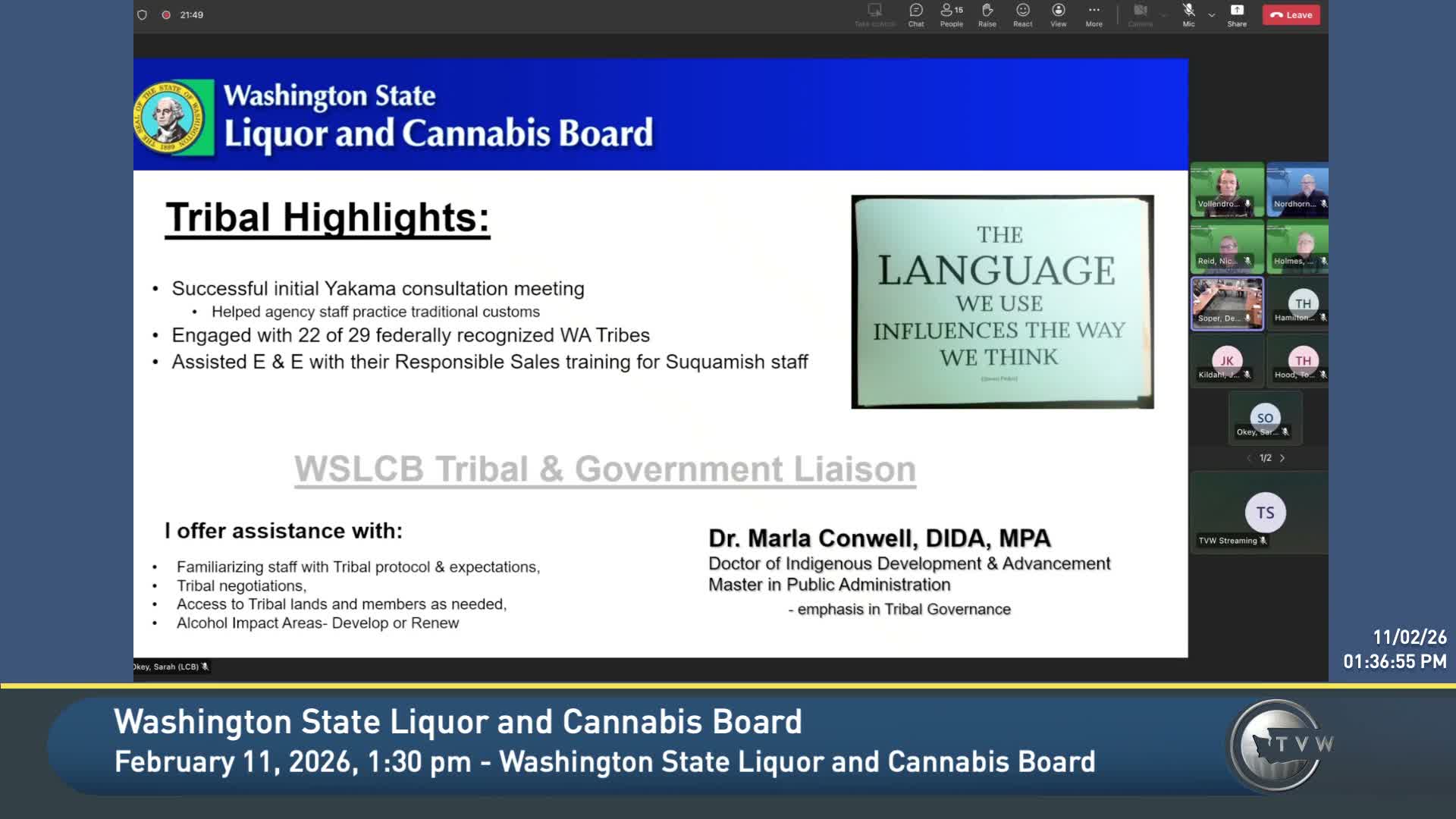
Summary
The Liquor and Cannabis Board reported in‑person tribal consultations, engagement with 22 of 29 federally recognized tribes, and plans to update MOA Exhibit A to reflect a legislative fee change (noted in the transcript as 07/27/2025) that can raise some tribes' annual fees substantially.
Dr. Marla Conwell, the agency's tribal and government liaison, told the executive management team the agency has increased direct engagement with tribes and recently completed one of its first in‑person consultations.
"We traveled to the reservation...and I met with the agency staff prior to the consultation," Conwell said, and described using tribal language at the meeting as an opening that helped participants feel heard. She said the agency engaged 22 of Washington's 29 federally recognized tribes in the past year and is pursuing further contacts and agreements.
Conwell flagged a records‑management problem: some tribes are listed in agency records as having current memoranda of agreement (MOAs) when they do not, while others that do have MOAs are not reflected correctly. She said the discrepancy has become more important since a legislative change to liquor privilege fees (recorded in the transcript as 07/27/2025).
To address the change, Conwell proposed updating MOAs to include an "Exhibit A" that lists fees by privilege and location, allowing enforcement and licensing staff to track fee liabilities and making increases transparent to tribes. She said that for some tribes with flat fees of about $2,000–$3,000, the new structure could increase annual payments "to over $9,000," and that the exhibit approach would make the basis for those increases clear.
On outreach, Conwell said she maintains a tribal leaders listserv and uses gov delivery emails and phone follow‑ups; she told board members she often forwards legislative and agency information with a greeting explaining how changes may affect tribal governments and inviting further questions.
Conwell also clarified legal limits: the agency can engage with non‑federally recognized tribes by email and conversation, but cannot form MOAs or compacts with them unless they are federally recognized. She said some tribes prefer to remain alcohol‑ and cannabis‑free by tribal decision or treaty and therefore do not seek compacts.
The chair and board members asked follow‑up questions about communication practices and how the agency will present fee changes; Conwell said she is developing an FAQ for internal and external SharePoint sites and will work with licensing and finance staff to ensure consistent messaging.
The agency did not propose a formal vote or action in this meeting; Conwell said updating MOAs and outreach processes are priorities for staff work going forward.