
State board declines Learn Everywhere credit for New Hampshire Energy Education after debate
Get AI-powered insights, summaries, and transcripts
Subscribe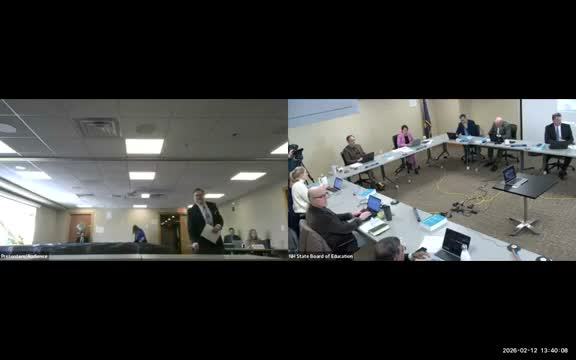
Summary
The board voted not to approve a Learn Everywhere application from New Hampshire Energy Education, after members raised concerns that the short retreat‑centered model and materials leaned toward advocacy, lacked balanced scientific depth for semester credit, and raised age‑appropriateness and vetting questions for external partners.
The State Board of Education voted against approving a Learn Everywhere application from New Hampshire Energy Education, concluding the submission did not demonstrate the neutral, semester‑level instruction required for high school credit.
Presenters described a year‑long, student‑driven project model built around a two‑day intensive retreat and ongoing mentor contact through the remainder of the school year. They said the program connects students to engineers and energy experts and supports teams as they plan and implement community projects ranging from compost systems to building energy audits.
Board members repeatedly questioned whether two intensive days plus periodic follow‑up produce the depth of content expected for credit, especially on complex engineering topics such as wind installations, grid design and trade‑off analysis. Several members said materials appeared to emphasize advocacy and campaign skills over balanced technical analysis. One member summarized the concern: "This appears to be teaching students how to construct and run campaigns based on a policy conclusion rather than guiding a balanced technical inquiry and accounting for trade‑offs."
Other concerns included whether the program would limit projects to the organization's energy policy perspective rather than enabling neutral student choice; how external mentors and partners would be vetted; and whether the learning sequence ensures that students acquire sufficient scientific grounding before public advocacy. Several board members suggested the group rework the curriculum to include stronger, documented science components and clearer year‑long instructional hours aligned to state standards. A motion to reject the initial application passed after discussion.
Presenters said they would refine the application, pointing to project examples and year‑long mentorship, and asked the department to consider revisions. The department invited them to resubmit with clarified content, stronger demonstration of balanced critical thinking and a clearer alignment of hours and assessment to semester credit standards.