
Fargo Board of Health backs resolution urging ban on flavored tobacco sales, stronger retail licensing
Get AI-powered insights, summaries, and transcripts
Sign Up Free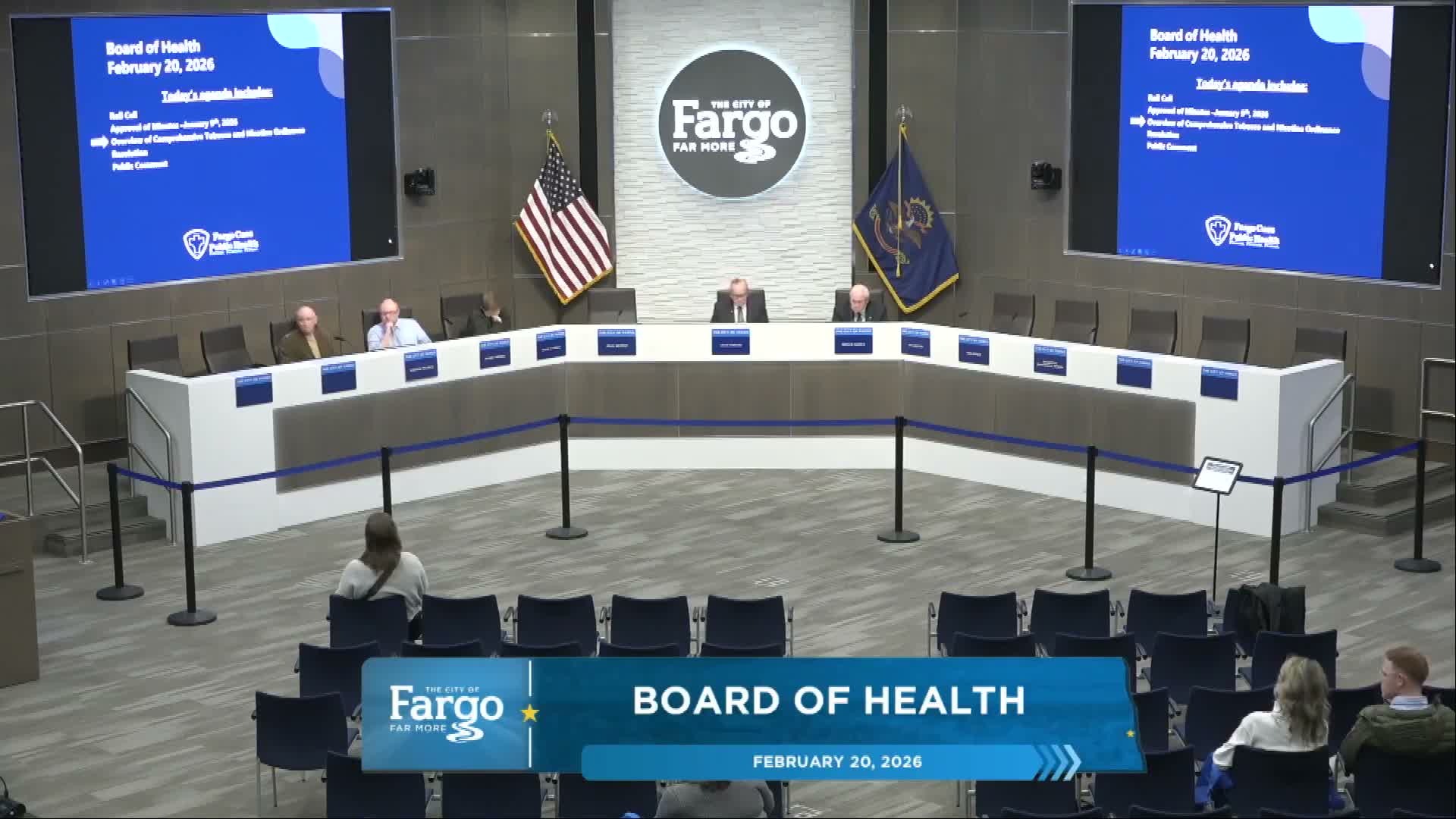
Summary
After presentations and public comment, the Fargo Cass Board of Health voted to recommend a draft ordinance that would create a local tobacco retailer license, require mandatory retailer education, strengthen penalties and end the sale of flavored tobacco and nicotine products to reduce youth vaping.
The Fargo Cass Board of Health voted on Feb. 20 to support a resolution recommending local action to reduce youth access to tobacco and nicotine products, including ending the sale of flavored products and strengthening local retailer licensing and enforcement.
The board’s action follows a presentation by Abby Lang, health promotion director at Fargo Cass Public Health, who walked members through a draft update to City of Fargo chapter 35 that expands definitions to cover modern nicotine products, proposes a local retailer license, mandatory retailer education and escalated penalties for violations. "Nicotine is the drug that is being delivered regardless of a vape, a hookah, a pouch," Lang said, arguing flavored and high-potency products increase youth initiation and addiction risk.
Lang told the board the draft would require a local retailer license aligned with the state annual term, allow local enforcement and enable quicker responses to complaints. She said Fargo currently has about 144 tobacco retailers and the proposal contemplates reducing the maximum number of licenses over time to about 65 (roughly one per 1,000 residents aged 21 and older), with existing licensees grandfathered and a phased implementation. The presentation included proposed administrative penalties (for example, a first violation remaining at $500 with a proposed probation period of 24 months, escalating to $2,000 fines and potential revocation for repeat offenses) and use of forensic ID scanners for repeat violators; Lang said scanners cost about $5,300 each and the department would seek grant support to provide devices at no cost when possible.
Board members and the public asked questions about enforcement, online sales and cross-jurisdiction impacts. Chair John Strand moved to place public comment before the resolution vote, and the board heard several speakers. Andrea Huiseth Zozel, associate professor of public health and president of the North Dakota Public Health Association, urged limiting flavored tobacco sales as an evidence-based step to reduce youth vaping. "Flavored tobacco products contribute to increased vaping for teens and young adults," she said.
Representatives from schools and public safety described operational impacts in Fargo classrooms. Fargo Public Schools Superintendent Corey Steiner said vaping disruptions are frequent and that vape sensors have recorded dozens of daily activations at high points this year; he urged action to protect students’ learning environments. Troy Nelson, a Fargo police officer and school resource officer, said flavored vapes have become a trend and a disruptive force in schools.
Small-business concerns were raised by local retailer Zach Johnson, owner of SportsVape, who said his shop has passed compliance checks for 12 years and warned that a flavor ban could shift demand online or to illicit sellers. "A flavor ban would not eliminate the demand. It would eliminate the responsible retailers in Fargo and shift it to online or to other illicit sellers," Johnson said, asking for enhanced enforcement against noncompliant online sellers rather than a ban that would close compliant businesses.
Lang responded that the presentation’s cited survey data (from the CDC Foundation and YRBS local statistics) show in-person sources remain prominent and that studies from states with flavor restrictions—such as California, New York and Massachusetts—have shown post‑restriction declines in youth use in those jurisdictions. She also said penalties for supplying minors would be addressed in a separate city ordinance. Mayor Bernie Dardis noted the cross-border implications for nearby West Fargo and said he would bring the topic to his city commission for consideration.
After discussion, board member Oliver Frenzel moved to support the resolution and Grant Severson seconded. A roll-call vote recorded 'aye' votes from Andrew McLean, Oliver Frenzel, Grant Severson, John Strand, Bernie Dardis and Valentina Aced. The resolution to recommend the proposed ordinance to the City Commission was adopted.
Jen Fall, director of Fargo Cass Public Health, told the board the next steps are that the proposal will appear as a receiving file with the Fargo City Commission on March 2, with a possible first reading on March 16 and a second reading on March 30; she cautioned that the item may be pulled from consent to regular agenda to give the public another opportunity to comment.
The board’s resolution cites national and state youth tobacco data and encourages local elected officials across Cass County to consider evidence-based policy strategies, including local retail licensing, ending flavored-product sales and strict enforcement of age-of-sale laws. The Board of Health will not itself enact the ordinance; its adopted resolution is a recommendation to the City Commission, which will take the next formal steps in March.