
Will County board splits on 53‑acre solar special‑use permit; variances for vegetation and monitoring approved
Get AI-powered insights, summaries, and transcripts
Sign Up Free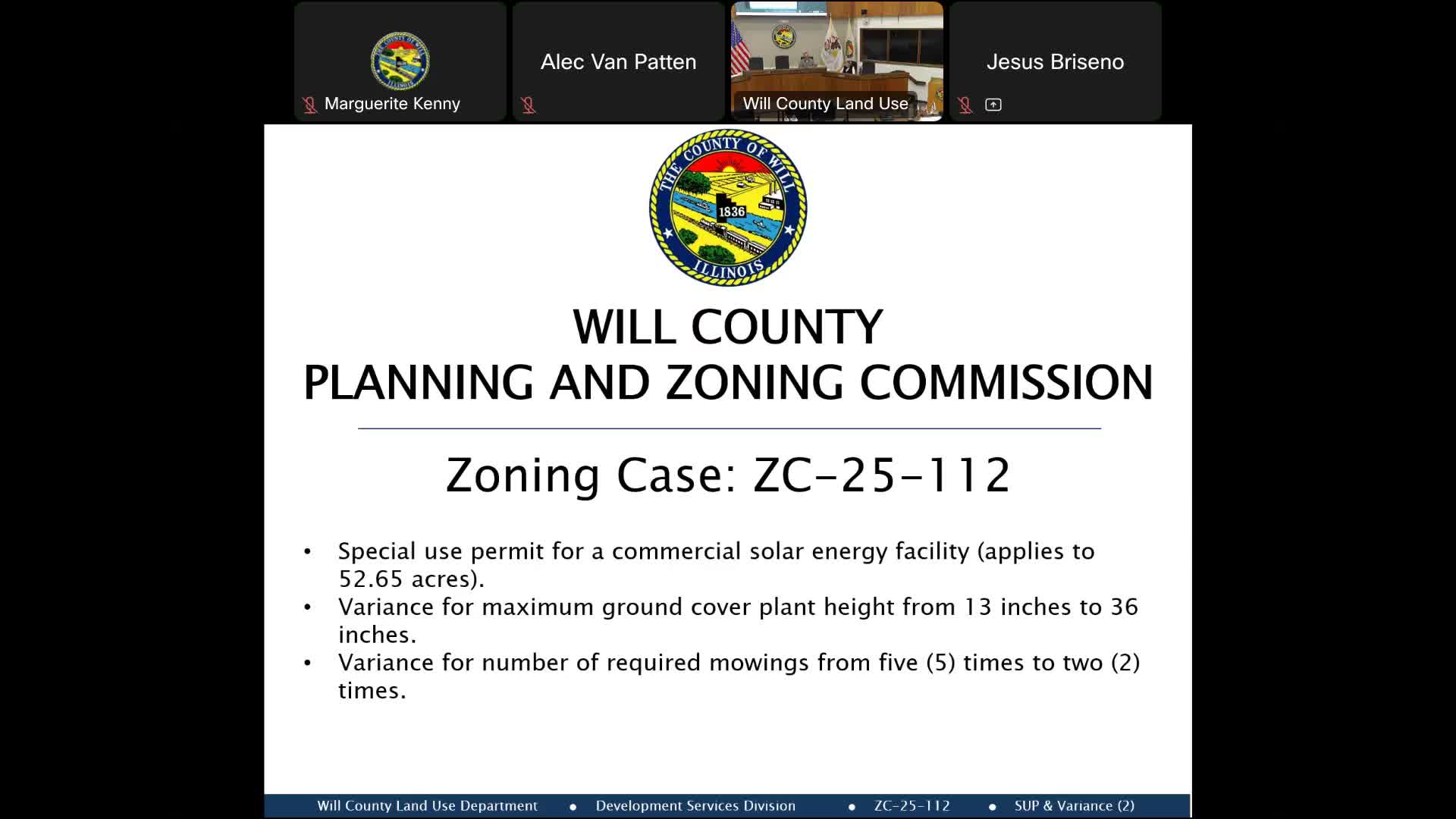
Summary
The Will County Zoning Board of Appeals on Feb. 17 split 2–2 on recommending a special‑use permit for a proposed ~5 MW, 53‑acre commercial solar facility at 5949 W Eagle Lake Road and forwarded the matter to the county board; separate variances for taller pollinator plantings and reduced monitoring passed 4–0.
The Will County Zoning Board of Appeals on Feb. 17 heard testimony and staff analysis on a proposed commercial solar project and split 2–2 on a recommendation for a special‑use permit, sending the matter to the county board for final action while approving two land‑management variances.
Staff presented zoning case ZC25112 seeking a special‑use permit for about 52.65–53 acres on the southern portion of a larger property previously permitted in 2025. Staff identified the owner as 'Helenea Stumbres Land Trust' with George Kwan listed as beneficiary and said the developer will require building permits plus approvals from the road and fire districts. The staff report referenced Will County zoning ordinance §155‑9.245, required a deconstruction (decommissioning) bond at permitting, and recommended approval of the special‑use permit and the two supporting variances.
Chad Jibazi of Synergy, who identified himself during the presentation, said the project would be about 5 megawatts with roughly 9,800 panels, take about six months to construct, and require two to three maintenance visits per year. Jibazi said the project participates in Illinois Shines community solar and can serve roughly 700 subscribers; he noted developer plans for a pollinator‑friendly seed mix, a $200,000 community donation set‑aside, and a property‑tax benefit estimated to flow about $20,000–$25,000 annually to local taxing districts for this size of project.
During public comment, Lester Batterman, a farmer who lives on the road where the project is proposed, said he opposed additional loss of farmland and expressed concern about long‑term maintenance and reliance on external funding. George Coyne, who identified himself as a property owner, supported the project and said the ground could improve under cover vegetation and that discounted power matters to local residents. The developer and staff said a decommissioning bond and conservation plan would be part of permitting and that the applicant will coordinate with the soil conservation district.
A motion to recommend approval of the special‑use permit was made and seconded, but roll call produced a 2–2 tie. The board recorded the tie and directed that the recommendation go forward to the Land Use Department and the County Board for final action. Separate roll‑call votes approved the variances for increasing allowed ground‑cover plant height (13 inches to 36 inches) and for a reduced monitoring frequency; those variances passed 4–0, allowing pollinator mixes that may grow taller than county default limits if permitted at the permitting stage.
Next procedural steps include staff coordination on required permits (building, road district, fire district), finalization of operations and maintenance and decommissioning plans at permitting, and consideration of the special‑use permit by the county board.