
Washington County planners outline state-driven housing mandates and local response
Get AI-powered insights, summaries, and transcripts
Subscribe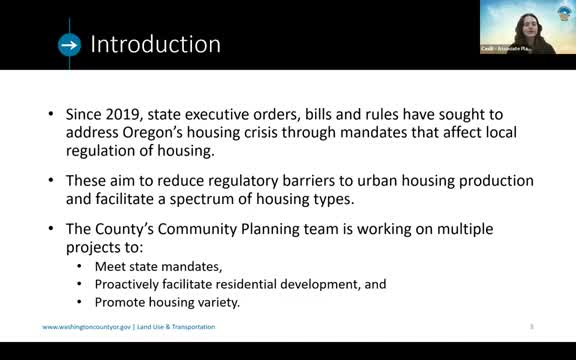
Summary
County planners told the Planning Commission that state laws since 2019 (including House Bill 2001, HB 2138 and SB 974) require changes to local rules and that the county will pursue a mix of code amendments, grant-funded promotions and consultant support to meet housing production and reporting deadlines.
Cassie Brown, an associate planner, told the Washington County Planning Commission on Feb. 18 that since 2019 the state has steadily expanded requirements meant to increase housing supply and streamline approvals. "In 2019, House Bill 2001 was adopted. This was a landmark bill that ... introduced middle housing as an outright allowed use on lots that permit a single detached unit," Brown said, summarizing the state direction that now also includes HB 2138 and SB 974.
The presentation framed the county's immediate tasks: collaborate with Metro to identify a 20‑year housing need, set production targets for a 6–8 year horizon, and prepare recurring analyses. Brown said the statewide 2026 housing model code provides a clear path to compliance and may supersede local standards where they block housing options.
Why it matters: the county must update local regulations and complete a housing capacity analysis due in 2029 and a housing production strategy due in 2030 to show progress on state targets. Anne Kelly, lead housing planner, said staff expects the first round of analysis to be a "really big lift" and likely to require consultant support and state funding.
County staff also described a state-funded promotional program intended to normalize "middle housing" types and inform residents about permitting and design. "It's really a highly marketing oriented product," Kelly said, noting the work will pair with internal communications to develop an implementation plan once consultant work is complete.
Funding and timing: Miss Johnson (director) told commissioners the county implemented a supplemental fee on building permits effective July 1 to support planning activities; the fee revenue is being held in reserve and may help implement code amendments if state grant funds are not available. Staff said they will prioritize tasks in light of available funding and intended to return with more detailed proposals at future work sessions.
Next steps: planners said they will continue outreach, participate in ONA/ONA-rulemaking advisory committees, and return with project‑level recommendations and timelines. The presentation closed with commissioners asking for more detail on outreach audiences and how consultant-resourced analyses will be funded.