Fairfax County presents plan for three new speed humps on western Fairway Drive; Task Force to ballot proposal
Loading...
Summary
FCDOT presented a traffic-calming proposal for the western portion of Fairway Drive that would add three speed humps after a traffic study recorded high speeds (1,400 vehicles/day; 80th-percentile 40 mph eastbound). The Task Force must decide whether to ballot the plan (241 properties; 121 yes votes required).
Fairfax County Department of Transportation staff on Thursday presented a proposed traffic-calming plan for the western portion of Fairway Drive that would add three speed humps with fire-and-rescue cutouts, after a 24-hour study showed high operating speeds on the roadway.
Ryan O'Carroll of the Fairfax County Department of Transportation said the study recorded about 1,400 vehicles in 24 hours and 80th-percentile speeds of 40 miles per hour eastbound and 34 miles per hour westbound — meeting the program's speed and volume criteria. "Traffic calming is the installation of physical devices to reduce vehicle speed," O'Carroll said, noting the county's five-step process from eligibility review to installation.
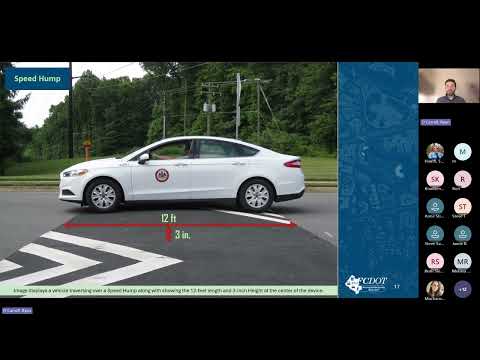
The draft plan calls for three additional vertical speed humps spaced to meet county and VDOT placement rules (minimum 300 feet between devices and 150 feet from intersections). The proposed humps would be about 12 feet long and 3 inches high, include fire-and-rescue cutouts, white chevrons, a double yellow center line and advisory 15 mph signage at each device.
Under the county's community-initiated ballot process, each occupied property in the ballot area will receive one ballot; the proposal area contains 241 occupied properties, and more than 50% of those properties must return a yes vote for the plan to move forward — a threshold of 121 yes votes, Task Force lead Steve Sarandos said. Ballot packages are distributed by the Task Force, returned directly to the District Supervisor's Office, and the ballot period will be open at least three weeks.
The presentation prompted a split reaction from residents. Several speakers supported the plan as a way to reduce dangerously high speeds near the ball field and pedestrian routes. "It has slowed down traffic," said one resident who lives on the east side and praised east-end humps installed earlier.
Other residents urged the Task Force and FCDOT to consider less-invasive or reversible alternatives before installing permanent humps. "Our cluster is almost universally against the idea of putting speed humps down," a nearby neighborhood representative said, and suggested measures such as painting a permanent centerline, installing solar speed-feedback signs, placing additional 25-mph speed limit signs, or targeted police enforcement. Residents also raised concerns that humps with cutouts can encourage center-tracking and that repeated braking and acceleration could slightly increase emissions and noise for nearby homes.
FCDOT and the Task Force responded that several alternatives are limited by outside authorities or availability. Staff said permanent centerlines and crosswalks require VDOT approval; in many locations VDOT requires ADA ramps and connecting sidewalks on both sides for a crosswalk to be approved, a constraint that has limited where crosswalks can be added. County police maintain a small number of portable radar-display units that rotate through neighborhoods for three- to four-week periods; permanent pole-mounted speed displays are not yet generally available. Staff also said state law currently limits where automated speed cameras may be used (generally to school or select work zones during arrival/departure periods).
On effectiveness, FCDOT and Task Force members cited a follow-up speed study on the east end, collected Nov. 20, 2024, that measured reductions of about 12 mph in the eastbound 80th-percentile speed and about 10 mph in the westbound 80th-percentile after humps were installed there. Staff said they saw a similar reduction near existing devices and expect vertical devices to reduce operating speed across the roadway length under consideration.
No formal action was taken at the meeting. The Task Force must reconvene to decide whether to proceed with the presented plan and the balloting process; if the Task Force votes to move forward, the plan will be submitted to the Fairfax County Board of Supervisors for endorsement and then to VDOT for final acceptance before the county schedules installation. Staff said the recording and slides will be shared with the Task Force and posted online; residents were given a county contact and phone numbers for follow up.
Next procedural steps: the Task Force will decide whether to move forward, prepare ballot materials if they do, and set a ballot schedule. If the plan is approved by the ballot (121 yes votes needed out of 241 occupied properties), the Board of Supervisors will be asked to endorse the plan and FCDOT will coordinate with VDOT and the Department of Public Works and Environmental Services to schedule installation.