
Committee hears wage-equity briefings; providers urge bigger, predictable pay increases and parity with city roles
Get AI-powered insights, summaries, and transcripts
Subscribe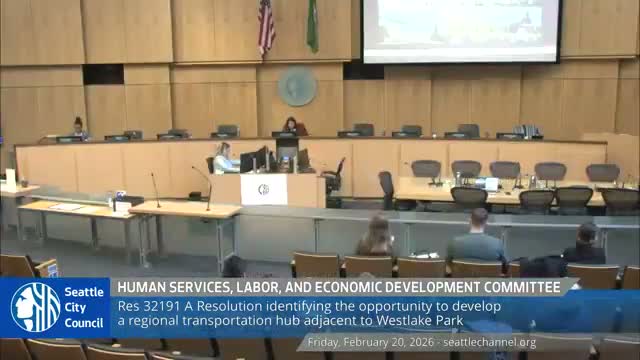
Summary
City staff and King County presented findings on human-services provider pay: HSD reported roughly $4.2M added to provider contracts in 2024 (a 2% increase) with a sample showing 75% of sampled positions received raises (average 8%); providers told the committee that modest, one-time increases are insufficient and asked for multiyear predictable funding and parity with comparable city positions.
The Human Services, Labor & Economic Development Committee spent the bulk of its Feb. 20 meeting on wage equity for human-services contracts, hearing briefings from City Council central staff, the Human Services Department (HSD), King County, and a panel of nonprofit providers.
Jennifer Lebrecht, City Council central staff, reviewed the legislative history tied to the University of Washington wage study and noted prior council actions, including a 2% provider-pay increase in the 2024 adopted budget and another 2% included in the 2026 budget. Lebrecht distinguished inflationary contract adjustments required by municipal code from discretionary wage-equity increases and cited the UW study recommendations that informed council discussion.
HSD staff presented findings from the department's 2024 provider-pay report. Owen Capis and Tanya Kim said HSD identified 244 contracts across 148 agencies that received provider-pay funds and that about $4,200,000 was added to those contracts in 2024 (a 2% increase from base contract levels on average). HSD used a sampling approach for deeper reporting: of the subsample surveyed, 455 positions were represented and 342 (75%) received a wage increase; agencies reported an average increase of 8% and most increases went to lower-paid positions. HSD also noted that many agencies used additional funding sources (fundraising, state, county, federal) in combination with city funds to increase pay.
King County Division Director Michael Bailey described the county's Veterans, Seniors and Human Services Levy workforce-stabilization strategy, which budgets approximately $57,000,000 for codesigned workforce investments over the levy cycle, and reported early, directional improvements in some provider vacancy and turnover measures after deployment of workforce stabilization funds.
Nonprofit providers who testified in a roundtable told the committee that the incremental 2% increases to date are meaningful in some cases but insufficient overall. Marissa Pres of the Seattle Human Services Coalition reiterated the UW finding that the sector faces a roughly 37% wage gap. Janice Taguchi of Neighborhood House gave a concrete parity example for case managers: Neighborhood House reported a range of $30.27–$42.81 for a city-funded program while a comparable city job was posted at $42.55–$50.42, which Taguchi characterized as roughly a "40.5% pay disparity" for that role. Karen Lee of Plymouth Housing and Liz Vivian of Aurora Commons emphasized that small increases help retention but that organizations also need funding for benefits, administrative capacity, and predictable multiyear support to sustain permanent raises.
Committee members pressed staff on methods and on measuring impact for subcontractors; HSD said it used a sample-based survey for deeper questions and that staff can incorporate subcontractor reporting in future work. Vice Chair Foster and other members highlighted the human-costs of turnover and the need for coordinated action among city, county and philanthropic funders.
The committee did not take formal legislative action on wage-equity measures during this meeting. Chair Alexis Mercedes Rink closed by saying the discussion made clear "we have some work to do on the city side" and that the committee will continue the conversation during the budget season and future meetings.
Notes on numbers and data: the UW wage study and HSD/King County analyses were presented in the meeting; HSD provided sample methodology details and appendices referenced in the report. Where transcript phrasing or numeric formatting was garbled in the record, the article reports figures as presented by staff or panelists and flags when the committee sought clarifications.