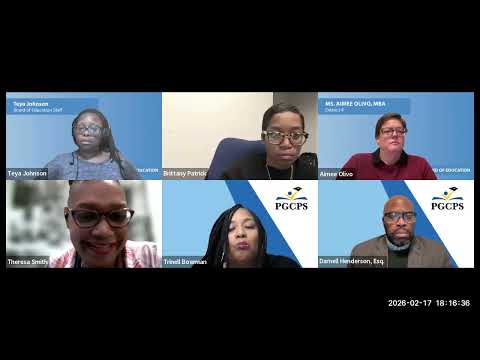
PGCPS general counsel cites staffing, reorganization and new tracking as steps to reduce staff ADA accommodation delays
Loading...
Summary
At a Feb. 17 Disability Issues Advisory Board meeting, PGCPS general counsel Darnell Henderson acknowledged delays in processing staff ADA accommodation requests, outlined a 28.64‑day average processing figure for a recent period, and described staffing and procedural changes — including moving the equity assurance office to HR and creating a director role — intended to speed responses.
At a Feb. 17 meeting of the Disability Issues Advisory Board, Prince George’s County Public Schools general counsel Darnell Henderson addressed a board member’s Maryland Public Information Act request that identified 271 staff ADA accommodation requests submitted between Jan. 3, 2023, and Nov. 26, 2024.
The MPIA-derived case list, presented to the board by member Miss Patrick, indicated extended delays between request submission and issuance of determination letters “often rang[ing] from 2 to 6 months,” with some cases “approaching or exceeding 1 year,” she said. “According to the records provided, that case list reflects 271 accommodation requests,” Patrick told the board.
Henderson said the records presented an incomplete picture of recent changes. He told members his office has implemented a tracking system and used outside partners while rebuilding capacity, and reported that "from 08/08/2025 to 01/21/2026, the average processing time is 28.64 days." He added that the accommodations under discussion are for staff, not students, and that student IEP and 504 processes remain separate.
Henderson acknowledged historic understaffing in the Office of Equity Assurance and said the district is recruiting more senior staff and creating a new director of fair practices position to oversee the unit. “We are currently in the process of hiring. We’ve had first round interviews finished last week,” he said, adding the district is working with the divisions of human resources and finance to “right size” the office.
On procedures, Henderson said PGCPS is updating Administrative Procedure 41‑72 to simplify forms and reduce unnecessary annual reauthorization requirements for permanent conditions. “For individuals who have permanent disabilities, not having them have to reapply every year” is a goal, he said, noting the current AP forms can be five or six pages and cumbersome.
Board members asked how the district prioritizes cases. Henderson said safety concerns—such as a high‑risk pregnancy—can move a request ahead of others rather than strict first‑in, first‑out processing. On data transparency, he said the district is collecting data to determine appropriate staffing levels and effectiveness but that he has not yet discussed public dashboards with the superintendent.
The board’s MPIA request also sought an annual equity assurance report required by AP 41‑72. Patrick said PGCPS responded that no such annual report was requested from an equity assurance officer for 2023 or 2024 and that “no responsive records exist” for the required cost information; the district instead provided the redacted case list and training inventories.
Henderson invited further review and follow‑up and thanked Patrick for raising the issue. Next steps identified in the discussion include finishing recruitment for equity assurance staff, updating AP 41‑72 to reduce administrative burden, and continuing use of a case‑tracking system to measure progress.