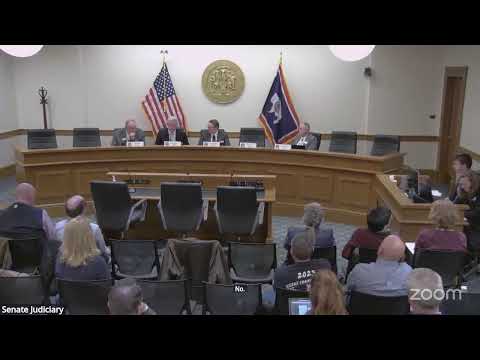
Senate Judiciary backs bill to require voter approval for stormwater taxes amid municipal objections
Loading...
Summary
Senate File 116 was reported favorably after committee debate; sponsors say the bill clarifies that fees tied to surface‑water projects that function as taxes require voter approval, while municipal representatives warned it could destabilize longstanding fee-based programs.
The Senate Judiciary Committee recommended Senate File 116 for passage after a contentious hearing in which proponents urged clarity that fees for surface-water projects that amount to taxes must go before voters, and municipal associations warned the change would produce legal and funding uncertainty for many Wyoming cities.
Sponsor Senator Crum told the committee the bill is a clarification of existing statute and cited provisions in title 15 and title 16 of Wyoming law to show the statutes must be read together. He argued the current law requires voter approval when a fee is effectively a tax or when a city imposes charges that function as a financing mechanism for a surface-water utility.
Pat Crank, representing the University of Wyoming, told the committee the university has filed suit challenging Laramie’s ordinance and said "if a city or county tries to impose a fee to manage surface water, they have to hold an election," citing a long-standing statutory reading. Proponents noted examples of potentially large master plans (the Laramie master plan figure cited in testimony was $130,000,000 as a total master-plan cost) and that some municipalities had recently reduced or suspended fees in response to public concern.
Opponents included Ashley Harp Schreed of the Wyoming Association of Municipalities and several municipal leaders who said many towns have successfully used service-fee financing under Title 15 for decades (Evanston cited operating since 1982) and warned that a blanket statutory change would impose retroactive uncertainty and could shift costs onto property tax bases or reduce system revenue for maintenance. WAM offered a proposed amendment—filed during the hearing—to limit the bill’s reach so it would not affect revenue obligations payable solely from system revenues, intergovernmental grants or state loan programs.
Committee members acknowledged ambiguity in current statutory language, discussed whether a fee trigger should be a small amount or a large capital project and recommended an interim study to examine statutory interaction in greater detail. The committee then moved and seconded the bill and recorded a roll-call vote of five ayes; the bill was reported favorably.
Next steps: the bill advances to the Senate floor; the committee also recommended an interim study on the statutes’ interaction and the trigger for voter approval.