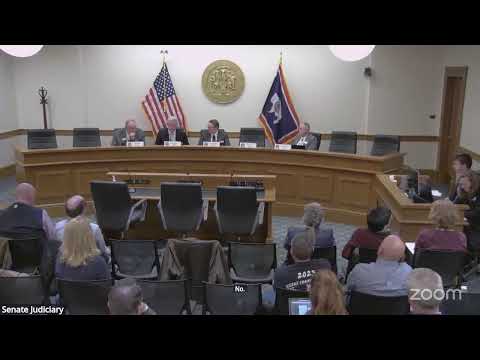
Senate Judiciary advances bill to formalize prescriptive easements for rural electric lines
Get AI-powered insights, summaries, and transcripts
SubscribeSummary
The Senate Judiciary Committee reported Senate File 99 favorably after stakeholders and utilities agreed to language allowing prescriptive easements for long-standing, visible electricity delivery lines while preserving landowner rights; the bill passed the committee 5–0.
The Senate Judiciary Committee on the final committee day voted to advance Senate File 99, a measure that would create a narrow statutory path for prescriptive easements on long-standing electricity delivery facilities, saying it would help rural utilities maintain safety and reliability while protecting landowner rights.
Sponsor Senator Cooper introduced the bill and turned the floor to Sean Taylor, executive director of the Wyoming Rural Electric Association, who told the committee the measure is intended to ‘‘clean up these old handshake deals’’ by giving utilities defined authority to maintain, repair and, in some limited cases, rephase existing lines that are visible and in continuous use. ‘‘We got everybody that was involved… rewriting of the bill,’’ Taylor said, describing a year-long stakeholder process that included co-ops, investor-owned utilities and agricultural groups.
Mandy Goode, counsel for WREA, walked the committee through the bill’s core limits. The proposed easement would be nonexclusive, apply only where a delivery system is visible and continuously used and would not apply to facilities placed after 01/01/2006, as written in the draft. The bill defines the easement footprint as 30 feet in each direction (60 feet total) and provides that utilities lose prescriptive rights after three years of abandonment. Goode said those constraints were crafted so ‘‘we're giving priority to agreements with the landowners where we possibly can.’'
Committee members pressed on the practical limits of the 30-foot band if utilities need to install taller poles or bring larger equipment. Senator Hicks asked whether heavier rebuilds would exceed the statutory corridor; Taylor and Goode replied that stakeholders agreed 30 feet was their working limit and any expansion beyond that would require a separate written easement negotiated with the landowner.
Public testimony was uniformly supportive. Brett Moline of the Wyoming Farm Bureau Federation, Jim McGavin of the Wyoming Stockgrowers Association and representatives from Lower Valley Energy, Basin Electric and Tri-State Generation & Transmission said the bill resulted from an inclusive process and urged the committee to move it forward so utilities can safely maintain aging infrastructure.
The committee moved and the clerk recorded a roll-call vote on Senate File 99. Senators Crago, Crump, Hicks, Cooper and Chairman Olsen recorded aye votes and the bill was recommended to pass out of committee, 5–0.
Next steps: the bill was reported to the floor for further consideration by the full Senate.