
Stonecrest commission outlines $55,000 2026 budget, proposes shifting marketing dollars to filmmaker hosting and youth programs
Get AI-powered insights, summaries, and transcripts
Subscribe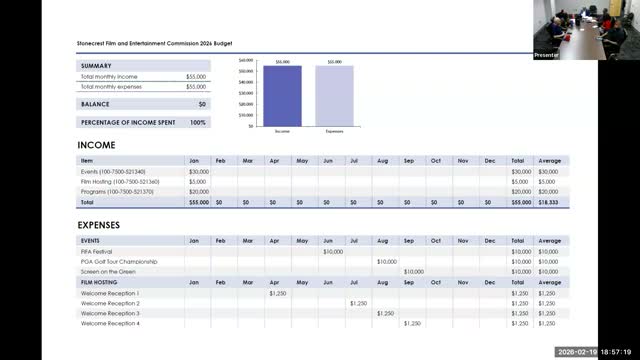
Summary
Economic Development Director Randall presented a proposed $55,000 spending plan for 2026 — initially listed as $30,000 for marketing, $5,000 for permitting and $20,000 for programs — and recommended reallocating some marketing funds toward hosting visiting filmmakers and education programs to boost future production activity.
Economic Development Director Randall presented the Stonecrest Film and Entertainment Commission’s draft 2026 budget on Feb. 19, saying the city has about $55,000 available for commission activities and staff want to use the funds to attract and support productions.
Randall said the existing line items are film marketing ($30,000), permitting ($5,000) and programs ($20,000), then described a proposal to move some of the marketing money into ‘film hosting’ — receptions and site visits meant to welcome filmmakers that choose Stonecrest as a location. “We are the only city in DeKalb County that has a commission,” Randall said, arguing that personal outreach and hosting could make Stonecrest more visible to production teams.
The commission discussed several concrete ways to spend the allocation: partnering with established festivals and industry groups, hosting location receptions, and funding local training programs for students and young adults. Commissioners identified possible partners named during the meeting, including BronzeLens and the Atlanta Film Festival, and raised the Production Rock Star Academy and local college programs as examples of training to support a pipeline into production jobs.
Commissioners emphasized practical constraints. Randall repeated that the current funds are limited and urged members to identify dates, partners and cost estimates before the next commission meeting so staff can place specific line items into the budget. He noted that event line items (marketing/host) and program line items ultimately determine whether the city needs to request more money from the council in a future budget cycle.
The commission did not vote on final budget line items at the meeting; members agreed to draft specific event and program proposals and reconvene to finalize allocations. The next procedural step agreed in the meeting was for commissioners to develop written proposals with dates and estimated costs that staff can fold into the budget for consideration at the following meeting.