Lifetime Citizen Portal Access — AI Briefings, Alerts & Unlimited Follows
Burbank Police to stop CALEA accreditation, citing duplication and reallocation of staff
Loading...
Summary
The Burbank Police Department told the Police Commission it will discontinue pursuit of Commission on Accreditation for Law Enforcement Agencies (CALEA) accreditation, saying the annual process is duplicative, consumes roughly 2.5 full-time-equivalent staff hours and that resources will be redirected toward technology and transparency initiatives.
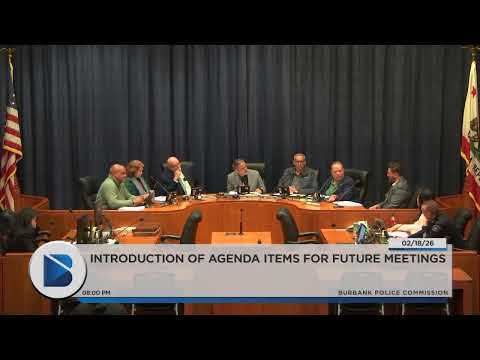
Lieutenant Emile Brimway told the Burbank Police Commission on Feb. 18 that the department has decided to discontinue participation in the CALEA accreditation process and will redirect staff time toward technology and public-facing data. "This process was a duplicative repetitive process," Brimway said, adding that the department plans to invest in drones, a real-time crime center and outward-facing dashboards.
The decision follows a 17-year relationship with CALEA, which Brimway said began as a self-assessment in 2008 and led to the city's first accreditation in 2014. The department was most recently accredited in November 2025, Brimway said. He described the scale of the CALEA workload: "There's over 400 standards that CALEA would look at... you're looking upwards of 1,700 different documents or proofs that we would have to provide to the auditors." Brimway also said an internal estimate put the annual administrative cost at about "2.5 full time employee hours."
Why it matters: CALEA accreditation is a recognized framework for police policies and organizational standards. The department argued that many safeguards now exist locally—including state-mandated POST compliance, contract oversight from an OIR reviewer, an internal Professional Standards Bureau, and routine audits—that duplicate what CALEA verifies. Commissioners pressed the department on how the city will preserve external review if the CALEA process ends; Brimway and staff pointed to continuing OIR review, internal audits, and participation in statewide professional groups as alternatives.
Commissioners asked whether withdrawing from CALEA would affect grants; Brimway replied, "Not that I am aware of," when asked about grant eligibility. Several commissioners suggested scheduling a one-year review to assess whether the change maintained accountability and transparency; one commissioner specifically asked for a report in 12 months on how the department fared without CALEA oversight.
Details reported by the department included: - Start of CALEA self-assessment: 2008; first full accreditation: 2014; last accreditation: November 2025. - Scope of standards: about 400 standards with sub-standards, described by staff as requiring roughly 1,700 evidence documents. - Estimated annual staff cost: about 2.5 full-time-equivalent staff hours, per an internal estimate cited by Brimway. - Current policy library: described as "upwards of 1,000 pages" and maintained in PowerDMS; the department also receives policy updates from Lexipol.
The chief and staff said internal audits, POST-mandated training reviews, the city's OIR contract and a professional standards unit will continue. Commissioners and staff also described joining or using peer-review mechanisms and training from professional associations such as Cal Chiefs and the International Association of Chiefs of Police to help identify best practices.
Next steps: Commissioners did not vote on the accreditation decision itself during the meeting; they asked staff to return with follow-up information and some asked for a formal report in about a year to evaluate whether accountability and transparency have been preserved without the CALEA process.