Get Full Government Meeting Transcripts, Videos, & Alerts Forever!
Get email alerts on the Business Regulation topic
No spam. Unsubscribe anytime.
Committee advances requirement for third-party filers to register with Secretary of State; tech upgrades estimated
Summary
25LSO0114 would require third-party filers who file 10+ compensated documents to register with the Secretary of State and provide notarized ID; SOS estimated a one-time technical cost of about $100,000 and the committee advanced the measure (roll call 8–5–1).
Lawmakers advanced a bill aimed at deterring serial or potentially fraudulent third-party filing operations by requiring registration, identification, and limited oversight of paid file-preparers.
Secretary Gray described 25LSO0114 as a tool to verify third-party filers who submit documents for other entities. The draft would require third-party filers who receive compensation and file 10 or more documents with the Secretary’s office to register, provide notarized attestation they are natural persons, and submit identifying information (address, phone, email, driver’s license). Gray and Colin Crossman said bringing these filers into a registration system would help the office detect and stop repeat or suspicious filings more quickly.
Crossman estimated a one-time technical upgrade cost of about $100,000 to the SOS filing system to accommodate the registration data and administrative tracking; staff also warned of additional manual workload for registrars to process and monitor compliance.
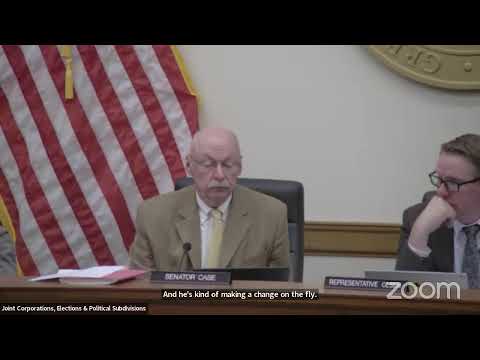
Committee members expressed concerns about scope and enforcement: Senator Barlow and others asked whether employees of existing commercial registered agents would be swept in and whether existing CRA authority and revocation tools would be sufficient. Scott Meyer (commercial registered agent) warned that requiring personal identification from employees who come and go could be burdensome and raised privacy questions. The Secretary and staff argued the measure is targeted at third-party filing mills rather than legitimate in-house filing and that a registration regime provides a front-end deterrent.
After debate the committee advanced the bill (roll call 8 ayes, 5 no, 1 excused). Staff will continue to work on precise definitions, thresholds, and administrative details to reduce unintended burdens on legitimate businesses and registered-agent operations.