Get Full Government Meeting Transcripts, Videos, & Alerts Forever!
Get email alerts on the Tax Increment Financing topic
No spam. Unsubscribe anytime.
Panel expands tax‑increment financing to cover affordable housing, narrows blight test and sets AMI cap
Summary
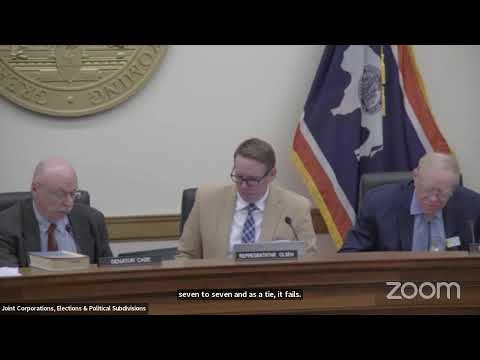
The committee approved legislation extending Wyoming's tax‑increment financing (TIF) program to permit use for affordable housing, adopted amendments replacing the income‑share definition with a 120% area‑median‑income (AMI) cap, reduced the blight‑factor threshold and added an eminent‑domain limitation before advancing the bill 11–3.
The committee voted to expand tax increment financing (TIF) to support affordable housing projects, modifying the existing urban renewal code to allow TIF for new construction of affordable units and to clarify valuation rules for project areas.
LSO attorney Josh Anderson described 25LSO0025 as an expansion of the Wyoming urban renewal code to authorize development and affordable housing as TIF‑eligible activities and as a set of conforming changes to definitions and valuation processes.
Ken Gill of the Department of Revenue warned the committee about administrative challenges when project parcels are subdivided after a base value is set. He suggested rulemaking to ensure the aggregate base is preserved and proposed dividing the established aggregate base among new parcels or a proportional approach so county treasurers can distribute base and increment correctly.
Several cities and municipal organizations backed the expansion. Mayor Patrick Collins (Cheyenne) described two projects using URA/TIF—one downtown 101‑unit apartment project and an eastern 190‑unit project—and showed how redevelopment can multiply tax receipts. "Once the development is done, it will pay a $140,000 in property taxes its first year," Collins said, and noted an 18‑year payback estimate for the downtown example.
The committee adopted multiple amendments: Representative Yin’s amendment replaced the HUD 30%‑of‑income affordability definition with a limit keyed to area median income (AMI), capping eligibility at 120% of county AMI; a separate amendment lowered the number of blight criteria required from four to two; and Senator Scott successfully added a restriction stating eminent domain could not be used to acquire owner‑occupied or residentially leased property under the statute. The Department of Revenue’s rulemaking language was narrowed to focus on the statutory section governing base value allocation.
Committee members debated both the risk of TIF overreach and its practical value as a redevelopment and infrastructure financing tool. County associations urged required consultation with other taxing entities because TIF defers incremental revenue that would otherwise flow to schools and districts.
The final roll call passed 11–3; the bill will move forward to additional drafting and session consideration.